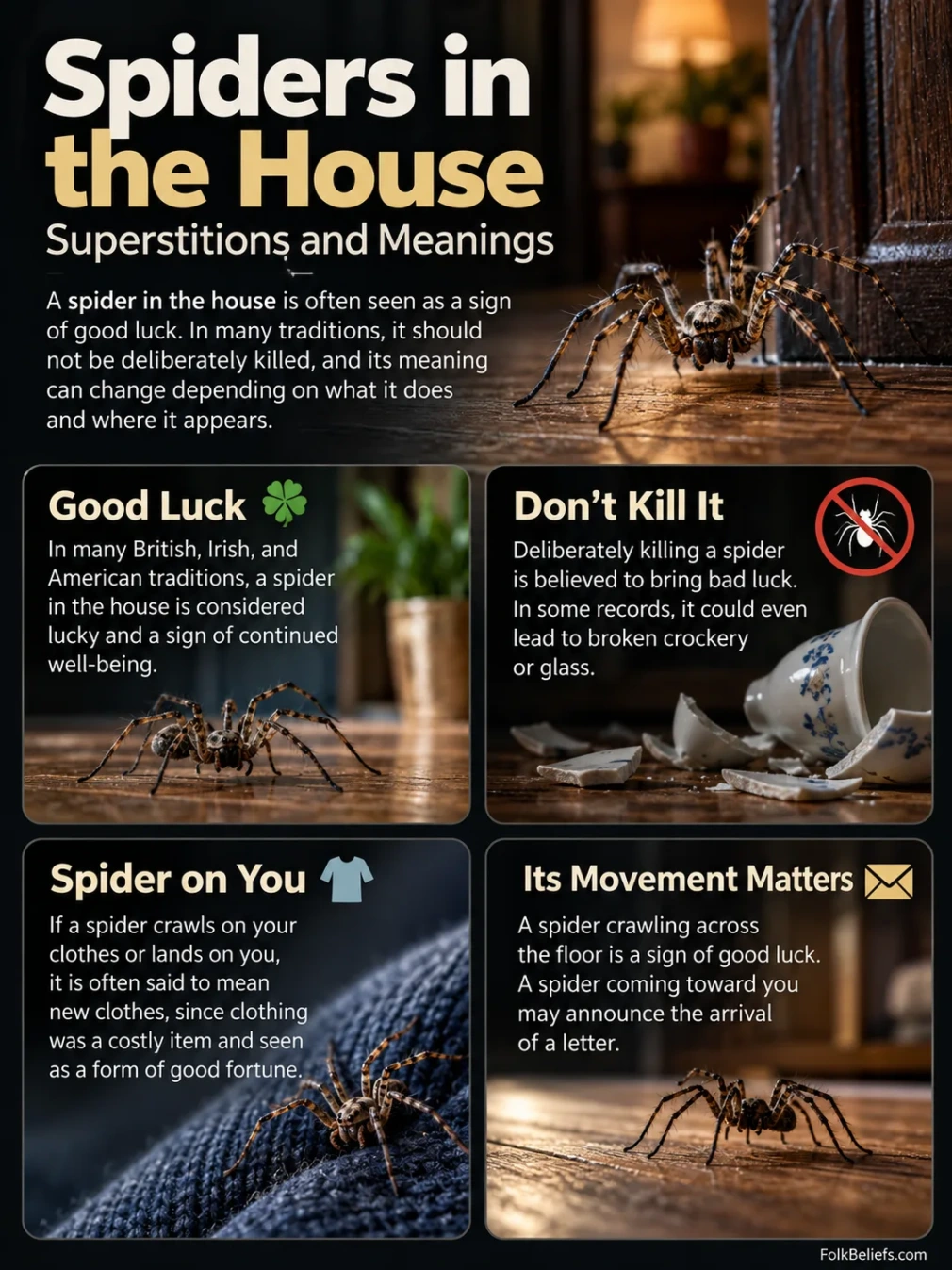
A spider in the house does not have one universal folklore meaning. In several British, Irish, and American records, an indoor spider is treated as lucky or at least as a creature that should not be deliberately killed. Other traditions change the meaning according to what the spider is doing, where it appears, or what time of day it is seen.
One well-recorded household belief warns against killing a spider. James Napier’s 1879 collection of West of Scotland folklore quotes the older saying, “If you wish to live and thrive, let the spider run alive.” He also describes a household practice in which webs could be swept away, but the spider itself was not intentionally killed.[1]
Is a Spider in the House Good Luck?
Good luck is one documented interpretation, but it is not a rule shared by every tradition. A folklore record collected at Camross in County Laois says that killing a spider is a sign of bad luck, while a spider creeping on a person’s clothes foretells a new suit of clothes.[2]
The same basic idea appears in British “money spider” lore. The British Arachnological Society notes that money spiders are small spiders in the family Linyphiidae rather than one single species. A traditional belief said that when one landed on a person, it had come to weave a new set of clothes. Because clothes were costly, the promised clothing could be understood as a gift of money or good fortune.[3]
| Encounter | Recorded Folklore Meaning | Documented Context |
|---|---|---|
| Spider left alive in the house | Associated with continued well-being; deliberate killing is avoided | West of Scotland collection and an older English proverb[1] |
| Spider crawling on clothing | New clothes are expected | Camross, County Laois[2] |
| Money spider landing on a person | New clothes or good fortune | British money-spider tradition[3] |
| Spider crawling across a floor | Good luck | American superstition collected by Fletcher B. Dresslar in 1907[4] |
Why Killing a Spider Can Be Considered Unlucky
The taboo against killing spiders is clearer in the surviving records than any single explanation for how it began. Napier records both the proverb about letting the spider live and a more specific belief that a servant who deliberately killed one would break crockery or glass that same day.[1]
Napier proposed that respect for spiders may have been helped by a Christian folk legend in which a spider’s web concealed the hiding place of the infant Jesus. He also compared it with stories in which a newly spun web protected a fugitive by making a hiding place appear undisturbed. This is Napier’s proposed explanation, not proof of a single origin for the superstition.
Irish archival material shows that the killing taboo also circulated independently in local collections. The Camross record is especially useful because the bad-luck rule and the new-clothes omen appear together in the same short group of beliefs.[2]
Movement Can Change the Meaning
American collections show that simply seeing a spider was not always enough to determine the omen. Fletcher B. Dresslar’s Superstition and Education, published in 1907, records a spider crawling across the floor as a sign of good luck. A spider coming toward a person was said to announce the arrival of a letter. The same collection also records bad luck from killing certain spiders.[4]
This type of record helps explain why broad statements such as “a spider in the house always means money” are too simple. In collected folklore, direction, movement, clothing, webs, and the person’s reaction to the spider can all alter the interpretation.
Morning and Evening Spider Superstitions
Time of day creates another variation. A French proverb is historically attested in 1812 in the form “Araignée du matin, chagrin; du soir, bon espoir”: a spider in the morning is linked with sorrow, while an evening spider is linked with hope.[5]
This saying should not be treated as a universal spider rule. It belongs to a particular proverbial tradition, and other collections assign different meanings to spiders seen at particular hours. The time-based versions are a good example of how a familiar household animal could acquire opposite meanings without either version replacing the other.
Not Every Indoor Spider Omen Is Lucky
Some local records are distinctly less favorable. A Schools’ Collection entry from Drumeela, County Leitrim, says that a spider landing on a coat foretells a new suit, but the same record assigns an ominous meaning to a spider described as “ticking in the wall.”[6]
This Leitrim example is evidence for a local recorded variant. It should not be expanded into a claim that Irish tradition in general treats spiders in walls as an omen. Folklore collections often preserve beliefs from particular families, informants, schools, or districts rather than nationwide rules.
What the Spider Means Outside Folklore
A spider indoors does not scientifically predict money, visitors, new clothes, sorrow, or future luck. The Natural History Museum notes that several spider species share human living spaces. Some remain indoors for long periods, while others enter through open windows or gaps beneath doors. Spiders also prey on other small animals and can help reduce nuisance household pests.[7]
The folklore meaning therefore comes from the tradition attached to the encounter, not from the spider’s biology. A spider on a coat, one crossing the floor, one seen in the evening, and one deliberately killed can carry different meanings even within closely related collections.
Sources and Records
- ↑1a ↑1b ↑1c James Napier, Folk Lore: Superstitious Beliefs in the West of Scotland Within This Century,
- ↑2a ↑2b ↑2c National Folklore Collection, UCD, The Schools’ Collection, Camross, Mountrath,
- ↑3a ↑3b British Arachnological Society, Money Spiders (Family: Linyphiidae),
- ↑4a ↑4b Fletcher B. Dresslar, Superstition and Education,
- ↑5 Base Historique du Vocabulaire Français, entry for araignée,
- ↑6 National Folklore Collection, UCD, “Omens and Superstitions Gathered from Pupils of Drumeela”,
- ↑7 Natural History Museum, “Spiders in Your Home”,
Documented Locations
Countries: Bahamas, Barbados, Russia
These labels identify where a version has been documented. They do not mean that everyone in the country, region, or community shares the belief.