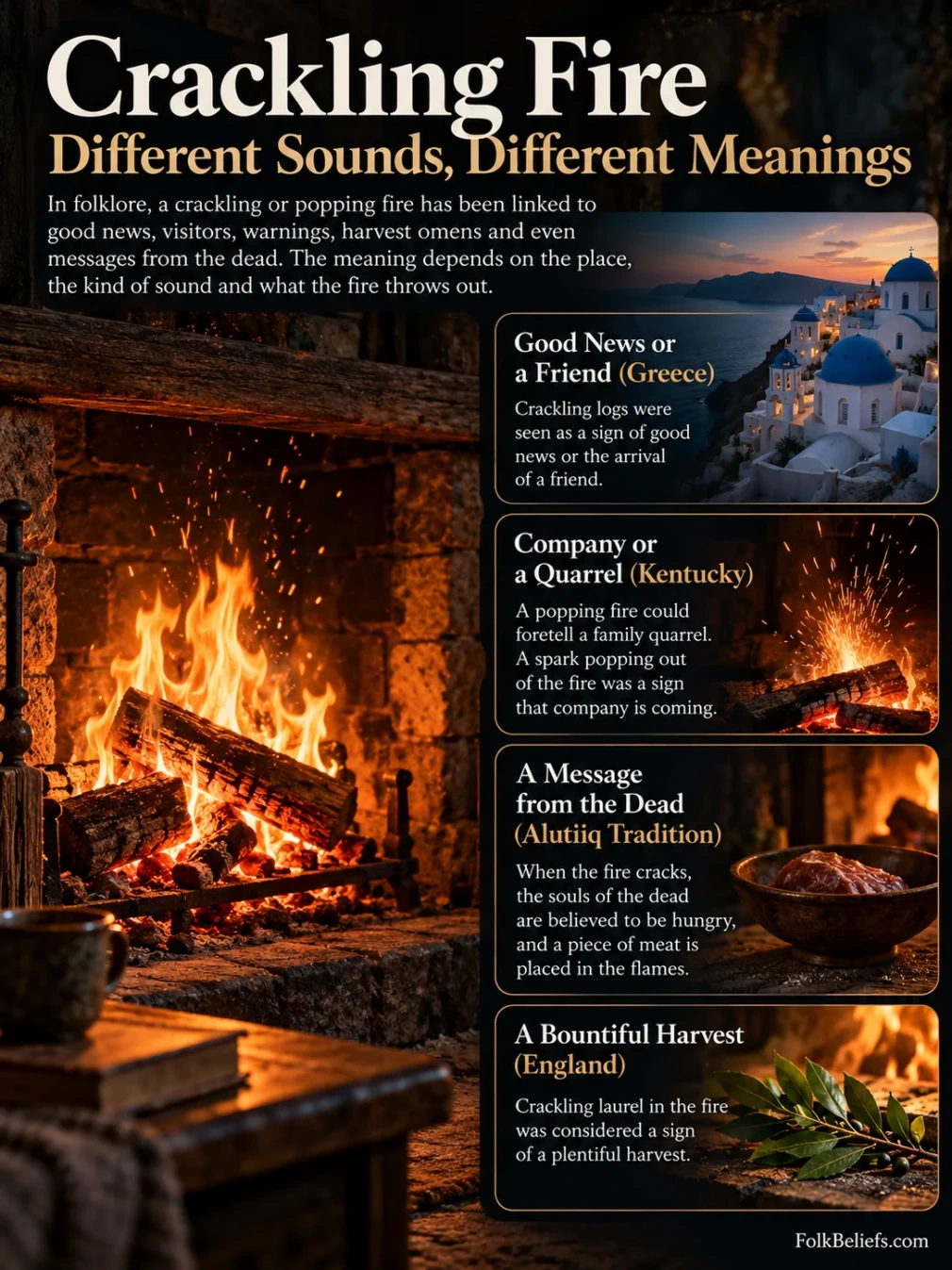
A crackling or popping fire has carried very different meanings in recorded folklore. In some traditions, the sound announced a visitor or good news. Elsewhere it warned of arguments, marked a seasonal harvest omen, or was understood as a message connected with the dead.
There is no single traditional meaning for a crackling fire. The interpretation depends on the place, the kind of sound, what the fire throws out, and sometimes the material being burned.
What Does a Crackling Fire Mean in Folklore?
| Recorded Context | Fire Sign | Folklore Meaning |
|---|---|---|
| Greek folklore recorded in the early 20th century | Logs crackling | Good news or the arrival of a friend |
| Kentucky folklore collection | Fire popping | A family quarrel in one belief; approaching company when a spark pops out |
| Alutiiq tradition | Fire cracking | The souls of the dead are hungry |
| English New Year material recorded by Robert Herrick | Laurel crackling in the fire | A plentiful harvest |
| Colombian folk interpretation | Firewood cracking loudly | Company is approaching |
Good News and an Approaching Friend in Greek Folklore
John Cuthbert Lawson’s 1910 study of Greek folklore records attention being paid to the way logs behaved in a household fire. In the material he describes, crackling logs generally pointed to good news or the arrival of a friend. The meaning changed if sparks and ashes were thrown into the room; that form of fire activity was associated with troubles and anxieties instead.[1]
The distinction matters. The record does not treat every noisy fire as the same omen. A crackling log could carry a favorable meaning, while material flying from the hearth could shift the interpretation in another direction.
A Popping Fire Could Mean Either Company or a Quarrel in Kentucky
Daniel Lindsey Thomas and Lucy Blayney Thomas collected several fire beliefs in Kentucky Superstitions, published in 1920. One entry says that a popping fire foretells a quarrel in the family. Another gives a different meaning to a spark popping out of the fire: company is coming.[2]
These two records show why details such as popping, sparking, and the movement of embers should not be collapsed into one general fire superstition. Even within a single collected body of folklore, closely related signs can point to different events.
When Fire Cracking Refers to the Dead
The Alutiiq Museum documents a different interpretation from Kodiak Alutiiq tradition. Its cultural record for the hearth explains that when the fire cracks, the souls of the dead are understood to be hungry, and a piece of meat is traditionally placed in the flames. The museum connects this with a wider relationship between the hearth, departed relatives, and food offerings.[3]
This is not a visitor prediction or a luck omen. Here the sound functions more like a signal interpreted through beliefs about ancestors and the hearth. Treating it as interchangeable with European or North American visitor omens would erase the cultural setting of the record.
Crackling Laurel as a Harvest Omen
Robert Herrick’s seventeenth-century poem A New Year’s Gift, Sent to Sir Simeon Steward places another form of crackling fire lore among seasonal household customs. The poem mentions crackling laurel as foretelling a plentiful harvest. Because the sign depends on laurel placed in the fire, it is more specific than an unexplained log suddenly snapping in an ordinary hearth.[4]
The record is useful as evidence that the sound itself could become part of seasonal divination. It does not establish that every household in England interpreted all crackling fires as harvest predictions.
Does a Crackling Fire Mean Someone Is Coming?
That interpretation does appear in more than one body of folklore, but it is not universal. The Greek record described by Lawson links ordinary log crackling with the arrival of a friend, while the Kentucky collection gives approaching company specifically to a spark that pops from the fire.
A documented Colombian variation also connects noisy firewood with visitors. SuperstitionsMap records a Colombian interpretation in which logs cracking loudly in a stove or hearth announce that company is approaching.[5]
These parallels are best treated as related visitor omens, not as proof that they share one origin. Similar domestic signs can develop in different places without carrying exactly the same history or wording.
Why Popping, Crackling, and Flying Sparks Should Be Kept Separate
Folklore records often distinguish between:
- a steady series of crackles from burning logs;
- a sudden pop from the wood;
- a spark or ember jumping out of the hearth;
- ashes being thrown into the room;
- a chosen substance, such as laurel, crackling after being deliberately placed on the fire.
Those differences can change the recorded meaning. A modern shorthand such as “a crackling fire means visitors” therefore captures only one family of interpretations.
The Ordinary Reason Wood Pops and Crackles
Firewood can make these sounds without any connection to an omen. Cornell Cooperative Extension material on wood heating notes that some resinous softwoods contain moisture pockets. As the wood heats, trapped gases and water vapor can build pressure and produce pops that throw sparks.[6]
Folklore gives cultural meanings to noticeable events around the hearth. Crackling, popping, and sparking are ordinary physical behaviors of burning wood and do not provide a reliable way to predict visitors, arguments, harvests, or future events.
Sources and Records
- ↑1 J. C. Lawson, Modern Greek Folklore and Ancient Greek Religion: A Study in Survivals,
- ↑2 Daniel Lindsey Thomas and Lucy Blayney Thomas, Kentucky Superstitions,
- ↑3 Alutiiq Museum, “Hearth, Kitchen — Kenirwik”,
- ↑4 Robert Herrick, “A New Year’s Gift, Sent to Sir Simeon Steward”,
- ↑5 SuperstitionsMap, “Colombian Superstitions”,
- ↑6 Cornell Cooperative Extension, Heating with Wood and Coal,
Documented Locations
These labels identify where a version has been documented. They do not mean that everyone in the country, region, or community shares the belief.