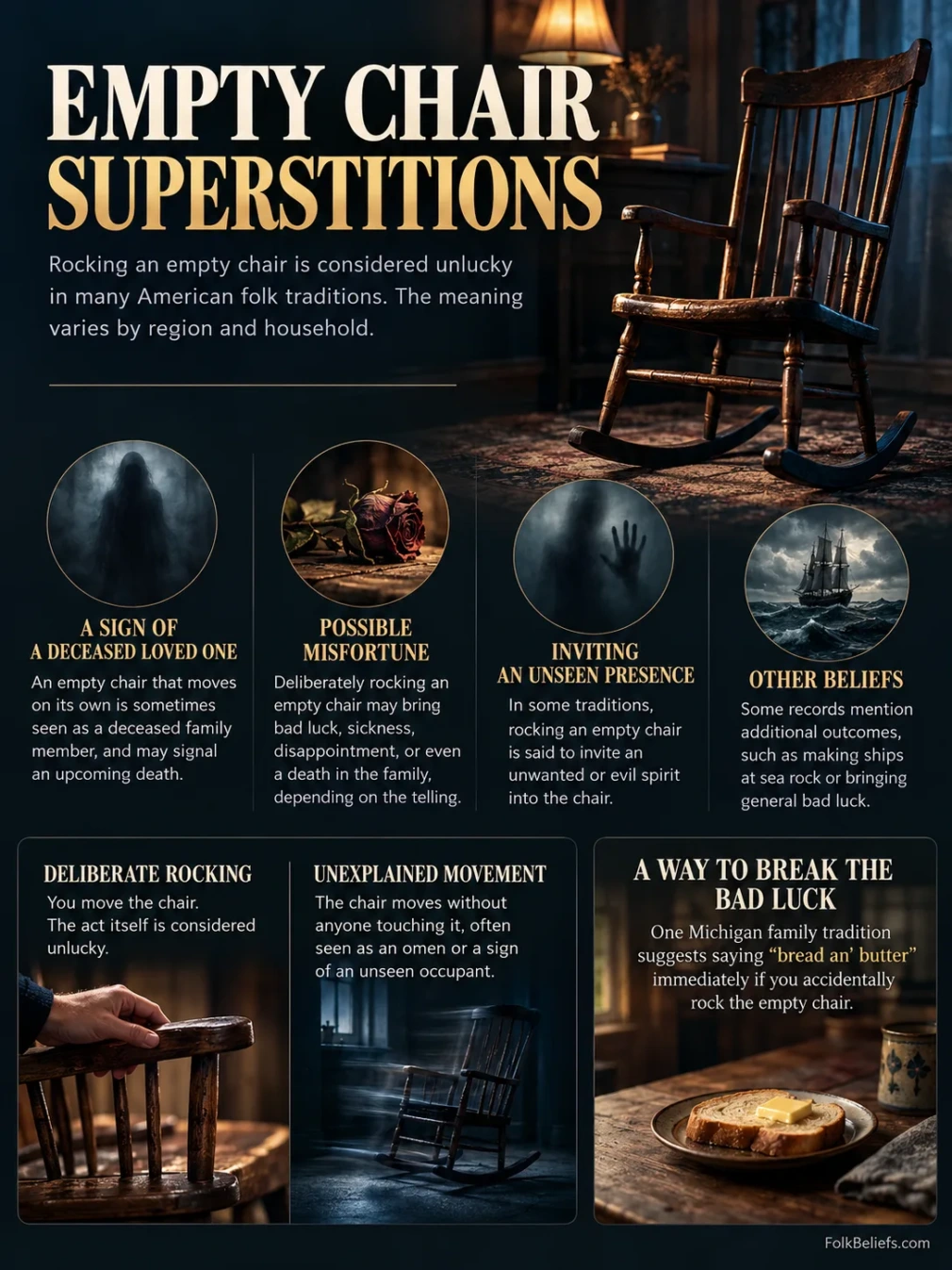
Rocking an empty chair is treated as unlucky in several recorded American folk traditions, but the expected result is not fixed. Some records connect the act with general bad luck, sickness, disappointment, or a death in the family. Other versions describe an empty rocker moving on its own as a sign of a deceased person or an unseen presence. These meanings belong to folklore, not to verified cause and effect.
What Does Rocking an Empty Chair Mean?
The wording changes from one record to another. A useful distinction is whether a person deliberately rocks an unoccupied chair or whether the chair appears to move without anyone touching it.
| Situation | Recorded Folk Meaning | Documented Context |
|---|---|---|
| An empty rocking chair moves while apparently unoccupied | A deceased family member is imagined as holding the chair, with the movement interpreted as a death omen. | Michigan, published in 1896.[1] |
| Someone deliberately rocks an empty chair | A death in the family, sickness, disappointment, or unhappiness may follow, depending on the telling. | Chicago and Detroit-area records collected in the 1960s.[2] |
| An empty rocker is set moving | General bad luck may be expected. | A University of Detroit folklore record dated 1963 gives this simpler warning.[3] |
| An empty rocking chair is deliberately rocked | The act may be described as inviting an unwanted spirit into the chair. | An Alabama record in the same archive, learned in the 1950s, gives this spirit-related version.[3] |
No one line in the table should be read as the universal meaning of the superstition. The records preserve different household and regional explanations for the same simple action.
An Early Printed Michigan Version
Fanny D. Bergen’s Current Superstitions, published for the American Folk-Lore Society in 1896, includes a Michigan belief about an empty rocking chair that seems to sway with no visible occupant. In that telling, the chair is imagined as being held by the spirit of a deceased family member who has returned to choose the next person to die.[1]
This record is narrower than the modern shorthand “never rock an empty chair.” The chair in the 1896 entry is already moving while apparently unoccupied. That makes it an omen based on unexplained motion, rather than simply a rule against pushing a vacant rocker.
Later Folklore Records Give Several Outcomes
Twentieth-century archive material shows why the belief should not be reduced to one fixed prediction. The James T. Callow Folklore Archive preserves a Chicago record from 1968 saying that rocking an empty rocking chair means someone in the family will die. Detroit-area records from the same decade give other outcomes: one calls it a sign of sickness, another predicts disappointment and unhappiness, and another says that rocking an empty chair will make ships at sea rock.[2]
The same archive also contains versions from California, New York, Michigan, and Alabama. Some connect the moving chair with death; one Alabama entry says that rocking an empty chair invites an evil spirit into it.[3] The records show transmission through families and local communities rather than a single rule shared by everyone in the United States.
A Maine Family Version Calls It “Rocking the Devil”
A University of Maine folklore record collected on March 6, 1968, lists several household acts that were supposed to bring bad luck. Among them is the warning not to rock an empty rocking chair. The informant explained that, according to a grandmother, doing so was “rocking the devil.”[4]
That wording is useful because it shows how a short household rule can acquire a vivid explanation inside one family. It does not establish a general Maine meaning, and it should not be expanded into a belief held across the state.
Does the Superstition Have a Way to Undo the Bad Luck?
Most records simply tell people not to rock the empty chair. One family tradition collected in Lansing, Michigan, around 1970 adds a spoken countermeasure. If someone rocks the chair by accident, the person is supposed to say “bread an’ butter” immediately to break the bad luck.[5]
This is a local family version, not a standard rule attached to the superstition everywhere it appears. It also shows that folk belief can include both a warning and a small verbal remedy for accidentally breaking it.
Deliberate Rocking and a Chair Moving by Itself Are Related but Different
Deliberate rocking: the person causes the movement, and the act itself is treated as unlucky or as a cause of later trouble.
Unexplained rocking: the chair appears to move without a visible person, so the motion is interpreted as an omen or as evidence of an unseen occupant.
These two forms often get blended together in retellings. The archive record matters because it preserves the exact condition attached to each belief. A warning against touching an empty rocker is not identical to a story about a rocker that starts moving on its own.
Where Did the Empty-Chair Superstition Start?
The surviving records used here do not identify one birthplace or one inventor. An 1896 published collection documents the moving-chair death omen in Michigan, while later university archives preserve related forms from several parts of the United States. That is enough to show a long record of circulation, but not enough to assign the belief to one state, one ethnic group, or one regional tradition.
It is also safer not to give the superstition an ancient origin without evidence. The documentary trail supports a household folk belief recorded in American collections; it does not support a precise starting date beyond the dates of the surviving records themselves.
The beliefs described here record what people said, learned, or repeated. They do not show that rocking an empty chair can cause bad luck, illness, death, or spirit activity.
Sources and Records
- ↑1a ↑1b Fanny D. Bergen, ed., Current Superstitions: Collected from the Oral Tradition of English Speaking Folk,
- ↑2a ↑2b University of Detroit Mercy Libraries, James T. Callow Folklore Archive,
- ↑3a ↑3b ↑3c University of Detroit Mercy Libraries, James T. Callow Folklore Archive, emptiness and empty-chair belief records,
- ↑4 University of Maine, Northeast Archives of Folklore and Oral History, NA2445 belief record,
- ↑5 University of Detroit Mercy Libraries, James T. Callow Folklore Archive, Lansing records,
Documented Locations
Countries: Brazil, Cuba, Italy, Mexico, United States
These labels identify where a version has been documented. They do not mean that everyone in the country, region, or community shares the belief.