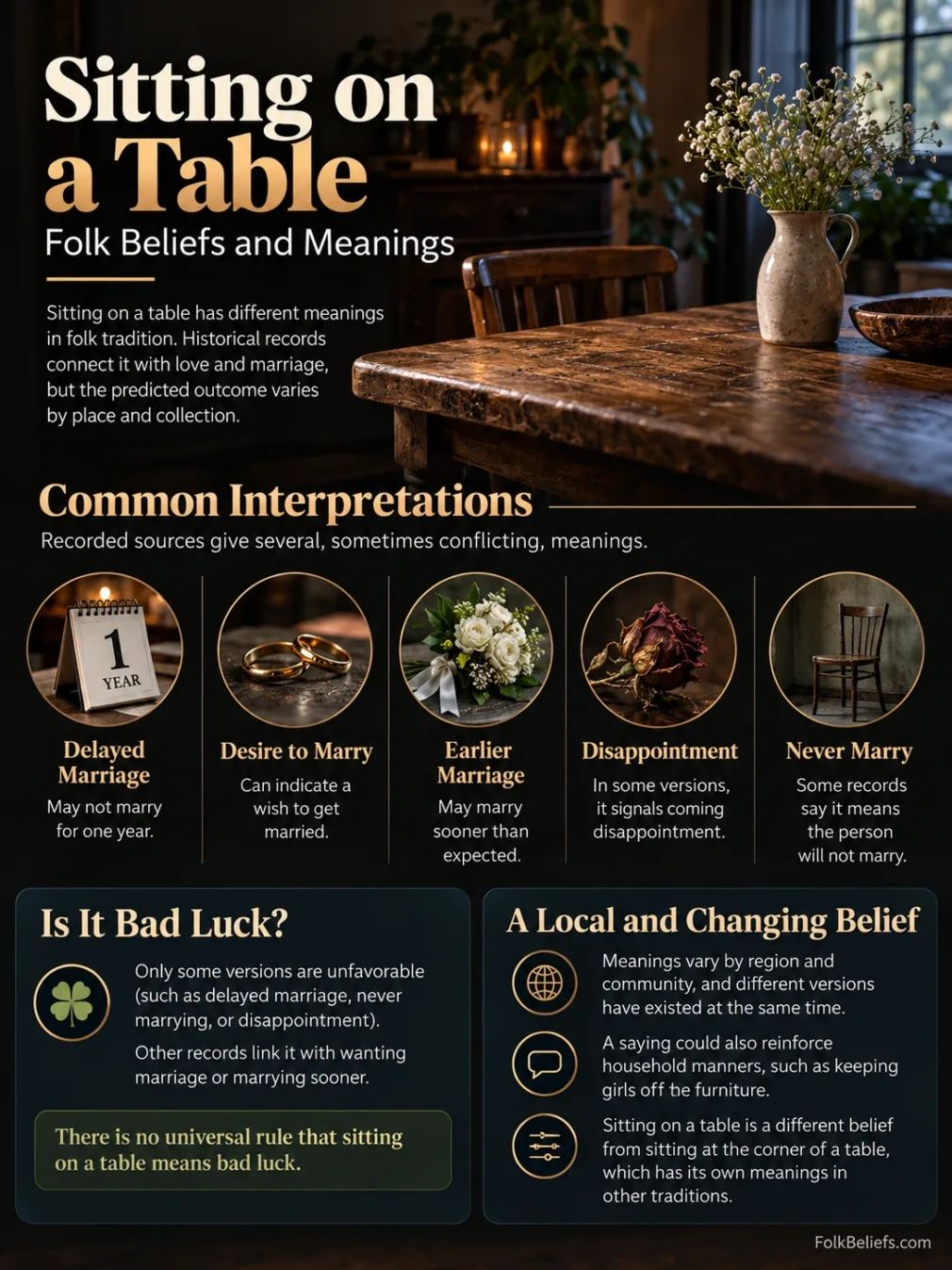
Sitting on a table has no single meaning in recorded folklore. Some collections connect it with delayed marriage, while others say it shows a desire to marry, predicts an unexpectedly early marriage, or means the person may never marry. Another recorded version treats the act as a sign of disappointment. These are local folk beliefs rather than rules shared across all places or communities, and they do not show that sitting on a table can affect a person’s future.
What Recorded Sources Say
Older folklore collections are especially useful here because they preserve conflicting versions instead of reducing them to one modern explanation. The differences appear even among records collected in the same period.
| Place or Collection | Recorded Meaning | Scope of the Record |
|---|---|---|
| New England, 1896 | Sitting on a table could mean that the person would not marry for one year. The same collection immediately notes another version in which the act means the person wants to marry. | Clifton Johnson’s collection of New England signs, sayings, and superstitions.[1] |
| New England, New York, Alabama, and Maine, 1896 | One entry says a person who sits on a table will not marry that year. A Maine rhyme gives almost the opposite prediction, connecting the act with marrying before one is ready. The same collection also records sitting on a table as a sign of coming disappointment in Maine and Massachusetts. | Separate entries preserved in Fanny D. Bergen’s collection of English-speaking oral tradition.[2] |
| Nebraska, 1933 | Two contradictory forms appear together: one predicts marriage sooner than expected, while another says the person will never marry. | Beliefs reported by Nebraska informants and compiled by Margaret Cannell.[3] |
| Toledo, Ohio | An archive record says that someone who sits on a table will remain an “old maid.” | A single recorded saying preserved in the James T. Callow Folklore Archive. It should not be treated as a rule for Ohio as a whole.[4] |
| York, Lincoln, Derby, and Nottingham counties, England, 1895 | Sitting on a table is recorded as indicating that the person wants to be married. | Sidney Oldall Addy’s collection of traditional material from these named English counties.[5] |
Is It Bad Luck to Sit on a Table?
Only some versions can reasonably be described that way. Delayed marriage, never marrying, or disappointment are unfavorable predictions, but other records associate the same act with wanting marriage or marrying sooner than expected. The evidence therefore does not support a universal rule that sitting on a table means bad luck.
Why Do the Meanings Contradict Each Other?
Folk beliefs are passed through families, neighborhoods, workplaces, schools, and local communities. They do not operate from a fixed rulebook. A short saying can change as it moves between speakers, and different meanings can remain in circulation at the same time.
The table superstition shows this clearly. Records from New England and Nebraska preserve opposite predictions without trying to decide which one is the “correct” version. For folklore research, that disagreement is useful evidence. It shows that the belief existed in several forms rather than as one stable prediction.
A Saying Could Also Reinforce Household Manners
One Toledo record offers a rare personal explanation for how the saying was used. The submitter recalled being told that sitting on a table would leave her unmarried and interpreted the warning as a way of keeping her off the furniture and encouraging the manners expected of girls in her family. That explanation belongs to the individual record; it does not establish the historical origin of the superstition everywhere else.[4]
This kind of use is plausible within domestic folklore because many household sayings attach a memorable consequence to ordinary behavior. Still, the surviving records do not provide enough evidence to claim that etiquette created every sitting-on-the-table belief.
Sitting on the Table and Sitting at the Corner Are Different Beliefs
Sitting on top of a table should not be automatically merged with beliefs about sitting at the corner of a table. A comparative study of English, Russian, and Mari superstition material treats them as different forms: the English example concerns sitting on the table, while the Russian and Mari examples discussed by the authors concern an unmarried person sitting at a table corner.[6]
The distinction matters because a familiar version from one community can easily be mistaken for the explanation of another. A record about a table corner does not automatically explain a belief about sitting on the tabletop.
Does Sitting on a Table Mean You Will Not Get Married?
That is one documented interpretation, but it is not the only one. Historical records give several forms:
- a delay in marriage for one year;
- never marrying;
- wanting to marry;
- marrying sooner than expected;
- and, in another version, coming disappointment.
The safest reading is therefore narrow: some communities and informants associated sitting on a table with marriage fortune, but the predicted result varied sharply by record and place. The superstition is useful as evidence of folk tradition, not as a prediction about anyone’s relationships.
Sources and Records
- ↑1 Clifton Johnson, What They Say in New England: A Book of Signs, Sayings, and Superstitions,
- ↑2 Fanny D. Bergen, ed., Current Superstitions: Collected from the Oral Tradition of English Speaking Folk,
- ↑3 Margaret Cannell, Signs, Omens, and Portents in Nebraska Folklore,
- ↑4a ↑4b University of Detroit Mercy Libraries, James T. Callow Computerized Folklore Archive,
- ↑5 Sidney Oldall Addy, Household Tales with Other Traditional Remains: Collected in the Counties of York, Lincoln, Derby, and Nottingham,
- ↑6 Ekaterina Fliginskikh, Svetlana Yakovleva, Ksenia Vavilova, Tatyana Soldatkina, and Maria Naletova, “Household Items in the Folk Ritual Superstitions of the English, Russian, and Mari Languages”,
Documented Locations
Countries: Brazil, Iceland, Italy, Peru, Serbia, Venezuela
These labels identify where a version has been documented. They do not mean that everyone in the country, region, or community shares the belief.