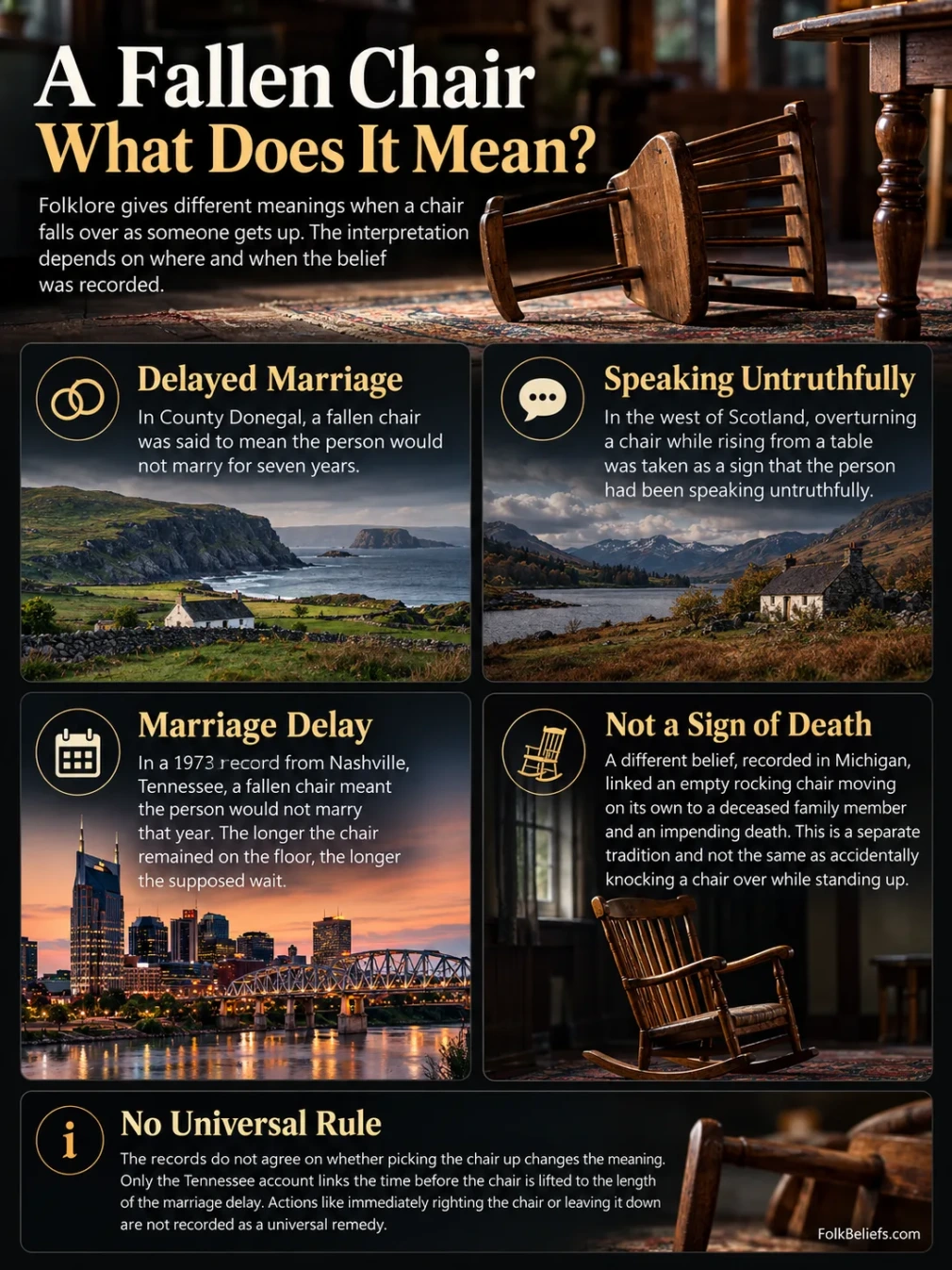
When a chair falls over as someone rises, folklore does not give one universal meaning. Surviving records connect the accident with delayed marriage in some places and with speaking untruthfully in another. The details depend on where and when the belief was recorded.
Recorded Meanings of a Chair Falling Over
The most useful records describe the action quite narrowly: a person gets up from a chair, often at a table, and the chair falls or overturns. Even within that narrow form, the interpretation changes.
| Documented Setting | What Happens | Recorded Meaning |
|---|---|---|
| Woodland, County Donegal | A person rises and the chair falls. | The person was said not to marry for seven years.[1] |
| West of Scotland, published 1879 | A person rises from the table and overturns the chair. | The accident was taken as a sign that the person had been speaking untruthfully.[2] |
| Nashville, Tennessee, recorded in 1973 | A chair falls backward from the table as someone gets up. | The person was said not to marry that year. The same field record adds that the longer the chair remained down, the longer the supposed wait before marriage.[3] |
Marriage Is One of the Clearest Recorded Themes
Two records separated by place and time connect a fallen chair with marriage, but they do not give the same rule. The Donegal version assigns a seven-year delay. The Tennessee version limits the first warning to the current year and then links the supposed delay to how long the chair is left on the floor.
That difference matters. It would be misleading to turn either version into a general “Irish” or “American” rule. The Donegal example belongs to the National Folklore Collection’s Schools’ Collection, a much larger body of local tradition gathered through primary schools between 1937 and 1939.[4] A single entry shows that the belief was recorded in that setting; it does not show that everyone in Ireland knew or accepted it.
The West Scottish Version Is About Truthfulness
James Napier’s nineteenth-century collection from the west of Scotland gives the fallen chair a different meaning. In his account, overturning the chair while rising from a table indicated that the person had been speaking untruthfully. The event functions more like a social omen than a prediction about future luck or marriage.
This version also shows why “a falling chair means bad luck” is too broad to describe the older evidence. Some records attach a very specific message to the accident. Others attach a different one.
Does a Falling Chair Mean Death?
The falling-chair records above do not all support a death interpretation. A different chair motif was connected with death in some collected folklore, and the two ideas can easily become mixed together.
Fanny D. Bergen’s 1896 collection records a Michigan belief about an empty rocking chair moving back and forth while apparently unoccupied. In that particular belief, the movement was attributed to a deceased family member returning to choose the next person to die.[5]
The distinction is important: an empty rocking chair moving on its own is not the same motif as accidentally knocking a chair over while standing up. Historical collections assigned different meanings to different kinds of chair movement.
Does Picking the Chair Up Change the Omen?
There is no shared rule across the records. The Tennessee field note is unusual because it connects the time before the chair is picked up with the supposed length of the marriage delay.[3] The Donegal and West Scottish records cited here do not provide the same condition.
For that reason, actions such as immediately righting the chair, leaving it down, turning it around, or performing another gesture should not be presented as a universal remedy unless a particular tradition actually records one.
These records document folk interpretations of an ordinary household accident. They are evidence of transmitted belief and custom, not evidence that a falling chair can predict marriage, reveal whether someone has lied, or foretell future events.
Sources and Records
- ↑1 National Folklore Collection, UCD, “Proverbs,” Woodland, The Schools’ Collection,
- ↑2 James Napier, Folk Lore: Or, Superstitious Beliefs in the West of Scotland Within This Century,
- ↑3a ↑3b University of Detroit Mercy Libraries, James T. Callow Folklore Archive, Nashville, Tennessee marriage-belief record,
- ↑4 National Folklore Collection, UCD, “The NFC Collections”,
- ↑5 Fanny D. Bergen, ed., Current Superstitions: Collected from the Oral Tradition of English Speaking Folk,
Documented Locations
Countries: United States
These labels identify where a version has been documented. They do not mean that everyone in the country, region, or community shares the belief.