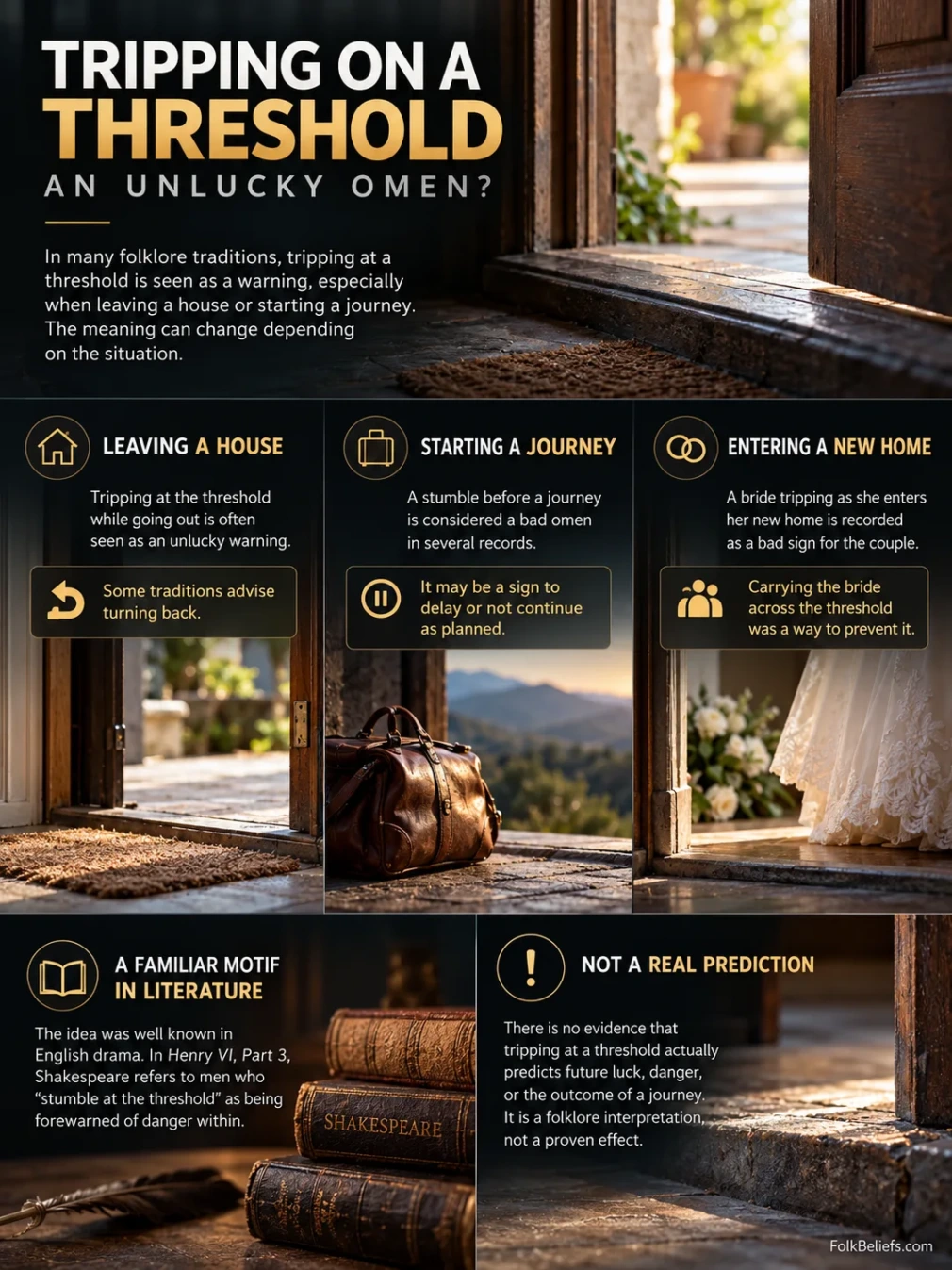
Tripping on a threshold is recorded in several folklore traditions as an unlucky omen, especially when someone is leaving a house or beginning a journey. The warning is not universal, and the predicted consequence changes with the setting. Some records advise turning back or delaying the errand; a wedding record instead links a bride’s trip while entering her new home with bad luck for the couple.[1][2]
What Does Tripping on a Threshold Mean?
In the clearest historical records, the stumble acts as a warning attached to a departure or crossing. J. G. Frazer’s 1890 comparison of folk beliefs gives a Pythagorean saying that a person who stumbles at the threshold while going out should turn back. The same article reports that a threshold stumble before a journey was considered unlucky in the Scottish Highlands and among Saxons of Transylvania. It also records cases in which a person leaving on particular business would postpone or abandon the trip after stumbling, including a Malay example and a Batak example from Sumatra; Frazer used the period spelling “Batta.”[1]
| Recorded Context | Folklore Meaning | Response in the Record |
|---|---|---|
| Leaving a house | Unlucky warning | Turn back |
| Setting out on a journey | Bad omen for the journey | Do not continue as planned |
| Leaving on particular business | Unfavorable sign for the errand | Delay or abandon it for the time |
These are separate records collected and compared by a nineteenth-century folklorist. They should not be read as proof that everyone in Scotland, Transylvania, Southeast Asia, or Sumatra shared one rule. The evidence supports a narrower statement: specific communities and sources attached an unlucky meaning to stumbling while crossing out of a house.
When the Person Is Entering Rather Than Leaving
The meaning can shift when the crossing marks entry into a new home. A record in the National Folklore Collection’s Schools’ Collection, from Lissadill, states that a bride tripping as she enters her new home was believed to bring bad luck on the newly married pair. The same record explains carrying the bride across the threshold as a way to prevent that trip.[2]
The wedding version is not the same belief as every ordinary doorstep stumble. In this archival example, the person is a bride, the crossing is into a new home, and the predicted effect concerns the marriage. Those details define the record’s scope.
That wedding form also shows why “tripping on a threshold” does not have one fixed meaning. The physical action is similar, but the social moment changes the interpretation.
An English Literary Record of the Omen
The threshold-stumble motif was familiar enough to appear in English drama. In Henry VI, Part 3, Shakespeare gives Richard a warning that men who “stumble at the threshold” may be forewarned of danger within.[3] A literary line is not a population survey, but it is useful evidence that the omen was intelligible to an early modern English audience.
Thomas Firminger Thiselton-Dyer’s Domestic Folk-Lore, published in 1881, gathers related British material about stumbling. It notes a belief that stumbling in the morning just after going outdoors meant ill luck and repeats older references to stumbling at a threshold as ominous.[4] This widens the context beyond weddings: the unlucky stumble could belong to everyday departure lore as well.
Why the Threshold Attracted Omens
A threshold is the exact point where a person passes between outside and inside. That made it useful in rituals and beliefs about departure, arrival, marriage, hospitality, and household protection. It is tempting to turn that pattern into a single explanation, such as saying that people everywhere feared spirits living beneath doorways. The evidence does not support such a simple origin story.
Deborah Mary Kerr’s 2019 doctoral study at the University of Birmingham re-examined Greek and Roman threshold beliefs and rejected the older claim that threshold customs can generally be explained by ghosts haunting the doorway. Her study instead treats Roman marriage crossing as part of the bride’s movement into a new household.[5]
For that reason, the safest reading of a threshold stumble is contextual. In departure lore it may warn against continuing; in a wedding record it may threaten the couple’s luck; in literature it can signal danger associated with entering. Those meanings overlap, but they are not interchangeable.
Does the Superstition Predict a Real Event?
No evidence shows that accidentally tripping at a doorway predicts future luck, danger, or the outcome of a journey. The documented material is folklore: it records how an accident was interpreted within particular traditions and texts.
A real trip usually has an ordinary physical cause, such as an uneven sill, a raised door strip, loose footwear, poor lighting, or simply catching a foot while moving. The folklore meaning belongs to the story people attach to the event, not to a proven predictive effect.
Sources and Records
- ↑1a ↑1b J. G. Frazer, “Some Popular Superstitions of the Ancients”,
- ↑2a ↑2b National Folklore Collection, UCD, “Superstitions,” Lissadill, The Schools’ Collection,
- ↑3 Folger Shakespeare Library, Henry VI, Part 3,
- ↑4 T. F. Thiselton-Dyer, Domestic Folk-Lore,
- ↑5 Deborah Mary Kerr, Gods, Ghosts and Newlyweds: Exploring the Uses of the Threshold in Greek and Roman Superstition and Folklore,
Documented Locations
Countries: India
These labels identify where a version has been documented. They do not mean that everyone in the country, region, or community shares the belief.