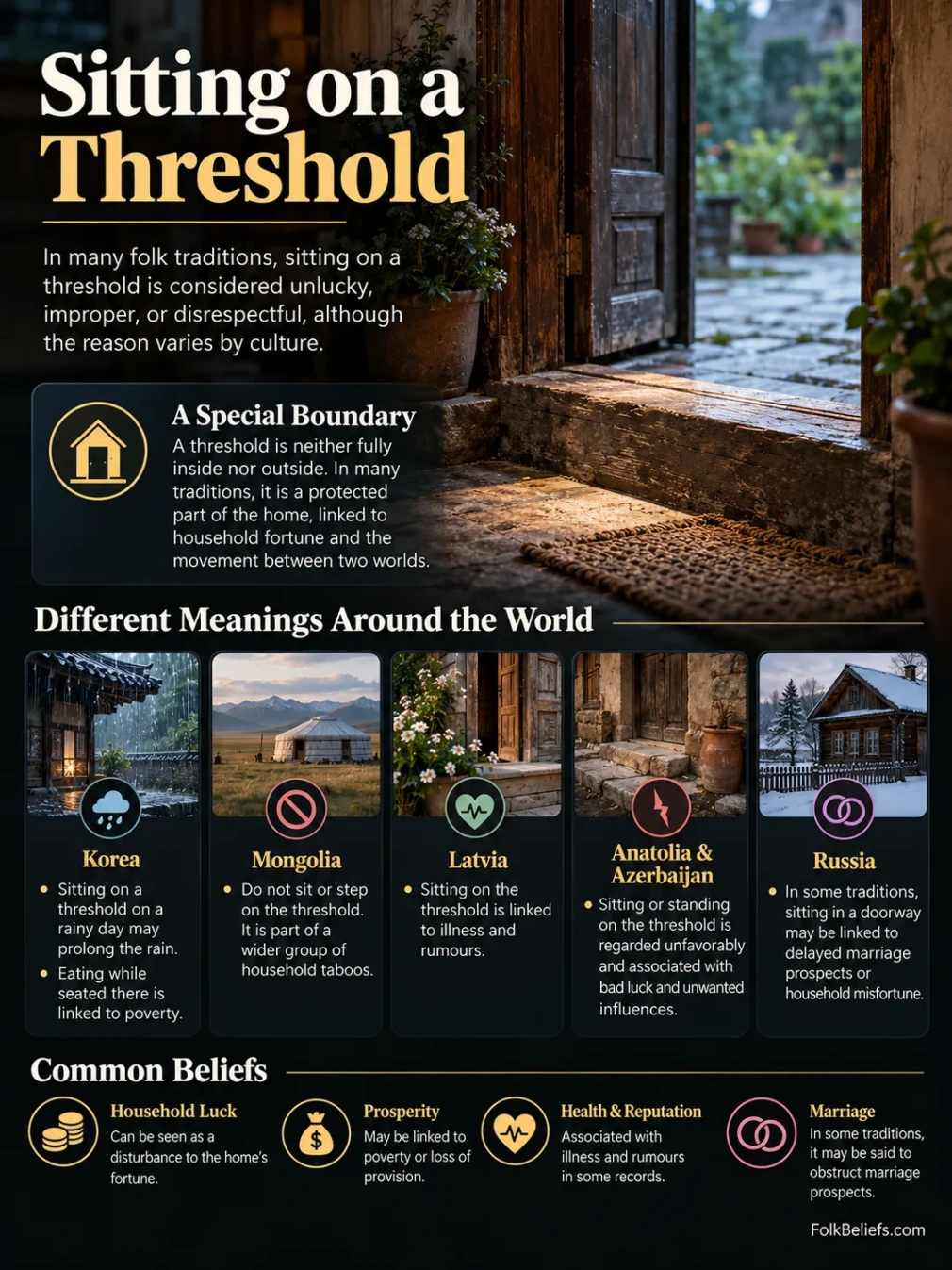
Sitting on a threshold is treated as unlucky or improper in several documented folk traditions, but the reason is not the same everywhere. Some records connect the act with household misfortune, while others attach more specific consequences to it, such as illness, gossip, loss of prosperity, delayed marriage, or unusual weather. In other traditions, the rule survives simply as a prohibition against using the threshold as a seat.
The common feature is the place itself. A threshold is neither fully inside nor fully outside. Folklore records from different regions show that this boundary could be treated as a protected part of the home, a place associated with household fortune, or a point where movement between domestic and outside space had to be handled carefully.
What Does Sitting on a Threshold Mean in Folklore?
There is no single worldwide meaning behind the superstition. A comparative study of housing taboos in Korea and Mongolia gives two quite different sets of rules. In its Korean material, sitting on a threshold on a rainy day is linked with prolonging the rainy season, while eating a meal while seated there is said to lead to poverty. The Mongolian material gives a simpler prohibition: a person should not sit on the bosgo, or threshold, and should not step on it either.[1]
| Documented Setting | Recorded Threshold Belief | Meaning or Consequence |
|---|---|---|
| Korean material | Sitting on the threshold is restricted in particular situations. | A rainy-day version is linked with continued rain; eating while seated there is linked with poverty. |
| Mongolian material | Do not sit or step on the threshold. | The record presents the rule as part of a wider group of household threshold taboos. |
| Latvian tradition | Avoid sitting on the threshold. | An older record links the prohibition with avoiding illness and rumours. |
| Some Anatolian and Azerbaijani records | Sitting or standing on the threshold is regarded unfavorably. | Regional records associate the threshold with bad luck and unwanted influences entering the home. |
| Some Russian traditions | Avoid sitting on the threshold. | Recorded explanations range from a general prohibition to luck or marriage-related interpretations. |
Why the Threshold Is Treated Differently From an Ordinary Seat
Latvian folklore research describes the threshold as a boundary between the household interior and outside space. In the traditions examined by Edita Olupe, it was also associated with the welfare of the family and with Laima, a figure connected with luck and fate. This produced several threshold rules: people were warned against handing objects or greeting one another across it, chopping wood on it, and sitting there. The recorded sitting prohibition was connected with avoiding illness and rumours.[2]
This helps explain why sitting can become symbolically awkward. Sitting turns a place meant for crossing into a place of staying. In belief systems where the doorway separates household space from what lies beyond it, occupying that boundary may be treated as interfering with the proper order of the entrance.
The boundary explanation should not be treated as proof that every threshold superstition developed from one common origin. Similar rules can acquire different meanings in different communities, and surviving records do not always preserve the reason people originally gave for them.
Bad Luck in Anatolian and Turkic Threshold Traditions
R. Yaşa’s study of threshold traditions among Turkic and Mongolian communities records several forms of respect for the doorway. The study notes that standing or sitting on the threshold is viewed unfavorably in material from Azerbaijan. It also describes examples from Tunceli, Sivas, and Gaziantep in which sitting or stepping on the threshold is avoided and associated in local belief with bad luck and harmful influences entering through the doorway.[3]
These are regional folklore records, not a rule for everyone in Turkey, Azerbaijan, or the wider Turkic-speaking world. The distinction matters because threshold customs can differ between towns, families, generations, and communities even within the same country.
Does Sitting on a Threshold Affect Marriage?
Marriage is one interpretation attached to the superstition, but it should not be presented as the universal meaning. A modern reference collection of Russian superstitions records a version in which sitting in a doorway may be said to obstruct marriage prospects, luck, or the household’s good fortune.[4]
An older English-language survey published in 1896 gives a narrower account. It states only that in some parts of Russia a person was believed not to sit on the threshold, without assigning the marriage consequence to the rule.[5] Read together, the records show why statements such as “sitting on a threshold means you will not marry” are too broad. That is one recorded interpretation, not the definition of the superstition everywhere it occurs.
The Same Action Can Carry Very Different Warnings
Household Luck
Some traditions treat sitting on the threshold as a disturbance to household fortune or as improper treatment of a protected domestic boundary.
Prosperity
Other records connect the doorway with wealth or provision. The Korean example in which eating while seated on the threshold is said to result in poverty belongs to this type of interpretation.
Health and Reputation
The Latvian record gives another combination, connecting avoidance of threshold sitting with illness and rumours. These are recorded folk explanations rather than medical claims.
Marriage
Marriage-related meanings appear in some traditions, including a Russian variant, but they should not be projected onto threshold beliefs from other places unless a record actually makes that connection.
Sitting, Standing, and Stepping Are Not Always the Same Belief
Threshold folklore often contains several related prohibitions, but they should remain separate when the evidence separates them. A community may discourage sitting on a threshold, stepping directly on it, standing there for too long, passing objects across it, or greeting someone while the two people remain on opposite sides.
The presence of one rule does not automatically prove the others. The Korean and Mongolian comparison, for example, records both sitting and stepping restrictions in Mongolian material, while the Korean entries give more specific circumstances and consequences. Latvian material combines sitting with a wider set of doorway practices, yet its explanations are locally distinctive.
These beliefs describe traditional interpretations of household space. Sitting on an ordinary doorway threshold does not have a demonstrated effect on luck, marriage, weather, prosperity, or health. The folklore value lies in what the rule reveals about how particular communities understood the entrance to a home.
Sources and Records
- ↑1 Kim Ki-Sun and Lee Jong-Oh, “The Study of Housing-Related Taboos in Korea and Mongolia”,
- ↑2 Edita Olupe, “The Semantics of Threshold in Latvian Traditions”,
- ↑3 R. Yaşa, “The Culture of Threshold among Turks and Mongols”,
- ↑4 SuperstitionsMap, “Russian Superstitions”,
- ↑5 H. Clay Trumbull, The Threshold Covenant,
Documented Locations
Countries: India, Latvia, Mongolia, Mozambique, Nepal, Russia, Thailand, Turkey, Turkmenistan, Uzbekistan, Vietnam
These labels identify where a version has been documented. They do not mean that everyone in the country, region, or community shares the belief.