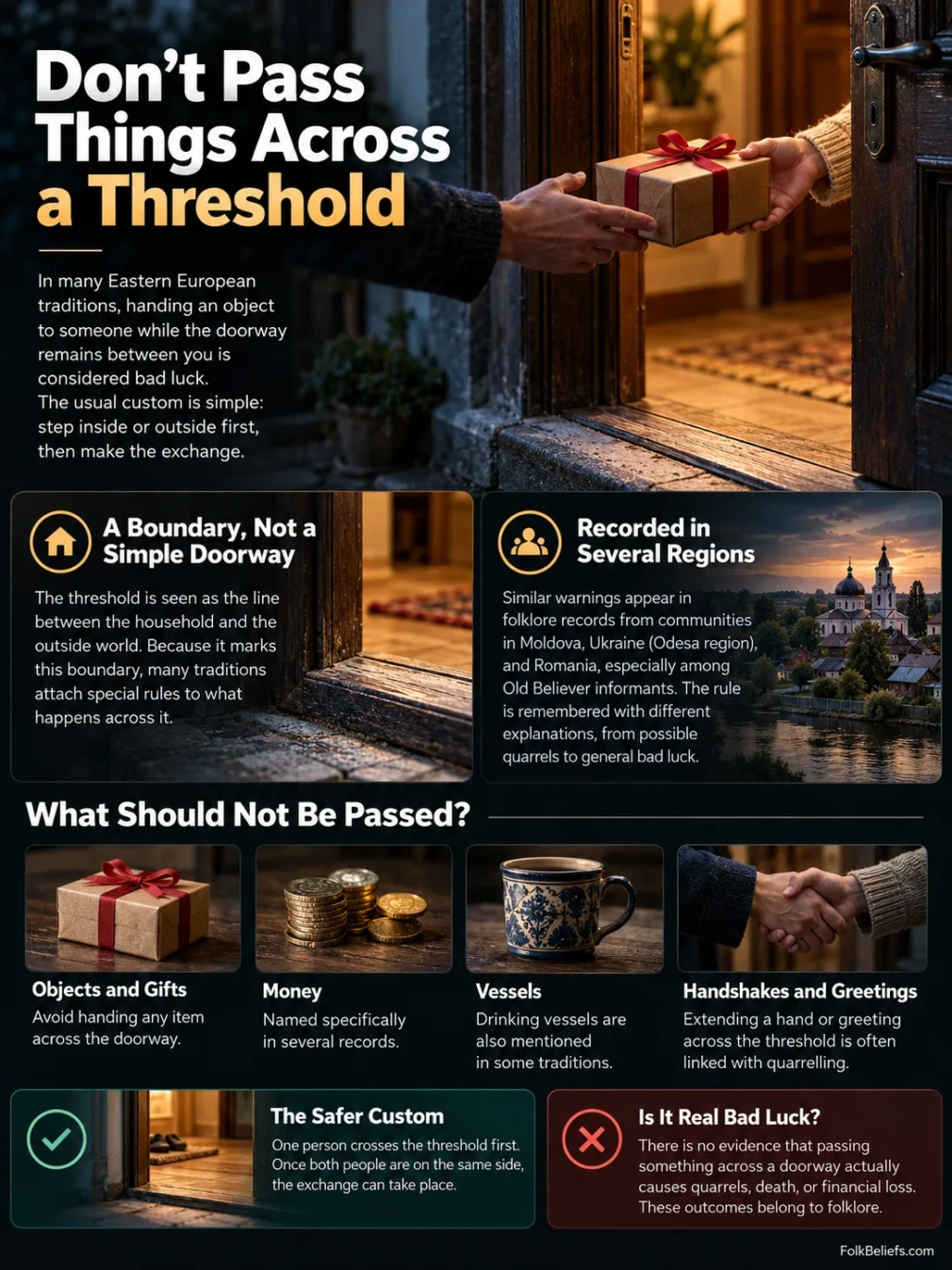
In one well-recorded threshold superstition, an object should not be handed from one person to another while the doorway remains between them. The safer customary action is simple: one person steps fully inside or outside first, and the exchange happens with both people on the same side. Russian folkloric and linguistic records connect this rule with a broader view of the threshold as a boundary between the household and the space beyond it.[1]
What Does Passing Something Across a Threshold Mean?
The belief concerns the act of exchanging something across the doorway, rather than the object simply crossing into the house. A visitor carrying a gift through the door is not doing the same thing as standing outside and extending the gift to someone who remains inside.
Historical Russian material associates such an exchange with a possible quarrel. The nineteenth-century collections of Vladimir Dal recorded related sayings against accepting something across a threshold, greeting across it, and offering a hand across it. A later study of the threshold in Russian linguistic tradition treats these rules as part of a larger group of customs in which the doorstep marks the division between domestic space and the outside.[1]
Common practical form: if two people are separated by the doorway, one of them crosses the threshold before the item changes hands. In some versions, the same rule also applies to a handshake or greeting.
Recorded Versions Do Not All Give the Same Reason
Field records are useful here because they show that the taboo can survive even when its explanation does not.
Moldova
Among Old Believer informants recorded in villages and cities in Moldova, researchers found statements that things were not passed across the threshold. One informant in Cunicea described avoiding even a greeting across it and explicitly called the practice a matter of custom rather than a canonical religious prohibition.[2]
Odesa Region, Ukraine
Field records from communities in the Odesa region include several versions of the rule. One informant from Vylkove specified that neither money nor drinking vessels should be handed across the threshold, but that anything could be given once the person had crossed it. Other informants remembered the prohibition without a firm explanation, while one associated violating it with death.[2]
Romania
Old Believer field material from Tulcea County also records warnings against handing things across the threshold. Some informants described the act simply as improper or sinful without offering a detailed prediction about what would follow.[2]
These records should not be turned into a rule for every resident of Moldova, Ukraine, Romania, Russia, or every Old Believer community. They document specific informants and communities. They also show why a single explanation such as “it always causes a quarrel” is too narrow: the warning can be remembered as custom, religiously framed prohibition, general bad luck, or an omen with a more specific consequence.
Why the Threshold Matters in the Belief
Traditional Russian treatments of the home often give the threshold more meaning than an ordinary strip of wood beneath a door. It can represent the edge between familiar household space and what lies outside. Because exchanges, arrivals, departures, weddings, greetings, and other movements pass through that boundary, folklore attached many rules to it.[1]
Some later explanations connect the taboo with older ideas about the dead or ancestors beneath or near the threshold. Such explanations appear in scholarship discussing Russian threshold traditions, but they should not be treated as the proven origin of every surviving version. A person may inherit the rule without inheriting any story about ancestors, spirits, or burial. The field records themselves contain several informants who knew what should not be done but did not know why.[2]
The evidence supports a boundary taboo more clearly than one universal origin story. The prohibition is documented, but its stated meaning changes between records.
Objects, Money, and Handshakes
The rule is often phrased broadly: do not pass anything across the threshold. More specific records mention money, vessels, gifts, or ordinary household items. A related prohibition applies to extending a hand or exchanging a greeting while the two people remain on opposite sides of the doorway.
A current Russian folklore compilation on SuperstitionsMap records the same cluster of beliefs separately: greetings and handshakes across the doorway are associated with tension or quarrelling, while objects such as money, bags, and keys are described as items that may be carried through the doorway or exchanged after both people occupy the same side.[3]
| Action | Recorded Folklore Treatment |
|---|---|
| Handing an object across the doorway | Avoided in several recorded traditions; the giver or receiver crosses first. |
| Passing money across the threshold | Named specifically in some Russian-language and Old Believer records. |
| Shaking hands across the threshold | Closely related taboo, often associated with quarrelling. |
| Greeting while separated by the threshold | Avoided in some recorded households and communities. |
Is Passing Something Across a Threshold Actually Bad Luck?
There is no evidence that an ordinary doorway exchange causes quarrels, death, financial loss, or another supernatural outcome. Those outcomes belong to folklore.
The custom can still matter socially. Someone may wait for a guest to enter before accepting a present, or refuse a handshake until both people stand on the same side, even without treating the predicted consequence literally. In that setting, following the custom functions as a familiar household habit rather than a test of whether the superstition is factually true.
The safest description, therefore, is not that one country or culture “believes” a single rule. Documented Russian and related Old Believer records preserve a recurring prohibition against exchanges across the threshold, with different explanations and degrees of observance.
Sources and Records
Documented Locations
Countries: Russia
These labels identify where a version has been documented. They do not mean that everyone in the country, region, or community shares the belief.