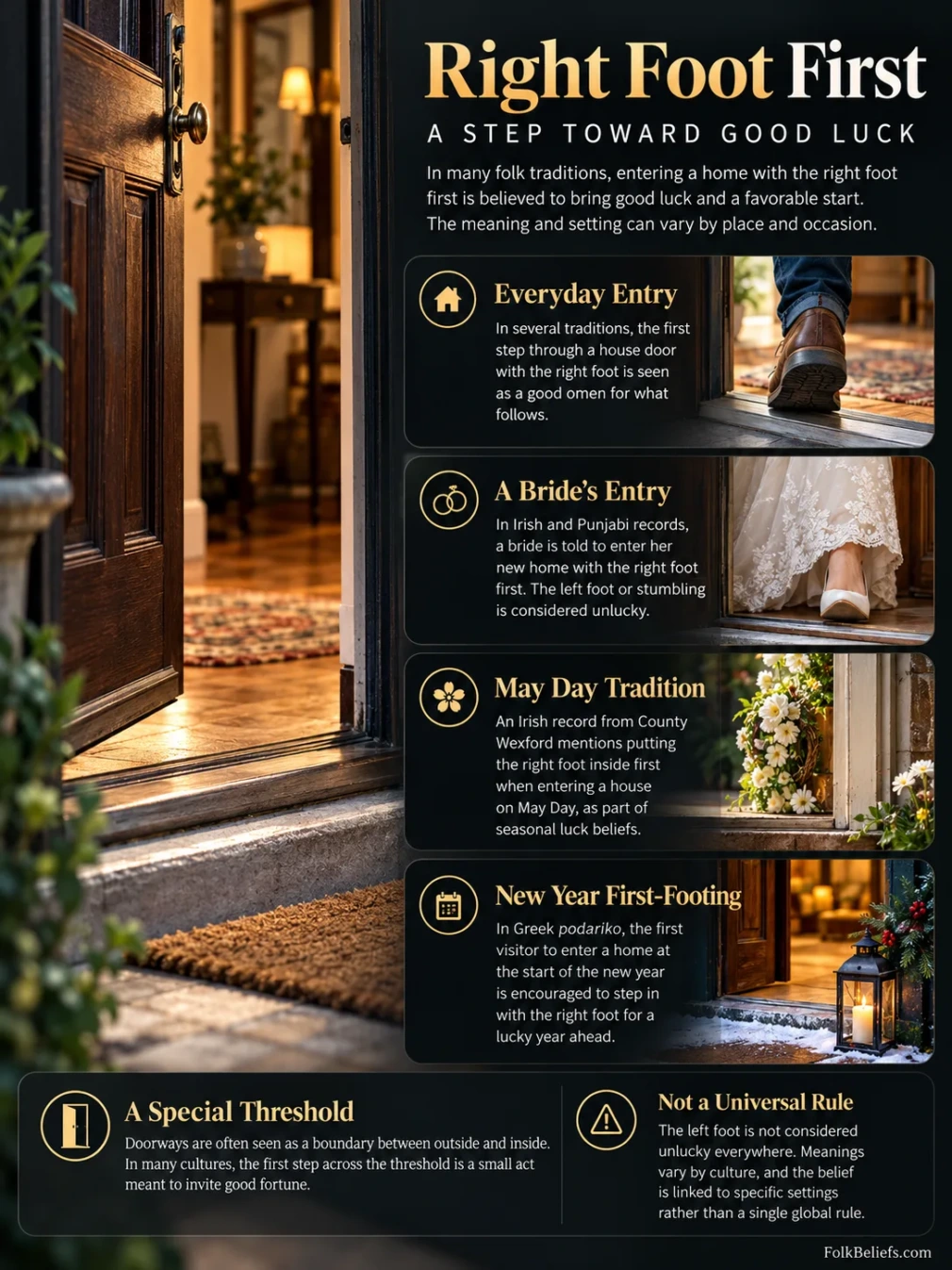
Entering a home with the right foot first is recorded in several folk traditions as a way of beginning the entry favorably. Depending on the record, the step may be associated with ordinary household luck, a bride entering her new home, or the first entry of a new year. The opposite step is sometimes described as unlucky, but the details vary by place and occasion.
What Does Entering With the Right Foot First Mean?
In its simplest recorded form, the belief treats the first step across a doorway as an omen for what follows. Fanny D. Bergen’s 1896 collection of oral superstitions among English-speaking communities includes an instruction to put the right foot foremost when going through a house door. The individual entry is not assigned a particular locality in the collection, so it should not be presented as the custom of one named state or region.[1]
A more geographically specific version appears in P. K. Devine’s 1937 collection from Newfoundland. There, failing to put the right foot first over the threshold when entering a house is described as unlucky.[2]
The belief does not have one fixed meaning everywhere. Some records concern everyday entry, while others apply only to weddings, a new household, a festival, or the first visitor of the year.
When the First Step Carries Extra Meaning
A Bride Entering Her New Home
Irish folklore records repeatedly connect the right-foot rule with marriage. In a Schools’ Collection record from Ballycloghan in County Longford, a bride entering her own home is told to take the first step inside with her right foot. Entering with the left, or stumbling as she enters, is treated as unlucky.[3]
This is a useful example of why the setting matters. The recorded action is not merely walking through a familiar doorway. It marks the bride’s entry into a household after marriage, giving the first step a ceremonial role.
Entering a House on May Day
A separate Irish record from County Wexford places the right-foot custom within May Day belief. The informant said that when entering a dwelling house on that day, a person should put the right foot inside first. The record appears alongside other May Day rules concerning household luck and what could be taken out of or brought into the home.[4]
That version should therefore be read as a seasonal household belief, not evidence that every house entry in Ireland required the same action.
A Punjabi Wedding-Night Record
The Dartmouth Folklore Archive preserves another wedding-related version from a Punjabi informant who grew up in Lahore, Pakistan. In her family tradition, entering with the right foot first on the wedding night was associated with having a good marriage.[5]
The archive identifies the account with that informant and her Punjabi background. It does not establish the practice as a rule followed throughout Pakistan, and the informant’s suggested explanation for the custom is presented as her own interpretation rather than a proven historical origin.
New Year First-Footing in Greece
In Greek podariko, the important step may belong to the first person entering a household at the start of the new year. A current Athens tradition page describes household members reminding the first visitor to enter with the right foot so that the new year will begin favorably.[6]
Here the meaning is tied to first entry and the beginning of a new period. It is therefore related to, but not identical with, a general rule about entering any house at any time.
Why the Threshold Matters in Folk Belief
Doorways often receive special attention in folklore because they mark movement between outside and inside. Research on Latvian traditions, for example, describes the threshold as a boundary between domestic and external space and records the right-foot crossing as one way of seeking good luck in that particular tradition.[7]
This helps explain why the first step can carry more meaning than an ordinary movement of the feet. A wedding creates a new household relationship. New Year marks a calendar boundary. Entering a new home creates another beginning. In each case, the doorway provides a natural place for a small act meant to favor what comes next.
Is the Left Foot Always Considered Unlucky?
No. The surviving records do not support a universal rule about the left side. In the Newfoundland and Irish examples above, the left foot can be the unfavorable alternative, but that contrast belongs to those recorded beliefs. It should not be extended automatically to every culture or every tradition.
The same caution applies to claims about the belief’s origin. Right-foot-first customs appear in different places and settings, but similarity alone does not prove that all versions descended from one source. The safest reading is narrower: several documented traditions use the right first step as a favorable beginning when crossing an important threshold.
Sources and Records
- ↑1 Fanny D. Bergen, Current Superstitions: Collected from the Oral Tradition of English Speaking Folk,
- ↑2 P. K. Devine, Devine’s Folk Lore of Newfoundland in Old Words, Phrases and Expressions,
- ↑3 National Folklore Collection, “Superstitions,” Ballycloghan, Ardagh,
- ↑4 National Folklore Collection, “Festivals of the Year – May Day,” Kildavin, Ferns,
- ↑5 Dartmouth Folklore Archive, “Marriage Superstitions”,
- ↑6 Athens Attica, “Magical Christmas and New Year’s Eve in Athens”,
- ↑7 Edita Olupe, “The Semantics of Threshold in Latvian Traditions”,
Documented Locations
Countries: Ghana, Greece, India, Iraq, Madagascar, Pakistan, Turkmenistan
These labels identify where a version has been documented. They do not mean that everyone in the country, region, or community shares the belief.