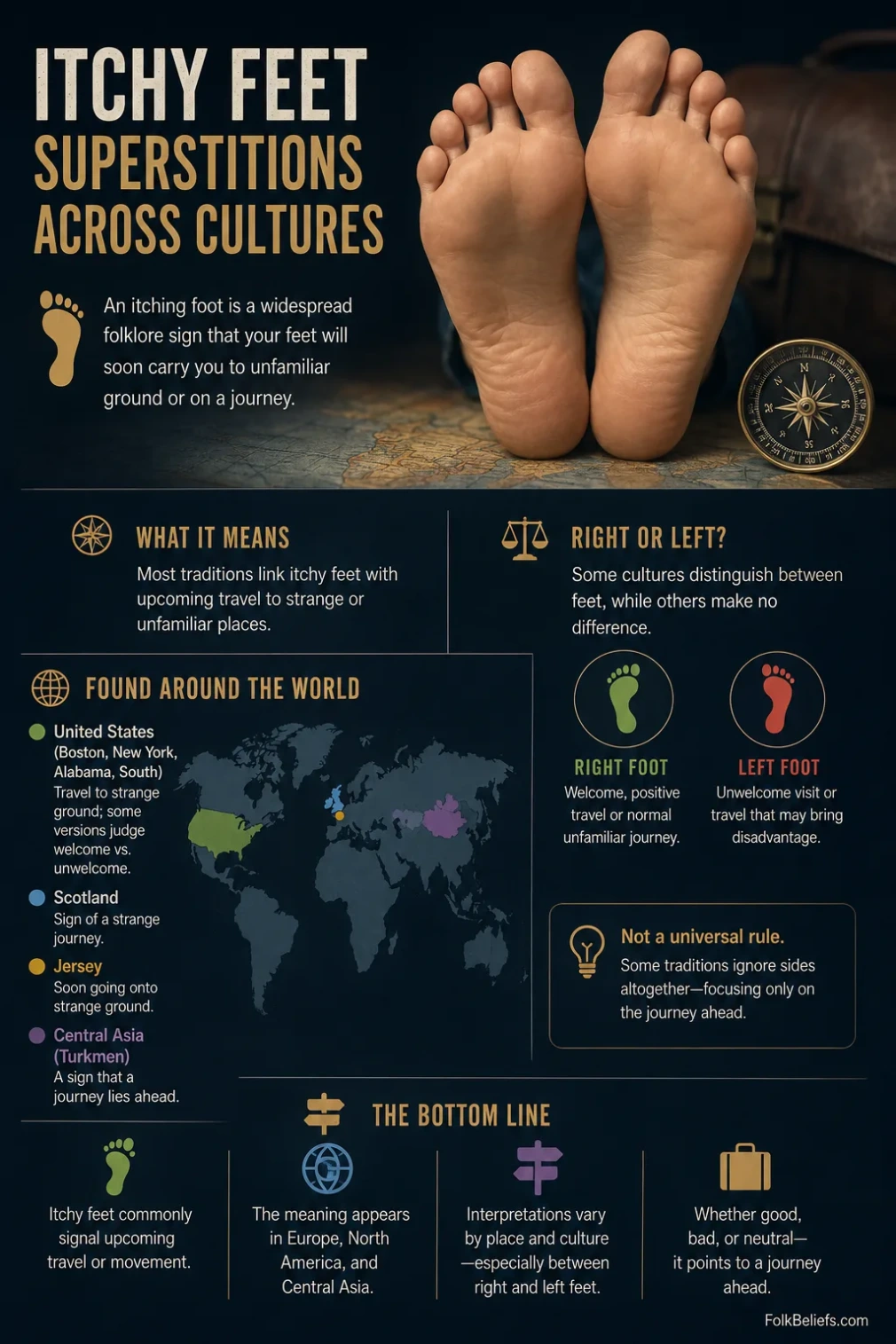
An itching foot is often linked with travel, movement, or stepping onto unfamiliar ground in recorded folklore. The pattern appears in nineteenth-century collections from the United States and western Scotland, in early twentieth-century Jersey material, and in more recent records from Central Asia. The details are not universal: some traditions make no distinction between feet, while particular American records give the right and left foot different outcomes.
Why Itchy Feet Became a Travel Omen
The most repeated interpretation is straightforward: feet carry a person from place to place, so an unexplained sensation in the foot becomes a sign that the feet will soon be used for a journey. Historical collectors often described the destination not simply as travel, but as strange ground or a strange journey.
Fanny D. Bergen’s 1896 collection Current Superstitions, based largely on English-speaking oral tradition, records a Boston belief that if the sole of either foot itches, the person will soon walk on strange ground.[1] The wording matters: this version does not assign good luck to one foot and bad luck to the other. Either sole can announce movement into unfamiliar surroundings.
A similar association was recorded in western Scotland. James Napier’s 1879 collection states that an itching foot was taken as a sign that its owner was about to undertake a strange journey.[2] Again, the record concerns the foot generally rather than a fixed left-versus-right rule.
Documented Variations by Place and Collection
| Recorded setting | Itching sign | Folklore interpretation |
|---|---|---|
| Boston, Massachusetts, 1896 collection | Sole of either foot | Walking on strange ground |
| Western Scotland, published 1879 | Foot | A strange journey |
| Southern United States, published 1899 | Right or left sole | Both concern unfamiliar ground, but the left version adds disadvantage |
| Jersey, published 1914 | Foot | Soon going onto strange ground |
| Turkmen record | Sole | A journey ahead |
Right Foot Versus Left Foot
The familiar internet formula that the right foot always means good travel and the left foot always means bad travel is too broad. Historical records show that such a contrast exists in some places, but not in every version of the belief.
Bergen’s collection contains a local version from Baldwinsville, New York, in which an itching right foot means going somewhere the person will be welcome, while an itching left foot means going somewhere the person will be unwelcome. A related Alabama entry says that an itching left foot while going to see someone means the visitor is not welcome.[1]
An 1899 article by H. M. Wiltse, Some Mountain Superstitions of the South, preserves another distinction. In that collection, an itching right sole predicts that the person will soon walk on strange ground, while an itching left sole predicts strange ground to the person’s disadvantage.[3]
The side of the body is a variant, not a universal rule. One American record distinguishes welcome from unwelcome; another distinguishes ordinary unfamiliar travel from disadvantageous travel; the Boston and Scottish examples make no right-left distinction at all.
Jersey Keeps the “Strange Ground” Meaning
J. le Bas’s Jersey Folklore Notes, published in the journal Folk-Lore in 1914, includes an itching foot among local omens and portents. The recorded interpretation says that the person will soon go on strange ground.[4]
The Jersey record is especially useful because it shows the travel motif surviving in another community without requiring the later good-foot/bad-foot division. The omen concerns where the person will walk, not money, romance, or a predetermined lucky outcome.
The Journey Motif Beyond English-Speaking Folklore
The link between an itching sole and travel is not confined to British and North American collections. A recorded Turkmen body omen also interprets an itching sole as a sign that a journey lies ahead.[5]
This similarity should not be treated as proof that all of these traditions share one historical origin. A foot naturally lends itself to symbolism involving roads, departure, walking, and unfamiliar places. Similar meanings can circulate through contact, develop separately, or change as a belief passes between families and communities. The surviving records do not establish one source from which every itchy-foot superstition descended.
Does the Sole Matter More Than the Rest of the Foot?
Many documented versions specifically mention the sole. Bergen’s Boston entry refers to the sole of either foot, and other American entries distinguish the right and left foot or sole.[1] The Turkmen record likewise identifies an itching sole rather than an unspecified sensation elsewhere on the leg or ankle.
Other sources simply say that the foot itches. This difference is another reason not to build an elaborate system in which the heel, arch, toes, top of the foot, and ankle must each predict separate events. Such detailed charts may appear in modern superstition content, but the historical records used here do not support a single cross-cultural map of meanings for every part of the foot.
What “Strange Ground” Means in the Older Records
In these sources, “strange” is best read in its older sense of unfamiliar or previously unknown. The omen therefore points toward walking somewhere different from one’s usual surroundings. Depending on the version, that can become a journey, a visit, or simply being taken to unfamiliar ground.
The additional emotional meaning varies. Some records stop there. Others add welcome, unwelcome, pleasure, or disadvantage. It is therefore safer to treat travel or unfamiliar ground as the recurring motif and the positive or negative outcome as a local variation.
These interpretations are folklore rather than a method for predicting future travel. A real foot itch has ordinary physical explanations. Itchy skin can result from dry skin, irritation, eczema, allergies, or fungal conditions such as athlete’s foot.[6] Persistent itching, a spreading rash, broken skin, swelling, or other concerning symptoms should be treated as a health issue rather than evidence that a journey is approaching.
Sources and Records
- ↑1a ↑1b ↑1c Fanny D. Bergen, ed., Current Superstitions: Collected from the Oral Tradition of English-Speaking Folk,
- ↑2 James Napier, Folk Lore: Or, Superstitious Beliefs in the West of Scotland Within This Century,
- ↑3 H. M. Wiltse, “Some Mountain Superstitions of the South”,
- ↑4 J. le Bas, “Jersey Folklore Notes”,
- ↑5 SuperstitionsMap, “Turkmen Superstitions”,
- ↑6 NHS, “Itchy Skin”,
Documented Locations
Countries: Afghanistan, Azerbaijan, Chile, Eritrea, Greece, India, Jamaica, Kazakhstan, Latvia, Morocco, Nepal, Philippines, Romania, Russia, Turkey, Turkmenistan, United States
These labels identify where a version has been documented. They do not mean that everyone in the country, region, or community shares the belief.