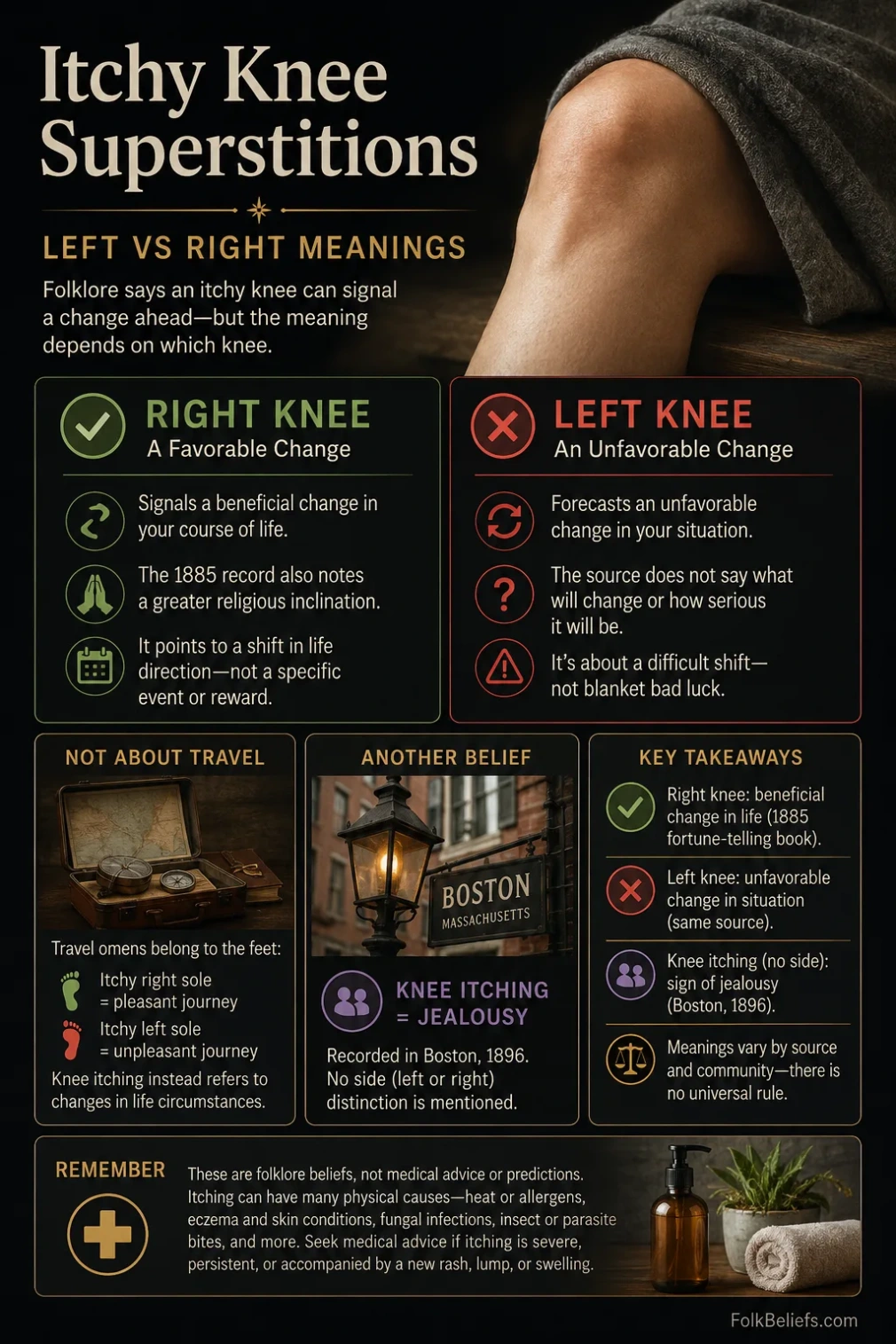
An itchy knee does not have one fixed meaning in folklore. One of the clearest historical left-versus-right rules appears in an American fortune-telling book published in New York in 1885. It treats an itch in the right knee as favorable and an itch in the left knee as unfavorable, but the details are more specific than the simple “good luck versus bad luck” version often repeated today.
Right Knee vs Left Knee in the Historical Record
The Witches’ Dream Book; and Fortune Teller, published by Henry J. Wehman in 1885, places knee itching among a series of bodily signs and auguries. Its right-knee entry predicts a beneficial change in the person’s previous course of life and adds that the person will become more religiously inclined. The corresponding left-knee entry predicts a change in the person’s situation of an unfavorable nature.[1]
| Knee | Recorded Meaning | How Narrowly to Read It |
|---|---|---|
| Right knee | A beneficial change in one’s course of life; the text also mentions becoming religiously inclined. | A favorable change, not a general promise of money, romance, or travel. |
| Left knee | An unfavorable change in one’s situation. | The source does not specify whether the difficulty concerns work, relationships, finances, or another area. |
What Does an Itchy Right Knee Mean?
In this nineteenth-century printed tradition, a right knee itch is a favorable omen of personal change. The wording points toward a change in the direction or character of a person’s life rather than a single lucky event.
The religious element is unusually specific. It belongs to this particular fortune-telling text and should not be expanded into a universal belief about itchy knees. Other traditions can assign completely different meanings to the same sensation.
What Does an Itchy Left Knee Mean?
The matching left-knee belief is much shorter. It forecasts an unfavorable change in circumstances. Nothing in the record identifies exactly what will change, how serious it will be, or when it will happen.
Calling the left knee simply a “bad luck knee” therefore loses some of the original meaning. The recorded omen concerns an unfavorable shift in situation rather than a blanket prediction that everything will go badly.
Does Knee Itching Predict a Journey?
Travel is frequently attached to itchy-knee interpretations in newer superstition summaries, but it is worth separating that claim from the older record. In the same 1885 book, the journey omens belong to the soles of the feet: an itching right sole predicts a pleasant journey, while an itching left sole predicts an unpleasant one. The knee entries immediately above them concern changes in life circumstances instead.[1]
That distinction matters when tracing folklore. A modern claim that “right knee means a good journey and left knee means a troubled journey” should not be attributed to this 1885 source, because the book assigns that particular right-versus-left travel rule to the feet.
Another Recorded Meaning: Jealousy
A different knee-itching belief was documented only eleven years later. Fanny D. Bergen’s 1896 Current Superstitions: Collected from the Oral Tradition of English Speaking Folk includes an item collected in Boston, Massachusetts stating that an itching knee means the person is jealous. The entry makes no distinction between the right and left knee.[2]
This Boston record shows why itchy-knee folklore cannot be reduced to one universal chart. A printed fortune-telling tradition could distinguish favorable right from unfavorable left, while a locally collected oral belief could connect the knee with jealousy and ignore sides altogether.
Is the Right Knee Always Good and the Left Knee Always Bad?
No. The favorable-right and unfavorable-left pairing is genuinely documented in the 1885 fortune book, but that does not make it a rule shared by every community or period.
For someone specifically looking for the historical left-versus-right interpretation, the safest wording is:
- Right knee itching: recorded in one nineteenth-century fortune-telling tradition as a beneficial change in the course of life.
- Left knee itching: recorded in the same source as an unfavorable change in one’s situation.
- Knee itching without a side: recorded in an 1896 Boston folklore collection as a sign of jealousy.
These meanings should remain separate rather than being combined into a single invented system.
What If Both Knees Itch?
The historical records used here do not provide a distinct omen for both knees itching at once. Likewise, they do not assign different knee meanings according to whether the person is male or female. Claims that create special meanings for both knees, different times of day, or separate male and female interpretations need their own identifiable folklore sources before they can be treated as documented variants.
Folklore Meaning and an Actual Itch Are Different Things
Knee superstitions are folklore, not medical explanations or reliable predictions of future events. An actual itch can have ordinary physical causes. The NHS notes that itchy skin can occur with reactions to heat or allergens, eczema and other skin conditions, fungal infections, or insect and parasite exposure. Medical advice is appropriate when itching is severe, keeps returning, affects daily life, or appears with a new rash, lump, or swelling that causes concern.[3]
Sources and Records
Documented Locations
Countries: United States
Regions: Massachusetts (United States)
These labels identify where a version has been documented. They do not mean that everyone in the country, region, or community shares the belief.