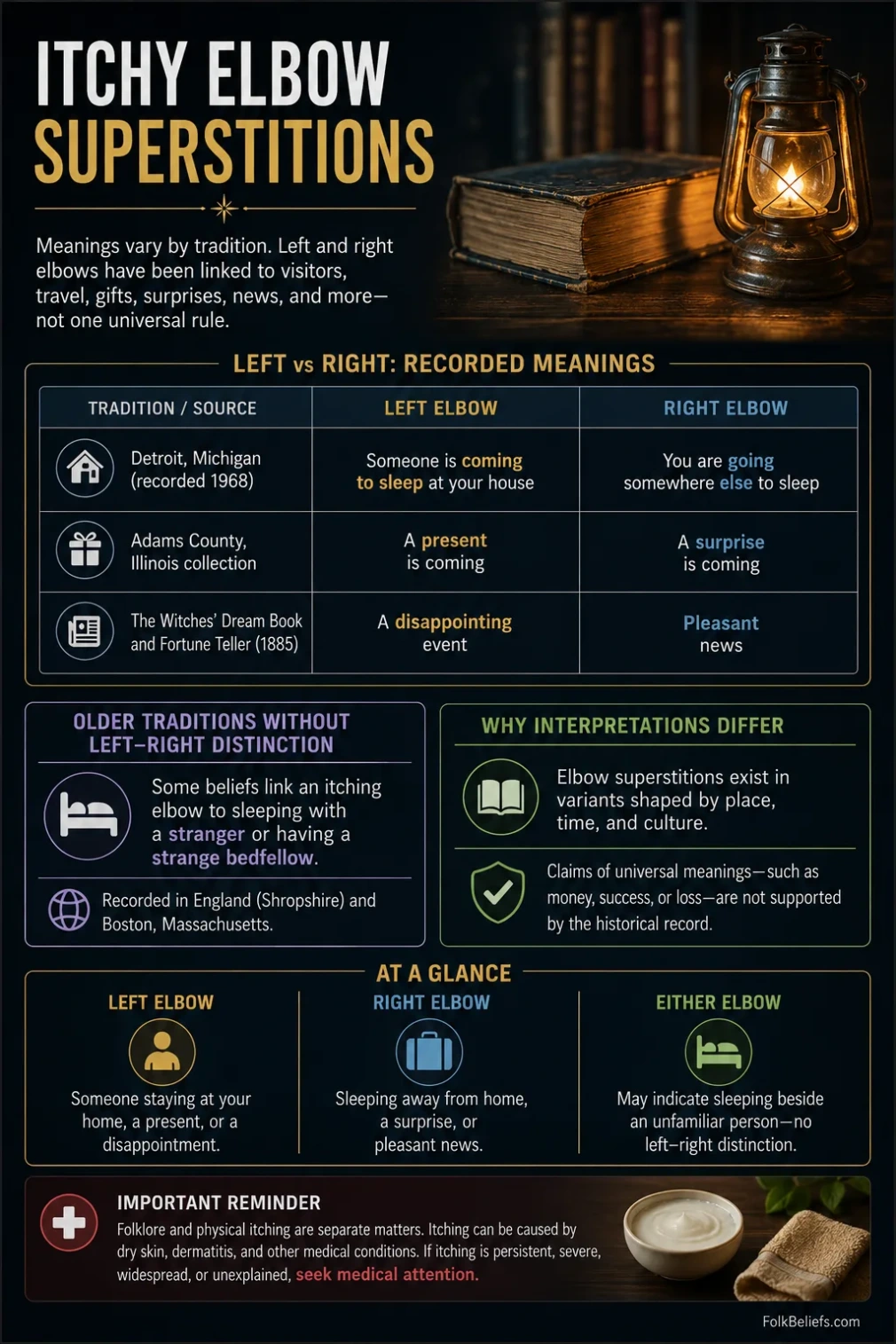
An itchy elbow has carried several meanings in recorded folklore, but the surviving sources do not support one universal rule in which the left elbow always means one thing and the right always means another. In different collections, the itch can point to a visitor, sleeping away from home, a present, a surprise, pleasant news, or disappointment.
What Does an Itchy Left or Right Elbow Mean?
The clearest left-versus-right record comes from the James T. Callow Folklore Archive at the University of Detroit Mercy. A belief learned in Detroit in 1968 says that an itching left elbow means someone is coming to sleep at your house, while an itching right elbow means you will go somewhere else to sleep.[1]
| Recorded Tradition | Left Elbow | Right Elbow |
|---|---|---|
| Detroit, Michigan, recorded 1968 | Someone is coming to sleep at your house | You are going somewhere else to sleep |
| Adams County, Illinois collection | A present is coming | A surprise is coming |
| 1885 fortune-telling book | A disappointing event | Pleasant news |
The Adams County, Illinois folklore collection preserves another pairing. There, an itching left elbow foretells a present, while an itching right elbow foretells a surprise.[2] This version does not make the left side unlucky. Both interpretations concern something unexpected arriving.
Right Elbow Itching in Older Fortune Lore
A different interpretation appears in The Witches’ Dream Book and Fortune Teller, published in New York in 1885. It says that an itching right elbow joint foretells news that will cause pleasure. The corresponding left-elbow entry predicts a vexing disappointment.[3]
Under that particular printed tradition, the contrast is therefore simple: right elbow = welcome news and left elbow = disappointment. It is one documented version rather than a rule that can safely be applied to elbow folklore everywhere.
Older Elbow Superstitions Did Not Always Distinguish Sides
Some historical traditions cared about the elbow but not whether it was left or right. Charlotte Sophia Burne’s Shropshire Folk-Lore records the belief that when an elbow itches, the person will have a strange bedfellow.[4]
A similar belief crossed the Atlantic. Fanny D. Bergen’s 1896 collection Current Superstitions, assembled from the oral traditions of English-speaking communities, records a Boston, Massachusetts belief that an itching elbow means you will sleep with a stranger.[5]
In these older examples, “stranger” and “strange bedfellow” belong to the wording and social setting of the recorded superstition. The records do not establish a modern prediction about romance or relationships.
Why Left and Right Meanings Differ Between Sources
The surviving records show that elbow superstitions circulated in variants. A Detroit version divides the omen according to who will sleep away from home. An Illinois version distinguishes a present from a surprise. An 1885 printed fortune book contrasts pleasant news with disappointment. Other English and American collections mention an itching elbow without assigning separate meanings to the two sides.
For that reason, claims that an itchy right elbow universally means money, success, or good luck—or that an itchy left elbow universally means financial loss or bad luck—should not be presented as established traditional rules without a source tied to a particular community, collection, or period.
Documented Left vs Right Variations
Left Elbow
Recorded meanings include someone coming to stay at your home, receiving a present, and experiencing a disappointment.
Right Elbow
Recorded meanings include sleeping somewhere away from home, receiving a surprise, and hearing pleasant news.
Either Elbow
Some older traditions simply associate an itching elbow with sleeping beside an unfamiliar person, with no left-right distinction.
Is an Itchy Elbow Considered Good or Bad Luck?
It depends on the tradition being consulted. The Adams County records give favorable or neutral expectations to both sides. The 1885 fortune-telling source gives the right elbow a favorable interpretation and the left a less welcome one. The Detroit record is mainly about changes in sleeping arrangements rather than good or bad fortune.
This variation is part of the folklore itself. It is more accurate to ask which recorded version is being used than to assign a fixed positive or negative meaning to every itchy elbow.
Folklore and physical itching are separate matters. An itch is a bodily sensation, not evidence that an omen will occur. Dry skin and skin conditions such as dermatitis are among ordinary causes of itching. Persistent, severe, widespread, or otherwise unexplained itching may need medical attention.[6]
Sources and Records
- ↑1 University of Detroit Mercy Libraries, James T. Callow Computerized Folklore Archive, itching-elbow belief learned in Detroit, Michigan, February 15, 1968.
- ↑2 Harry Middleton Hyatt, Folk-Lore from Adams County, Illinois,
- ↑3 The Witches’ Dream Book and Fortune Teller,
- ↑4 Charlotte Sophia Burne, Shropshire Folk-Lore,
- ↑5 Fanny D. Bergen, ed., Current Superstitions: Collected from the Oral Tradition of English Speaking Folk,
- ↑6 Mayo Clinic, “Itchy Skin (Pruritus) — Symptoms and Causes”,
Documented Locations
Countries: United States
Regions: Massachusetts (United States)
These labels identify where a version has been documented. They do not mean that everyone in the country, region, or community shares the belief.