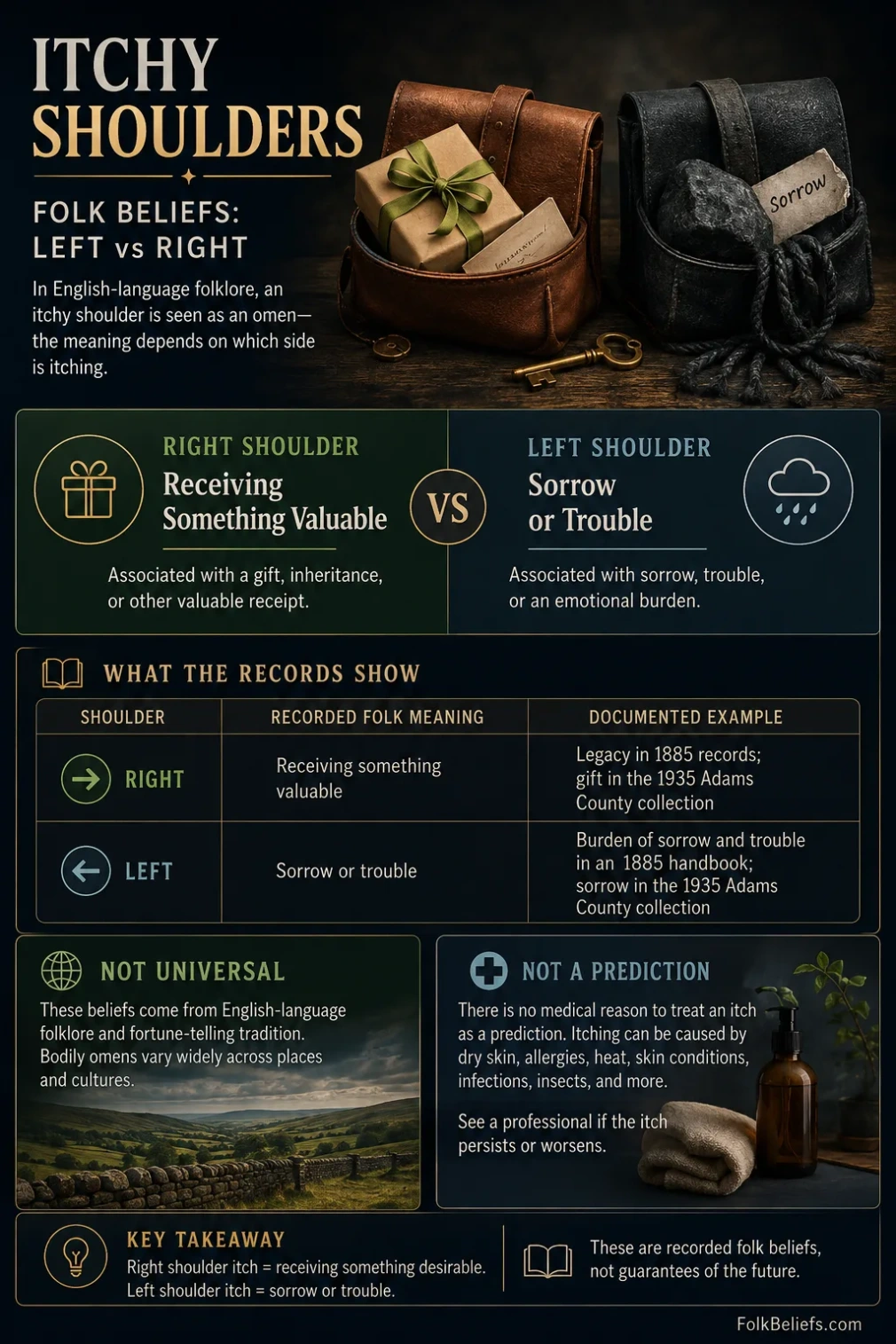
An itchy shoulder has been treated as an omen in some English-language folk-belief records, with the meaning changing according to the side. The surviving evidence gives a fairly clear contrast: the right shoulder is associated with receiving something of value, while the left shoulder is associated with sorrow or trouble. These are recorded folk interpretations, not predictions or medical explanations.
What Does an Itchy Right Shoulder Mean?
The right-shoulder belief appears in nineteenth-century English-language material. An 1885 note published in The Folk-Lore Journal states that itching of the right shoulder foretells a large legacy.[1]
A fortune-telling handbook published in New York in the same year gives essentially the same interpretation. The Witches’ Dream Book and Fortune Teller says that itching on the right shoulder means a large legacy will soon be bequeathed to the person.[2]
The wording changes in a later American folklore collection, but the favorable direction remains. Harry Middleton Hyatt’s Folk-lore from Adams County, Illinois, published in 1935, records: if the right shoulder itches, a gift is expected soon.[3]
These records therefore support two closely related right-side meanings: an inheritance or legacy in the 1885 material and a more general gift in the Illinois collection. It would be too broad to turn those records into a rule shared by every culture.
What Does an Itchy Left Shoulder Mean?
The left shoulder receives a different interpretation in the sources that record both sides. The 1885 Witches’ Dream Book and Fortune Teller connects an itching sensation on the left shoulder with bearing a heavy burden of sorrow and trouble.[2]
Hyatt’s Adams County collection preserves a shorter version of the same idea several decades later: an itching left shoulder means that sorrow will soon be experienced.[3]
In these particular records, then, the contrast is straightforward. The right shoulder points toward receiving something desirable, while the left points toward an unwelcome emotional experience.
| Shoulder | Recorded Folk Meaning | Documented Example |
|---|---|---|
| Right | Receiving something valuable | Legacy in 1885 records; gift in the 1935 Adams County collection |
| Left | Sorrow or trouble | Burden of sorrow and trouble in an 1885 handbook; sorrow in the 1935 Adams County collection |
Are the Left and Right Meanings Universal?
No. The evidence here documents particular strands of English-language folklore and popular fortune-telling tradition. It does not establish a worldwide belief that every itchy right shoulder is lucky or every itchy left shoulder is unlucky.
The distinction matters because bodily omens vary widely even within the same broad tradition. Different places and collectors can preserve different meanings for itching hands, feet, ears, elbows, and other body parts. A recorded belief should therefore be tied to the source and setting in which it appears rather than presented as something everyone once believed.
The shoulder records are interesting because similar meanings appear more than once. An 1885 fortune-telling book and a 1935 Illinois folklore collection both connect the right shoulder with receiving and the left shoulder with sorrow. That repetition shows that the left-right contrast circulated in more than one English-language source, but it does not reveal a single point of origin.
Does an Itchy Shoulder Actually Predict Anything?
There is no medical reason to treat an itch as a prediction of a gift, inheritance, sorrow, or future event. The superstition belongs to folklore.
Ordinary itching can have many physical causes. The NHS notes that itchy skin can result from dry or irritated skin and may also occur with allergies, heat reactions, skin conditions, infections, or insect-related causes.[4] A persistent or troublesome shoulder itch is therefore better treated as a physical symptom rather than evidence that the traditional omen is coming true.
Sources and Records
Documented Locations
Countries: United States
Regions: Illinois (United States)
These labels identify where a version has been documented. They do not mean that everyone in the country, region, or community shares the belief.