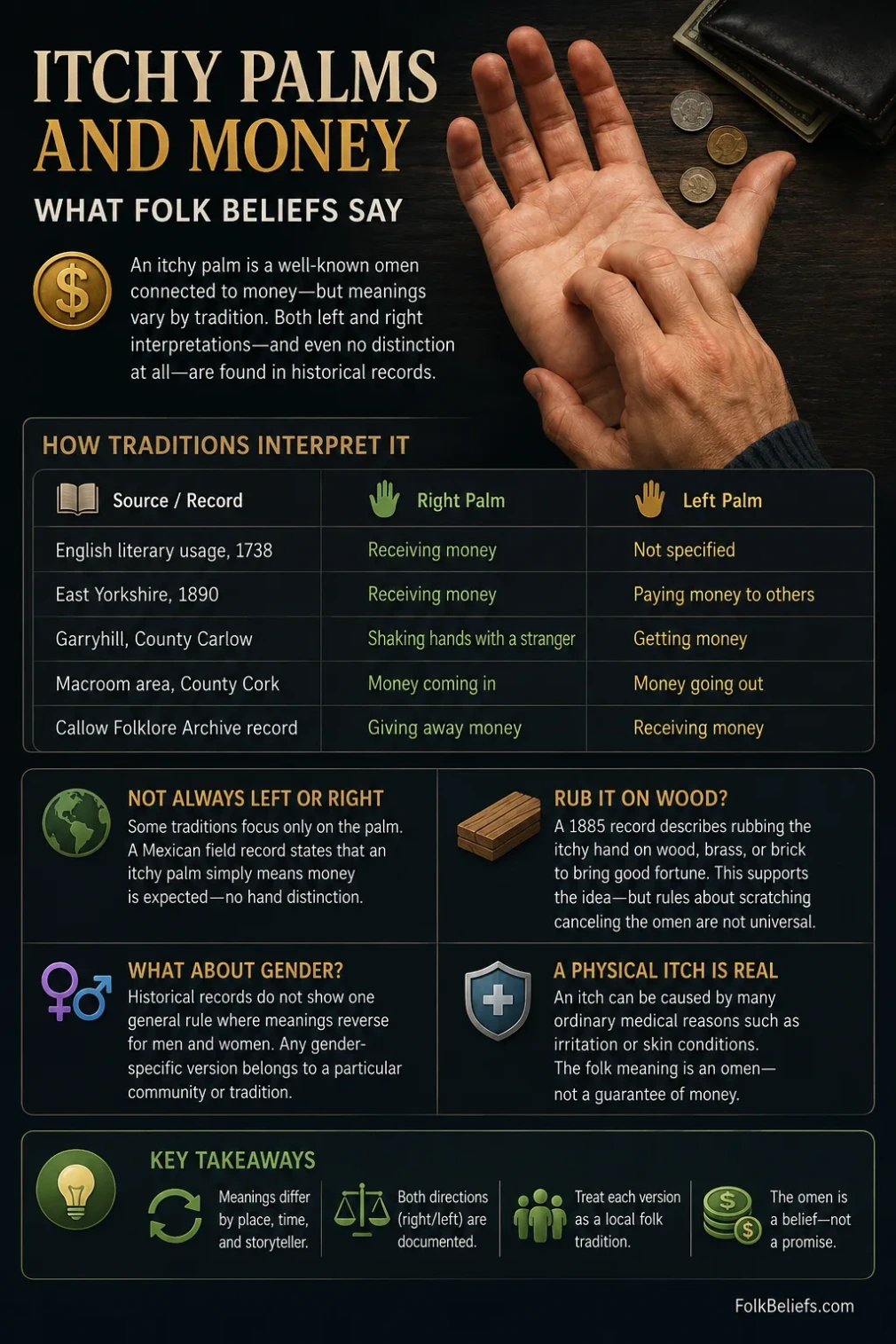
An itchy palm is widely linked with money in folk belief, but there is no single left-hand and right-hand rule shared across all traditions. One familiar version says an itching right palm means money will be received and an itching left palm means money will be paid out. Historical and archival records also preserve the reverse arrangement, versions in which only one hand concerns money, and versions that do not distinguish between the hands at all.
The disagreement is not a modern distortion. Different meanings appear in records separated by place and period, so the safest reading is to treat each version as a particular folk tradition rather than a universal code.
Why Itchy Palms Became Associated With Money
The connection between an itching hand and incoming money was already recognizable in English print by the early eighteenth century. Jonathan Swift’s Polite Conversation, first published in 1738, includes a character who interprets an itching right hand as a sign that she will receive money.[1]
This does not establish where the superstition began. Swift was using familiar conversational sayings for comic effect, which instead shows that the association between an itching hand and money was already understandable to his audience.
Later folklore collections make the pattern much less uniform. An 1885 contribution to The Folk-Lore Journal divided the omen by surface rather than by left and right: an itching palm indicated having money, while itching on the back of the hand indicated giving money away.[2] This is one reason a simple rule such as “right receives, left loses” cannot cover the full documented tradition.
Right and Left Palm Meanings in Recorded Traditions
| Record | Right Palm or Hand | Left Palm or Hand |
|---|---|---|
| English literary usage, 1738 | Receiving money | Not specified in the passage[1] |
| East Yorkshire, 1890 | Receiving money | Paying money to others[3] |
| Garryhill, County Carlow, Schools’ Collection | Shaking hands with a stranger | Getting money[4] |
| Macroom area, County Cork, Schools’ Collection | Money coming in | Money going out[5] |
| James T. Callow Folklore Archive record | Giving away money | Receiving money[6] |
The table shows why contradictory answers are common. Both directions are documented. Right-hand itching can mean receiving money in one record and giving it away in another. The same reversal occurs with the left hand.
What Does an Itchy Right Palm Mean?
In the East Yorkshire collection published by John Nicholson in 1890, an itching right palm predicts the receipt of money, while the left predicts payment to someone else.[3] The County Cork record in the Irish Schools’ Collection preserves the same basic direction: right means money coming in and left means money going out.
Other records give the right hand a different role. The Garryhill material associates an itching right palm with an approaching handshake rather than money. In that particular record, it is the left palm that predicts financial gain.
A University of Detroit Mercy folklore record reverses the money rule more directly: left means receiving money and right means giving it away. The meaning therefore depends on the tradition being quoted, not simply on which palm itches.
What Does an Itchy Left Palm Mean?
An itching left palm is similarly divided between two familiar interpretations:
- Money coming in: documented in the Garryhill Schools’ Collection record and in material preserved by the James T. Callow Folklore Archive.
- Money going out: documented in the County Cork Schools’ Collection record and in Nicholson’s East Yorkshire collection.
The contrast is especially clear in the Irish material. Two records held within the National Folklore Collection do not give the same answer. The Garryhill record says the left palm means money is coming, while the Macroom-area record says an itching left palm means money goes out. These records belong to different local contexts and should not be collapsed into a single “Irish rule.”
Some Versions Do Not Distinguish Left From Right
Not every palm-itching belief depends on handedness. A record in the USC Digital Folklore Archives, collected from a Mexican informant, simply states that when the palm itself itches, money is expected. No separate left-versus-right meaning is required in that version.[7]
This type of record matters because modern explanations often present the superstition as though the left/right distinction were always essential. In the archival evidence, the central idea can instead be the sensation in the palm and its association with money.
Does the Meaning Change for Men and Women?
Gender-specific explanations are common in contemporary retellings, but the historical and archival records cited here do not establish one general rule in which the meanings automatically reverse for men and women. The documented variation is already extensive without adding a universal gender distinction.
A male-or-female version may belong to a particular family, community, religious interpretation, or later popular tradition. It should be identified that narrowly when evidence is available rather than presented as the meaning of itchy palms everywhere.
Rubbing an Itchy Palm on Wood
Some traditions add an action to the omen. The 1885 Folk-Lore Journal record includes instructions for rubbing the itching hand against materials such as wood, brass, or brick, with each action connected to the hoped-for outcome.[2]
This provides historical support for the familiar idea of rubbing an itching hand on wood. It does not support every modern rule attached to scratching. Claims that scratching the palm always cancels the money omen, for example, should not be treated as part of one universal tradition without a more specific source.
Is an Itchy Palm Actually a Sign That Money Is Coming?
In folklore, the itch functions as an omen. It does not provide evidence that a financial event will occur. A physical itch is medically known as pruritus and can occur for many ordinary reasons, including irritation and various skin or health conditions.[8]
The folk interpretation and the physical sensation are therefore separate matters. A brief unexplained itch can still prompt a familiar family saying, but a persistent or troublesome palm itch is a physical symptom rather than proof that money is about to arrive or leave.
Sources and Records
- ↑1a ↑1b Jonathan Swift, Polite Conversation, first published in 1738; Project Gutenberg edition of the 1892 Chiswick Press text.
- ↑2a ↑2b The Folk-Lore Journal, Vol. III, “Itching: Auguries”, Folk-Lore Society, 1885.
- ↑3a ↑3b John Nicholson, Folk Lore of East Yorkshire, London, 1890.
- ↑4 National Folklore Collection, UCD, “Traditional Irish Superstitions,” Garryhill,
- ↑5 National Folklore Collection, UCD, “Some Superstitions,” Clochar na Trócaire, Maghcromtha,
- ↑6 University of Detroit Mercy Libraries, James T. Callow Folklore Archive,
- ↑7 USC Digital Folklore Archives, “Palm Itching”,
- ↑8 MedlinePlus, “Itching”,
Documented Locations
Countries: Argentina, Azerbaijan, Colombia, Greece, India, Ireland, Jamaica, Latvia, Mexico, Pakistan, Poland, United States
These labels identify where a version has been documented. They do not mean that everyone in the country, region, or community shares the belief.