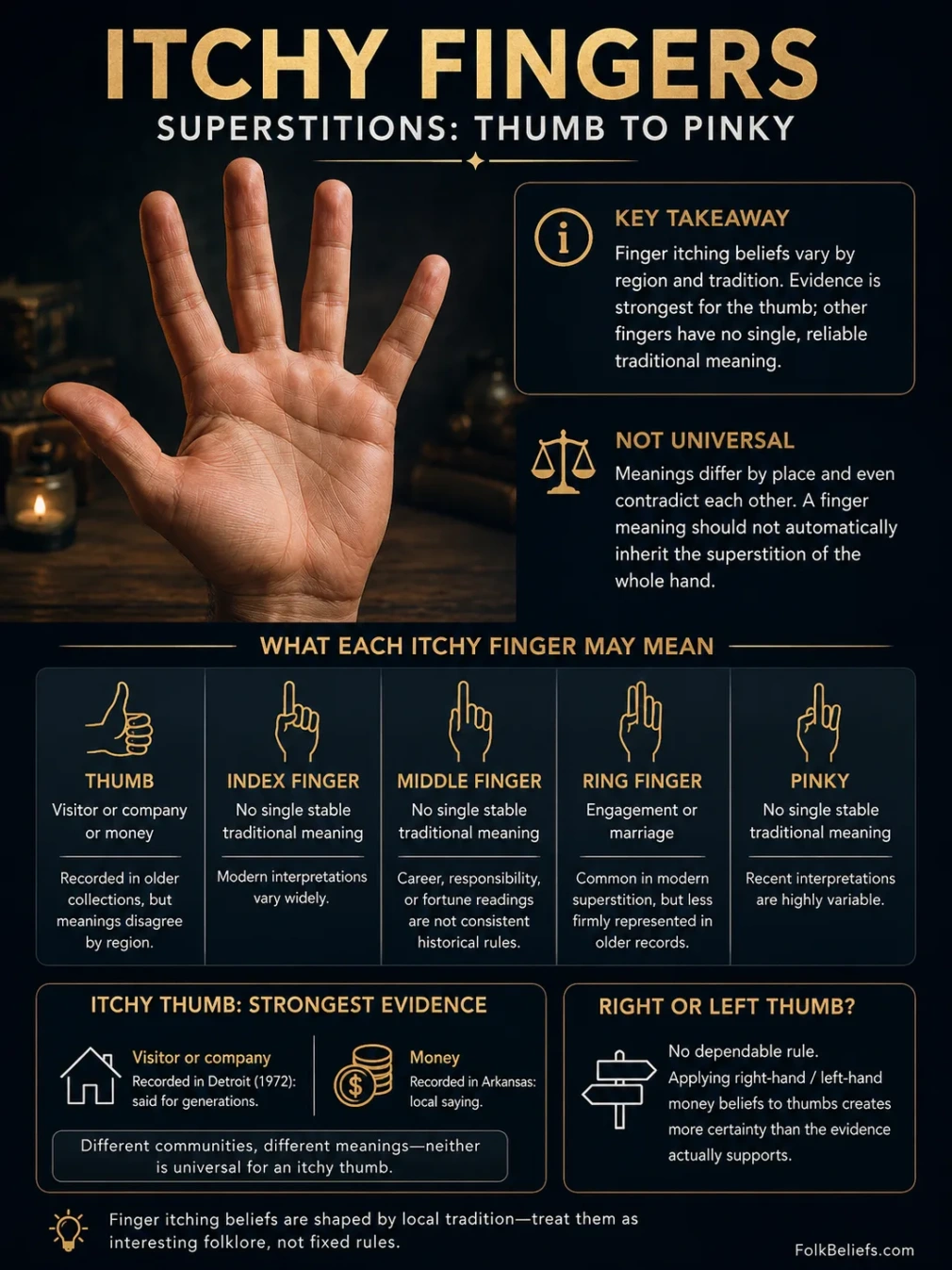
An itchy finger does not have one universal traditional meaning. Older folklore collections are much clearer about itching hands and palms than about a complete thumb-to-pinky system. A few individual fingers do have recorded beliefs, especially the thumb, while several familiar finger-by-finger meanings found online today are later or weakly documented interpretations rather than stable historical rules.
The most useful distinction: a specific finger meaning should not automatically inherit the superstition of the whole hand. Historical records also contradict one another, so even well-established itching beliefs can change by place and family tradition.
What Does It Mean When a Particular Finger Itches?
| Finger | Recorded or Commonly Repeated Meaning | Evidence |
|---|---|---|
| Thumb | A visitor or company; in another local record, money | Specific regional records exist, but they disagree |
| Index finger | No single stable traditional itching meaning | Modern interpretations vary widely |
| Middle finger | No single stable traditional itching meaning | Modern career, responsibility, or fortune readings are not consistent historical rules |
| Ring finger | Engagement or marriage in a familiar modern superstition | Commonly repeated today, but less firmly represented in older itching collections |
| Pinky / little finger | No single stable traditional itching meaning | Recent interpretations are highly variable |
Itchy Thumb Superstitions
The thumb has unusually useful evidence because at least one university folklore archive records a belief specifically about an itching thumb, rather than an itching hand in general.
A record in the University of Detroit Mercy’s James T. Callow Folklore Archive states that an itching thumb meant company was coming. The belief was recorded in Detroit in 1972, and the submitter described it as something said for generations, though not necessarily believed literally.[1]
That meaning was not universal. A collection published by the Baxter County Historical and Genealogical Society in Arkansas lists a different local saying: an itching thumb meant that the person would have money.[2]
Thumb meaning: documented versions include both an approaching visitor and money. The records come from different communities, so neither should be presented as the universal meaning of an itchy thumb.
Does an Itchy Right or Left Thumb Change the Meaning?
The thumb records above do not establish a dependable right-versus-left rule. It is tempting to borrow the familiar right-hand and left-hand money beliefs and apply them specifically to each thumb, but that creates a more precise system than the historical evidence supports.
This matters because even the broader hand superstition changes direction from one collection to another. A side distinction can therefore be meaningful within a particular tradition without becoming a general rule for every itchy thumb.
Itchy Index Finger Superstitions
The index finger is frequently assigned meanings such as direction, decisions, leadership, luck, or ambition in recent spiritual interpretations. Those explanations usually derive the prediction from the finger’s everyday use for pointing rather than from a clearly identified older itching record.
In the historical collections used here, the index finger does not carry a stable, separate itching omen comparable to the documented palm or thumb beliefs. That does not mean no family or local tradition has ever assigned one. It means a single traditional answer such as “an itchy index finger predicts success” would claim more certainty than the record allows.
Right and Left Index Finger Meanings
Modern lists often give the right and left index fingers opposite meanings. The assignments are inconsistent: one source may associate the right side with success while another uses it for money, action, or authority. Without a location, community, or identifiable tradition behind the rule, these are better treated as contemporary symbolic interpretations rather than established folk records.
Itchy Middle Finger Superstitions
The middle finger has the same evidence problem. Recent explanations sometimes connect its itch with career progress, responsibility, balance, money, or personal strength. These meanings can sound plausible because symbolism is being attached to the finger after the fact, but they do not form a consistent historical itching tradition in the older collections cited here.
A person may certainly encounter a family saying about the middle finger, yet there is no sound basis for treating one modern interpretation as the standard meaning across cultures.
Itchy Ring Finger Superstitions
The ring finger is different because it already carries a strong association with engagement and marriage in societies where rings are worn on that finger. A familiar contemporary superstition therefore says that an itchy ring finger means an engagement or marriage may be approaching. This interpretation appears in modern collections of wedding and engagement superstitions.[5]
Its evidence should still be described carefully. The marriage reading is easy to understand through the symbolism of the ring finger, but the older hand-itching material is much better documented than a centuries-old rule assigning marriage specifically to an itching fourth finger.
Ring finger meaning: engagement or marriage is the most recognizable modern reading. It should not be expanded into a fixed prediction about a proposal, a particular partner, or an exact time.
Does the Left Ring Finger Mean Marriage?
Modern versions often emphasize the left ring finger, especially where engagement and wedding rings are normally worn on the left hand. Other versions simply say “ring finger” without specifying a side. That difference suggests that ring-wearing custom helps shape the superstition.
Claims that the right ring finger always means one event while the left always means another are much less dependable. Those detailed charts vary considerably between modern sources.
Itchy Pinky or Little Finger Superstitions
The little finger has accumulated many recent interpretations, including gossip, news, overlooked details, relationship concerns, or an approaching change. There is no single one of these meanings that emerges as the established historical rule in the older itching records considered here.
For that reason, a pinky itch is best described as having variable modern interpretations rather than one documented traditional prediction. A local or family belief may be more specific, but its meaning belongs to that tradition rather than to a universal finger code.
Why Money Is More Strongly Connected With the Hand Than With Individual Fingers
The best-documented itching-hand superstition concerns money. Fanny D. Bergen’s 1896 collection Current Superstitions records a New York version in which an itching right hand meant receiving money and an itching left hand meant spending it. The same collection immediately gives another variant from New Brunswick and New England: rubbing an itching left hand on wood was supposed to bring money. A Maine record says simply that itching in the palm meant that the hand would soon receive money.[3]
The contradictions continue elsewhere in the same collection. A Talladega, Alabama record says the right hand foretold money while the left meant shaking hands with a friend. Other entries connect an itching palm with a fight, a stranger, or even killing something rather than money.[3]
British regional evidence shows a similar money motif. Shropshire Folk-Lore records the rule that an itching right hand meant receiving money while an itching left hand meant paying money.[4]
The Callow archive preserves still more American variants. Records include a left hand predicting incoming money, a right hand predicting a handshake with a stranger, and other versions in which the right hand instead brings money.[1]
| Recorded Place | Right Hand | Left Hand |
|---|---|---|
| New York, 1896 collection | Receive money | Spend money |
| Shropshire | Receive money | Pay money |
| Talladega, Alabama | Get money | Shake hands with a friend |
| Some Callow Archive records | Handshake, letter, gift, or money depending on the record | Money or a gift depending on the record |
This variation explains why a neat rule such as “right means money coming in, left means money going out” cannot be applied automatically to every finger. It is one documented pattern among several.
“My Fingers Itch” Has Also Meant Something Quite Different
Not every historical reference to itching fingers is an omen. In Shakespeare’s Troilus and Cressida, Ajax says, “My fingers itch” during an angry exchange immediately before striking Thersites. In that context, the phrase expresses an urge to use his hands rather than a prediction about money, love, or luck.[6]
This older literary usage is useful because searches for finger-itching folklore can easily mix figurative language with actual body-omen beliefs.
What About “By the Pricking of My Thumbs”?
Another famous Shakespearean phrase is sometimes pulled into discussions of itchy thumbs. In Macbeth, the Second Witch experiences a pricking of the thumbs immediately before Macbeth arrives.[7]
That passage should not be quietly converted into a rule that “an itchy thumb means danger.” Pricking and itching are different sensations, and the literary scene is not evidence for the Detroit visitor belief or the Arkansas money belief. They are separate records that happen to involve the thumb.
Why Finger-by-Finger Meanings Vary So Much
Short body omens are especially easy to change in oral transmission. A person remembers that an itching hand means money, another remembers which side was lucky, and a later version may narrow the sensation from the hand to one finger. Symbolism can add another layer: the index finger points, the ring finger carries a wedding ring, and the little finger is associated with smallness. Those associations can generate convincing new explanations even when they are not present in older collections.
Bergen’s nineteenth-century collection itself notes that different meanings can be attached to the same action, accident, or coincidence and that popular beliefs can be modified as they pass between people.[3] Itchy-hand folklore illustrates that process particularly well.
When an Itch Is Physical Rather Than Folkloric
Finger superstitions are cultural interpretations, not medical predictions. Persistent itching can have ordinary physical causes. The American Academy of Dermatology notes that hand eczema can produce dry or inflamed skin, itching, burning, cracks, and itchy blisters, and irritation or allergic reactions can affect the hands as well.[8] An itch that persists, becomes painful, develops a rash or blisters, or repeatedly returns is better treated as a physical symptom than as evidence that an omen is coming true.
Sources and Records
- ↑1a ↑1b University of Detroit Mercy Libraries, The James T. Callow Folklore Archive, digitized folklore records including the Detroit itching-thumb belief and regional itching-hand variants.
- ↑2 Baxter County Historical & Genealogical Society, Quarterly, Volume 24, No. 1, local superstition list recording an itching thumb as a money sign.
- ↑3a ↑3b ↑3c Fanny D. Bergen, ed., Current Superstitions: Collected from the Oral Tradition of English Speaking Folk, American Folk-Lore Society, 1896.
- ↑4 Charlotte S. Burne, ed., Shropshire Folk-Lore: A Sheaf of Gleanings, digitized by the Bodleian Libraries, University of Oxford.
- ↑5 Fabienne Rauw, “Superstitions Around Weddings, Engagements and Rings”,
- ↑6 Folger Shakespeare Library, Troilus and Cressida, Act 2, Scene 1, text of Ajax’s “my fingers itch” exchange.
- ↑7 Folger Shakespeare Library, Macbeth, Act 4, Scene 1, text of the “pricking of my thumbs” passage.
- ↑8 American Academy of Dermatology, “Dry, Scaly, and Painful Hands Could Be Hand Eczema”, information on itching and other symptoms affecting the hands.
Documented Locations
Countries: Russia
These labels identify where a version has been documented. They do not mean that everyone in the country, region, or community shares the belief.