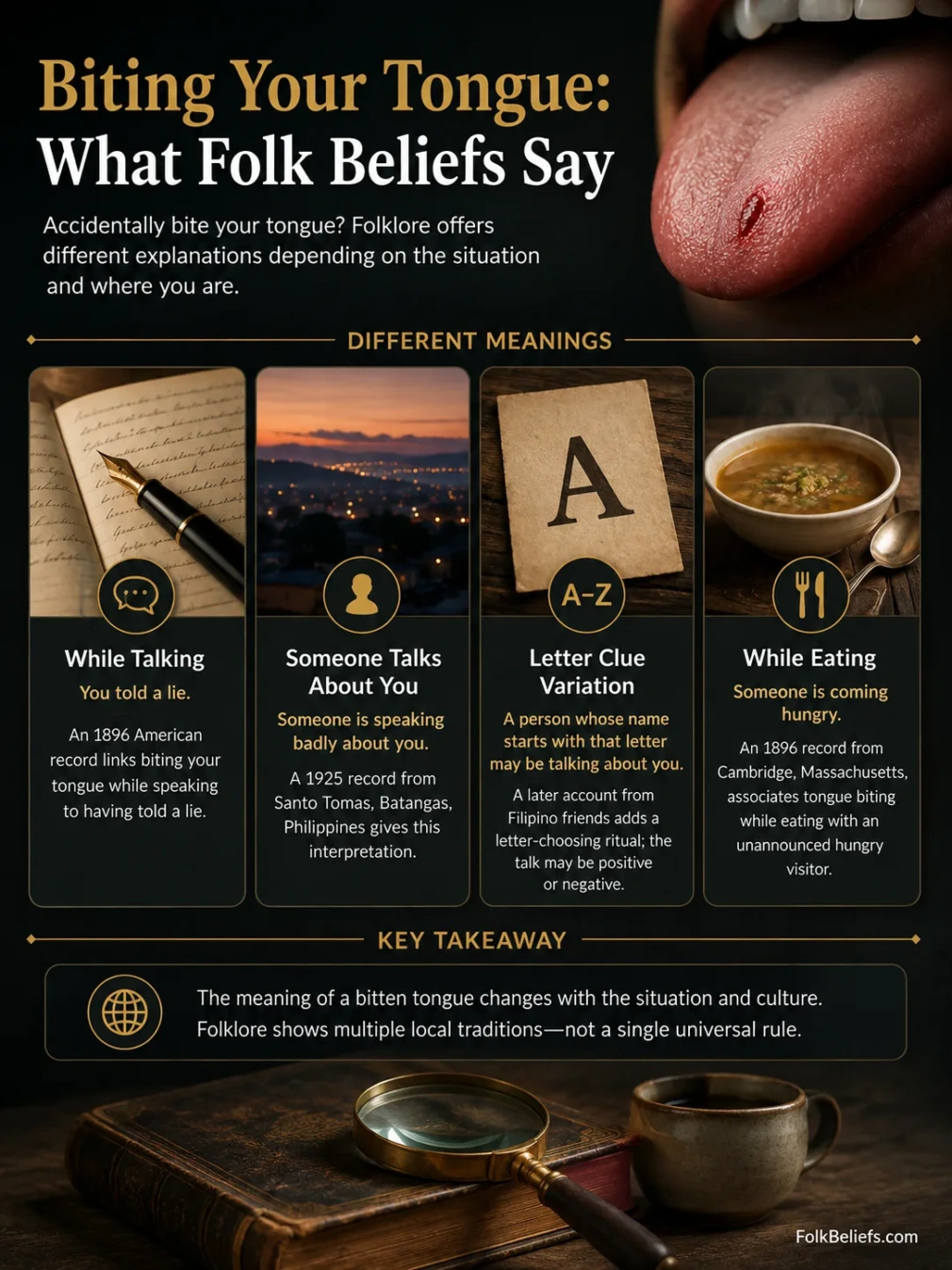
Accidentally biting your tongue does not have one fixed folk meaning. Recorded traditions give it several different interpretations. In some, the bite points back to the speaker and suggests a lie has just been told. In others, it means another person is talking about you. A few records attach a completely different meaning when the bite happens while eating.
The strongest documented examples are therefore best read as separate local and historical variants, rather than parts of a single universal superstition.
When Biting Your Tongue Means You Told a Lie
One of the clearest older American records appears in Fanny D. Bergen’s 1896 collection Current Superstitions. Item 1331 states that biting the tongue while talking means the person has told a lie.[1]
The wording matters. The record connects the belief specifically with a bite that occurs while talking. It does not say that every accidental tongue bite has this meaning.
A later oral-history entry in the USC Digital Folklore Archives records a related idea from a young informant associated with New Orleans. In that account, biting the lip or tongue meant that the person had been lying a lot recently.[2] This is close to the 1896 belief, although the two records differ in timing: one refers to a lie just told, while the other refers more broadly to recent lying.
Folklore distinction: These records associate tongue biting with dishonesty, but they do not establish a general rule for American folklore as a whole. They document particular forms of the belief collected in particular settings.
Someone May Be Talking About You
A different interpretation appears in a 1925 collection from Santo Tomas, Batangas. Aurora A. Hernandez recorded the belief that accidentally biting your tongue was a sign that somebody was speaking badly about you.[3]
This record is useful because its geographical scope is unusually clear. It comes from a collection identified specifically with Santo Tomas in Batangas Province. It should not be expanded into a claim that every Filipino community shared exactly the same interpretation.
A much later USC folklore record shows that a related belief was still being passed on in a Filipino social context. The informant, who was not Filipino, said that Filipino friends and coworkers had told him that after biting his tongue he should ask someone for a letter of the alphabet. A person he knew whose name began with that letter was then imagined to be talking about him. In this version, the conversation could be positive or negative rather than necessarily hostile.[4]
The two records therefore share the idea of distant speech being revealed through the tongue, but they are not identical. The 1925 Santo Tomas record specifies unfavorable talk. The later account includes a small identification game and leaves the character of the conversation open.
The Meaning Can Change Depending on What You Were Doing
The 1896 collection preserves an especially useful contrast. Immediately after the belief about lying while talking, Bergen records another tongue-biting superstition: if a person suddenly bites the tongue while eating, it means that someone is coming hungry. That second belief is identified with Cambridge, Massachusetts.[1]
| Recorded Situation | Folk Meaning | Documented Context |
|---|---|---|
| Biting the tongue while talking | You have told a lie | Recorded in an 1896 collection of English-speaking folk beliefs |
| Biting the tongue while eating | Someone is coming hungry | Cambridge, Massachusetts, recorded in 1896 |
| Accidentally biting the tongue | Someone is speaking badly about you | Santo Tomas, Batangas, recorded in 1925 |
| Biting the tongue followed by choosing a letter | A person whose name begins with that letter may be talking about you | Later account learned from Filipino friends and coworkers |
These examples show why the circumstances surrounding the bite matter. Folklore can assign different meanings to the same physical event depending on whether it happens during speech, during a meal, or without an obvious conversational context.
Biting the Tongue as a Way to Stop Gossip
Some traditions use tongue biting not as an omen but as a deliberate response to the idea that somebody is talking about you.
Harry Middleton Hyatt’s Folk-Lore from Adams County, Illinois records a belief connected with ringing ears: the person whose ear rings should bite their tongue, which was supposed to make the person talking about them bite their own tongue.[5]
Bergen’s earlier collection contains related forms in which pinching an ear or biting the corner of an apron was supposed to make a person speaking about you bite their tongue.[1]
Here the tongue is not predicting that gossip is occurring. Instead, making the distant speaker bite their tongue acts as a symbolic way of interrupting or punishing the unwanted speech.
Why Tongue-Biting Beliefs Often Center on Speech
Many of the recorded meanings connect the tongue with the activity it performs: speaking. A lie is expressed through the tongue; gossip is imagined as another person’s tongue working elsewhere; making a gossiping person bite their tongue symbolically stops the words.
This relationship helps explain why ideas about lying, gossip and silence can appear independently in different tongue-related traditions. It does not prove that every version developed from one original belief. The surviving records do not provide enough evidence for a single historical origin.
The familiar English expression “bite your tongue” also belongs to this language of speech and restraint. In ordinary modern English it means stopping yourself from saying something you want to say.[6] That idiom should be kept separate from accidental-bite superstitions. Deliberately “biting your tongue” figuratively means remaining silent; accidentally biting it can acquire one of several folk interpretations depending on the tradition.
Does the Side of the Tongue Change the Meaning?
The historical records used here do not establish a dependable left-versus-right system for tongue biting. They distinguish the circumstances of the bite more clearly than its physical location.
Modern lists sometimes assign separate meanings to the left side, right side, tip or underside of the tongue, but such detailed systems should not automatically be treated as old or widely shared tradition. Without a traceable regional or historical source, those interpretations are better regarded as later circulating variants rather than established rules.
What About Biting Your Tongue in Your Sleep?
The documented beliefs above mostly concern an accidental bite noticed while awake. They do not provide an old, consistent rule for interpreting tongue biting during sleep.
Repeated nighttime tongue biting also belongs in a different category from folklore. Clinical literature records several possible physical causes for recurrent tongue injury during sleep, so an unexplained pattern should not be treated as evidence that another person is gossiping, thinking about you or sending a message.[7]
Folklore meanings describe traditional interpretations of an event. They do not show that an accidental tongue bite can reveal whether somebody is lying, gossiping, thinking about you or approaching your home.
Sources and Records
- ↑1a ↑1b ↑1c Fanny D. Bergen, Current Superstitions: Collected from the Oral Tradition of English Speaking Folk,
- ↑2 USC Digital Folklore Archives, “Superstitions from New Orleans and Variants from East Asia”,
- ↑3 Aurora A. Hernandez, Superstitious Beliefs in Santo Tomas,
- ↑4 USC Digital Folklore Archives, “Biting Your Tongue”,
- ↑5 Harry Middleton Hyatt, Folk-Lore from Adams County, Illinois,
- ↑6 Cambridge Dictionary, “bite your tongue”,
- ↑7 American Academy of Sleep Medicine, “Tongue Biting: A Case of Sporadic Geniospasm during Sleep”,
Documented Locations
Countries: Afghanistan, Argentina, Italy, Malta, Nepal, Philippines, Qatar, Russia, Turkmenistan, United States
These labels identify where a version has been documented. They do not mean that everyone in the country, region, or community shares the belief.