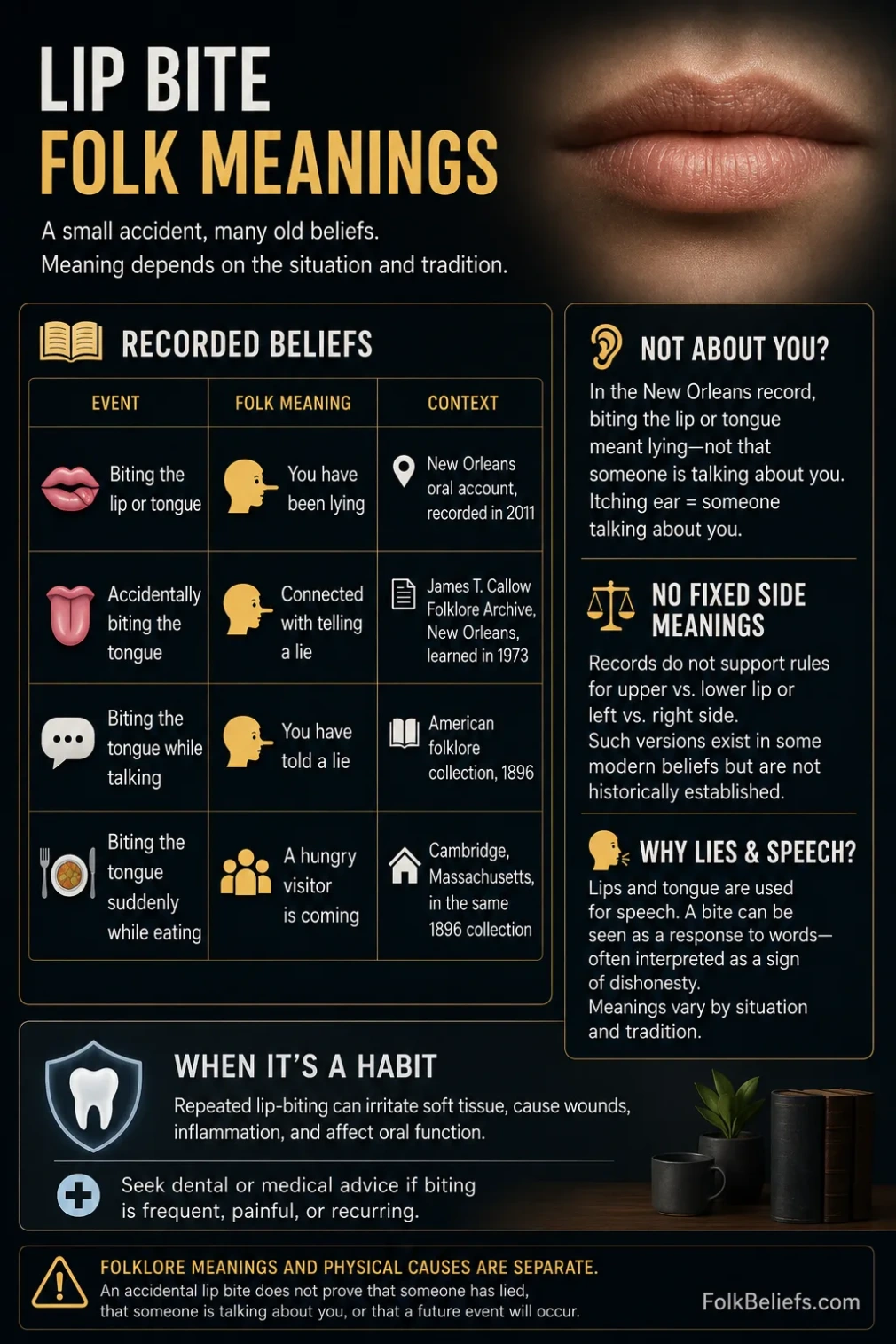
Accidentally biting your lip has been given different folk meanings, but the surviving evidence does not support one universal interpretation. One documented oral account associated with New Orleans says that biting the lip or tongue means the person has been lying.[1] Older records of tongue-biting show closely related ideas about lies, speech, and even an expected visitor.
What Does Biting Your Lip Mean in Superstition?
The clearest archived lip-biting example comes from the USC Digital Folklore Archives. In a 2011 interview, an informant who had lived in New Orleans since childhood described a group of body-related superstitions. In that account, accidentally biting the lip or tongue was connected with having lied recently.
This should be read as a recorded belief from one informant and social setting, not as a rule followed by everyone in New Orleans or by any broader community.
A related record in the University of Detroit Mercy’s James T. Callow Folklore Archive was learned in New Orleans in 1973. It says that a person who lies may develop a bump on the tongue or accidentally bite the tongue.[2] Although this record concerns the tongue rather than the lip, it preserves the same connection between accidentally biting part of the mouth and dishonesty.
| Recorded Event | Folk Meaning | Recorded Context |
|---|---|---|
| Biting the lip or tongue | You have been lying | New Orleans-associated oral account, recorded in 2011 |
| Accidentally biting the tongue | Connected with telling a lie | New Orleans record in the James T. Callow Folklore Archive |
| Biting the tongue while talking | You have told a lie | Published American folklore collection, 1896 |
| Biting the tongue suddenly while eating | A hungry visitor is coming | Cambridge, Massachusetts, in the same 1896 collection |
The Older Tongue-Biting Variants
Fanny D. Bergen’s Current Superstitions, published for the American Folk-Lore Society in 1896, preserves two useful variants. One says that biting the tongue while talking means a lie has been told. The next says that suddenly biting the tongue while eating means someone is coming who will be hungry.[3]
The contrast matters. Even within an older collection, the same physical accident did not always predict the same thing. What the person was doing when the bite occurred could change the interpretation.
That kind of variation is common in oral tradition. A belief may be remembered differently between families, towns, generations, or individual storytellers. It is therefore safer to preserve the wording and location of each record than to combine several versions into a single supposed rule.
Does Biting Your Lip Mean Someone Is Talking About You?
This is often associated with body-omen folklore, but it is not the meaning given to lip-biting in the USC record cited here. The same informant actually separated the two beliefs: an itching ear meant someone was talking about the person, while biting the lip or tongue was linked with lying.[1]
That distinction is useful because several body signs can acquire similar meanings as they circulate. Ear sensations, tongue bites, lip bites, sneezing, burning cheeks, and other involuntary events have all attracted folk explanations, but a meaning documented for one bodily sign should not automatically be transferred to another.
Upper Lip, Lower Lip, Left, and Right Meanings
Modern interpretations sometimes assign separate predictions to the upper lip, lower lip, left side, or right side. The archival records used here do not establish such a system for lip-biting.
In particular, these records do not provide evidence for fixed rules such as:
- upper lip meaning romance or affection;
- lower lip predicting an argument;
- the right side meaning praise or good news;
- the left side meaning gossip or criticism.
Such versions may circulate in contemporary belief-sharing, family tradition, or online spiritual interpretation, but they should not be described as universal historical folklore without a source that documents the particular community, period, and wording.
Why Lies and Speech Appear in These Beliefs
The connection between a mouth-related accident and spoken words is easy to recognize symbolically. The lip and tongue are involved in speech, so a sudden bite can be interpreted as a bodily response to something said.
In the documented New Orleans-related examples, that connection becomes moral: the bite points backward toward a lie rather than forward toward an unrelated event. In the 1896 eating variant, however, the meaning changes entirely and becomes a prediction about an approaching hungry person. These differences are a reminder that folk meanings are learned traditions, not fixed properties of the physical event itself.
Folklore meaning and physical cause are separate questions. An accidental lip bite does not provide evidence that someone has lied, that another person is talking about them, or that a future event will occur.
When Lip Biting Is a Repeated Habit
An occasional accidental bite is different from repeatedly biting the lips as a habit. The Faculty of Dentistry at Universitas Gadjah Mada notes that repeated lip-biting can irritate soft tissue and may cause recurrent wounds and inflammation. Persistent lower-lip biting can also affect oral function in some circumstances.[4]
Folklore can explain what a community or individual believed an accidental bite meant, but it should not replace ordinary dental or health explanations when biting is frequent, painful, or repeatedly injures the same area.
Sources and Records
- ↑1a ↑1b USC Digital Folklore Archives, “Supersitions from New Orleans and Variants from East Asia”,
- ↑2 University of Detroit Mercy, James T. Callow Folklore Archive, “Luck”,
- ↑3 Fanny D. Bergen, Current Superstitions: Collected from the Oral Tradition of English Speaking Folk,
- ↑4 Faculty of Dentistry, Universitas Gadjah Mada, “Can Lip-Biting Habits Damage Teeth?”,
Documented Locations
Countries: Ethiopia
These labels identify where a version has been documented. They do not mean that everyone in the country, region, or community shares the belief.