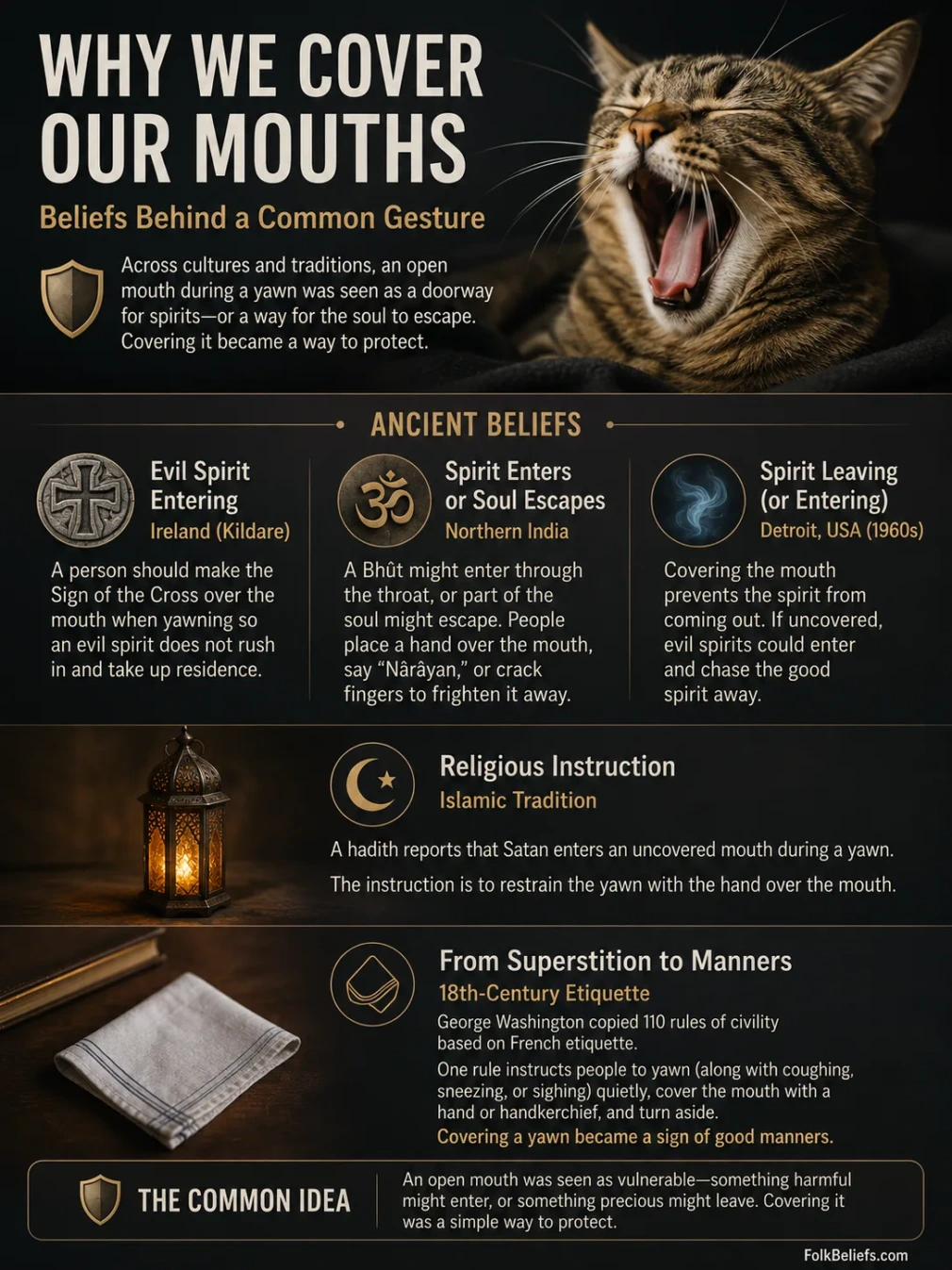
Covering your mouth when you yawn is now usually treated as ordinary manners, but folklore records give the gesture several older protective meanings. In different traditions, the open mouth could be imagined as a doorway through which an evil spirit entered, the soul escaped, or another harmful influence gained access. The records do not point to one universal yawning superstition or one proven point of origin.
These records describe beliefs, customs, and religious traditions. They are not evidence that spirits or souls literally enter or leave the body during a yawn.
The Open Mouth as a Vulnerable Boundary
Many yawning beliefs focus less on the yawn itself than on the open mouth. For a few seconds, a normally closed part of the body becomes exposed. Folklore could interpret that opening as a vulnerable passage, so covering it, making a religious gesture, saying a protective phrase, or performing another small action served as a symbolic way of closing the passage again.
An Evil Spirit Entering in a Kildare Record
A record in the National Folklore Collection’s Schools’ Collection from Naas, County Kildare, gives a direct example. The collected belief says that a person should make the Sign of the Cross over the mouth when yawning so that an evil spirit does not rush in and take up residence there.[1]
The protective action in this record is not simply hiding the yawn. The gesture guards the opening created by it. This distinction matters because later etiquette also tells people to cover a yawn, but for a different stated reason.
Northern India: A Spirit Entering or the Soul Escaping
William Crooke’s 1896 collection of popular beliefs in northern India records two possible dangers attached to yawning. In his account, a Bhût might enter through the throat, or part of the person’s soul might escape. The described responses include placing a hand over the mouth, saying Nârâyan, or cracking the fingers to frighten the spirit away.[2]
This record contains both of the ideas often associated with yawning folklore: something harmful may get in, or something belonging to the person may get out. It should not be treated as a belief held uniformly across India. Crooke was documenting material from a particular historical setting in northern India, and his record only supports that narrower context.
A Detroit Record About the Spirit Leaving
The James T. Callow Computerized Folklore Archive at the University of Detroit Mercy preserves a belief learned in Detroit in the 1960s. In that item, covering the mouth prevents a person’s spirit from coming out. The record adds that if the mouth was left uncovered, evil spirits could enter and chase the good spirit away.[3]
This is an individual archival record rather than proof of a citywide or American belief. Its value is that it shows the soul-escape and spirit-entry ideas still being transmitted in a twentieth-century North American setting.
A Related Instruction in Islamic Tradition
A similar protective image appears in Islamic religious tradition, although it should not simply be relabeled as a generic superstition. Sahih Muslim 2995a reports an instruction to restrain a yawn with the hand over the mouth because Satan enters.[4]
The resemblance to other yawning beliefs is easy to see: an uncovered mouth is treated as an opening that should be guarded. The context, however, is different. Here the instruction belongs to a religious textual tradition rather than an isolated folk saying collected from an informant. Keeping those contexts separate avoids turning every similar gesture into a single supposedly universal belief.
How Covering a Yawn Also Became a Rule of Manners
Historical etiquette provides another reason for the familiar hand-over-mouth gesture. George Washington’s Mount Vernon notes that Washington copied 110 rules of civility into his school book when he was about fourteen. The rules themselves came from an older French etiquette tradition. Rule No. 5 instructs a person who coughs, sneezes, sighs, or yawns to do it quietly, place a hand or handkerchief before the face, and turn aside.[5]
By this stage, covering a yawn could plainly function as social etiquette without any stated reference to spirits or escaping souls. That does not prove that manners replaced superstition in a simple sequence. Protective beliefs and rules of politeness could exist at the same time, and similar gestures can acquire different explanations in different settings.
This is why the common claim that everyone covers a yawn today because people once feared demons is too broad. Folklore supplies that explanation in some records, while etiquette texts provide a separate social reason for the same physical action.
Did the Custom Begin During a Plague?
Another often repeated explanation links protective gestures around yawning with plague. Olivier Walusinski’s 2010 review of beliefs about yawning discusses a European tradition connecting the Sign of the Cross before the mouth with a plague associated with the time of Pope Gregory the Great, around 590. The historical authority cited for that account, however, is a work published in 1769.[6]
That gap matters. The account shows that a plague explanation was recorded in later literature, but it does not establish 590 as the proven date when people first began guarding their mouths while yawning. Independent records attach the gesture to spirit entry, soul escape, religious practice, and ordinary civility. A single-origin story therefore goes beyond what the surviving evidence can support.
What the Yawning Superstition Means
Yawning beliefs are usually better understood as protective customs rather than predictions. They do not necessarily say that a yawn forecasts good luck, bad luck, death, visitors, money, or another future event. Instead, the yawn creates a brief moment of imagined vulnerability and the protective action responds immediately to it.
Depending on the record, that response may be covering the mouth, making the Sign of the Cross, saying a sacred name, cracking the fingers, or performing another familiar gesture. The details change because the beliefs come from different places, periods, families, and religious or folkloric settings.
The modern habit can continue even when its supernatural explanation has disappeared. Someone may cover a yawn simply because it is polite, while another person may connect the same gesture with a family teaching or religious practice. The historical record supports all of these possibilities more securely than the idea that one forgotten superstition explains why everyone covers their mouth today.
Sources and Records
- ↑1 National Folklore Collection, UCD, “Naas (Mercy Convent),” The Schools’ Collection,
- ↑2 William Crooke, The Popular Religion and Folk-Lore of Northern India, Vol. I,
- ↑3 University of Detroit Mercy Libraries, James T. Callow Computerized Folklore Archive,
- ↑4 Sahih Muslim 2995a,
- ↑5 George Washington’s Mount Vernon, “The Rules of Civility,” Rule No. 5,
- ↑6 Olivier Walusinski, “Popular Knowledge and Beliefs”,
Documented Locations
Countries: Azerbaijan, Greece, Palau, Poland, Sri Lanka, Turkey
These labels identify where a version has been documented. They do not mean that everyone in the country, region, or community shares the belief.