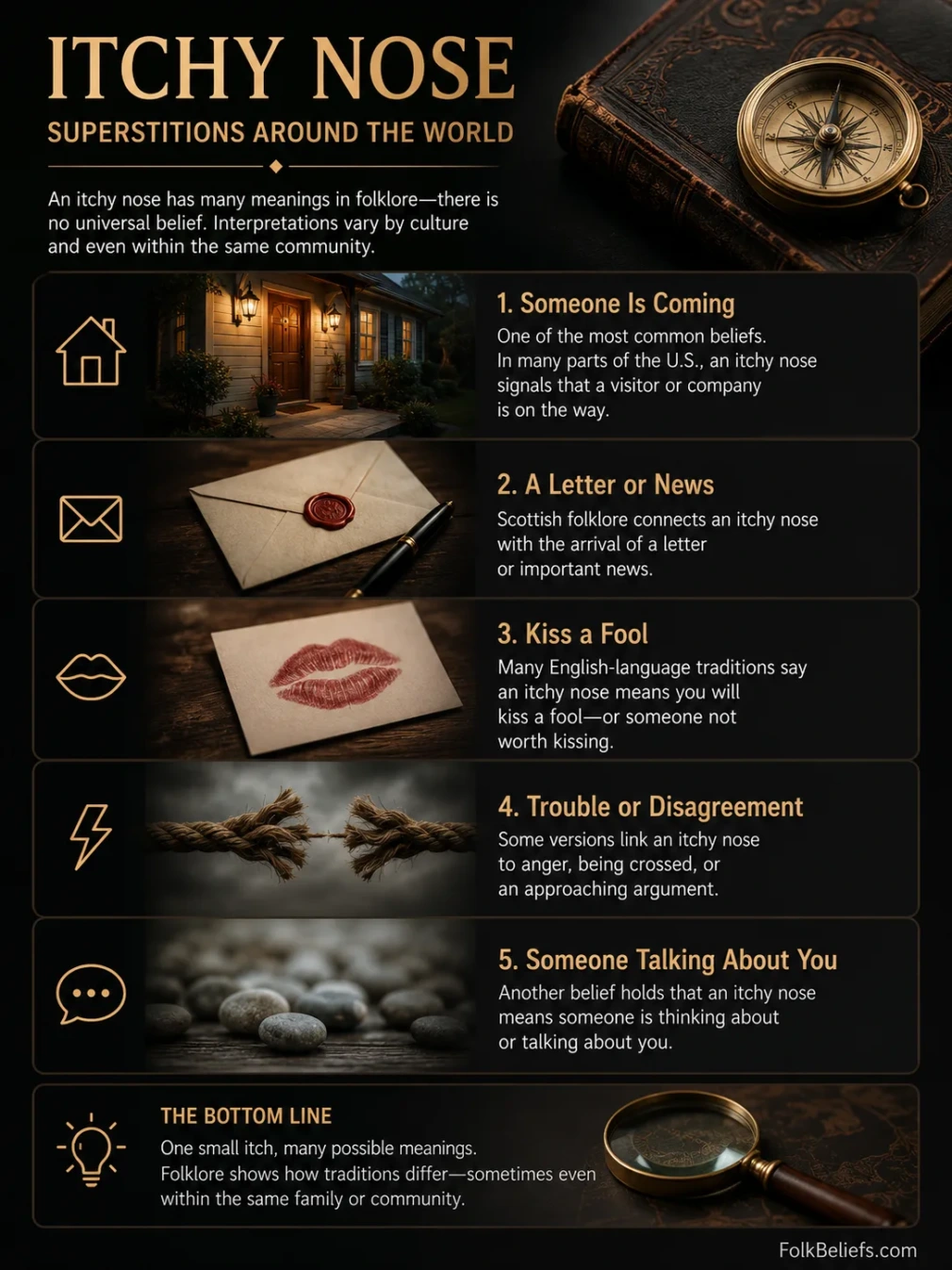
An itchy nose has carried very different meanings in recorded folklore. In some traditions it announces a visitor; elsewhere it points to a kiss, a letter, gossip, irritation, or an approaching disagreement. Historical collections also show that the same community can preserve several competing versions. There is therefore no universal itchy-nose superstition shared across cultures or even across neighboring families.[1]
When an Itchy Nose Means Someone Is Coming
The expectation of a visitor is one of the better-documented interpretations. The James T. Callow Folklore Archive at the University of Detroit Mercy contains records from Pennsylvania, Michigan, West Virginia, Tennessee, Kentucky, Missouri, and other locations in which an itching nose predicts company, a visitor, or someone coming to the house.[1]
A Kentucky family tradition collected by the Dartmouth Folklore Archive gives the belief simply as, “If your nose itches, you’ll soon have company.” The informant traced the saying through his great-grandmother, showing how a short bodily omen can survive through family transmission without needing a detailed explanation.[2]
The visitor interpretation also appears in a Federal Writers’ Project folklore record preserved by the Library of Congress. In material collected from an elderly African American informant in Texarkana, Arkansas, an itching nose was recorded as indicating that someone was coming to visit. The record should be read as evidence for that particular informant and collecting context, not as proof that all African American communities held the same belief or that the belief necessarily originated in Africa.[3]
The “Kiss a Fool” Tradition
Another widespread English-language version connects an itchy nose with kissing. Fanny D. Bergen’s 1896 collection Current Superstitions records several North American variants. One Prince Edward Island rhyme says that an itching nose may mean becoming angry, seeing a stranger, kissing a fool, or encountering danger. A Massachusetts version similarly associates it with seeing a stranger and kissing a fool, while another Massachusetts entry gives the prediction as being “kissed, cussed, or vexed.”[4]
The saying was not limited to nineteenth-century collections. The Callow archive preserves numerous twentieth-century American records stating that a person whose nose itches will kiss a fool. Other entries combine the kiss with a coming fight or anger, showing that short folk sayings often circulated in several forms at once.[1]
An English folklore collection published in 1881 gives yet another cluster of meanings. T. F. Thiselton-Dyer wrote that an itching nose could announce a stranger, while in the north of England it could mean that the person would be crossed, vexed, or kissed by a fool. He also cited an older saying in which an itching nose foretold drinking wine.[5]
Letters and News in Scottish Folklore
Scottish records give the nose itch a noticeably different role. John Gregorson Campbell’s Superstitions of the Highlands and Islands of Scotland describes bodily sensations as traditional premonitions and states that an itching nose foretells the arrival of a letter.[6]
Other nineteenth- and early twentieth-century Scottish collections preserve similar material. This makes the “letter is coming” interpretation especially useful as an example of why itchy-nose folklore should not be reduced to the familiar visitor or kissing sayings found in many North American records.
Does an Itchy Nose Mean Someone Is Talking About You?
Yes, that interpretation is documented too, but it is one variant rather than a fixed rule. A USC Digital Folklore Archives record describes a family belief that an itching nose means someone is thinking about or talking about you. The informant had learned it through her mother and grandmother.[7]
The same USC record is useful because the collector had also encountered another version in which an itchy nose meant that the person would kiss a fool. Two interpretations could therefore circulate among people living in the same broader social environment. The sensation stayed the same while the predicted event changed.
Left and Right Nose Itching Meanings
Online explanations often present the left and right sides of the nose as though each has a settled meaning. Folklore records do not support such a simple rule.
| Recorded Variant | Meaning | Collection Context |
|---|---|---|
| Left side | Someone is speaking unfavorably about you | Detroit-area archive record |
| Right side | Someone is saying favorable things about you | Same Detroit-area record |
| Whole nose | People are talking about you generally | Same Detroit-area record |
| Right nostril | A woman is coming to visit | Another Detroit record |
| Left nostril | A man is coming to visit | Another Detroit record |
| Right nostril | A letter or call from a man | Nashville, Tennessee record |
| Left nostril | A letter or visit from a woman | Nashville, Tennessee record |
These variants appear within the same university folklore archive.[1] They show why claims such as “the right side always means good luck” or “the left nostril always predicts a man” should be treated cautiously. Side-specific meanings belong to particular sayings and collecting contexts.
A Very Different Meaning in Greek-Speaking Macedonia
George Frederick Abbott’s 1903 Macedonian Folklore, based mainly on research among Greek-speaking communities in Macedonia in 1900–1901, provides a sharp contrast. Abbott compares the nose omen with Scottish and American parallels and records that, in the Macedonian material he collected, itching of the nose foretold corporal chastisement.[8]
This historical example does not establish a belief for everyone in Macedonia then or now. Abbott was recording folklore from particular communities and informants. It does, however, demonstrate how far the meaning of the same bodily sensation could shift between traditions.
Why the Same Itch Produces Different Omens
Short bodily omens are especially easy to transmit in conversation. They require no object, ceremony, or lengthy story. A person feels an itch, someone repeats a familiar saying, and the association can become part of family memory.
The surviving records also suggest that variation is normal. An itchy nose may predict company in one household and a kiss in another. A collector may find one meaning in Tennessee and another in Michigan, while an older Scottish source connects the sensation with a letter. Even left-right distinctions can contradict each other.
For that reason, geographical labels need care. A belief recorded in Kentucky is evidence of a Kentucky informant or family tradition; it does not automatically become “the Kentucky meaning.” Likewise, a nineteenth-century Scottish record should not be treated as a rule followed by all Scottish people.
What an Itchy Nose Means Outside Folklore
Folklore meanings are not medical explanations. An itchy nose can have ordinary physical causes. The NHS lists an itchy nose among the common symptoms of allergic rhinitis, which can be triggered by allergens such as pollen, house dust mites, animal dander, and mould.[9]
A passing itch can still prompt an old family saying, but the saying should be understood as folklore rather than a reliable prediction of visitors, gossip, romance, letters, or future events.
Sources and Records
- ↑1a ↑1b ↑1c ↑1d University of Detroit Mercy Libraries, James T. Callow Computerized Folklore Archive, itching-nose records,
- ↑2 Dartmouth Folklore Archive, “If your nose itches, you’ll have company”,
- ↑3 Library of Congress, Federal Writers’ Project, Arkansas folklore material,
- ↑4 Fanny D. Bergen, Current Superstitions: Collected from the Oral Tradition of English Speaking Folk,
- ↑5 T. F. Thiselton-Dyer, Domestic Folk-lore,
- ↑6 John Gregorson Campbell, Superstitions of the Highlands and Islands of Scotland,
- ↑7 USC Digital Folklore Archives, “Superstition/Folk Belief”,
- ↑8 G. F. Abbott, Macedonian Folklore,
- ↑9 NHS, “Allergic rhinitis”,
Documented Locations
Countries: Brazil, Cuba, Eritrea, Iraq, Italy, Jamaica, Morocco, Russia, Turkey, Turkmenistan, United States
These labels identify where a version has been documented. They do not mean that everyone in the country, region, or community shares the belief.