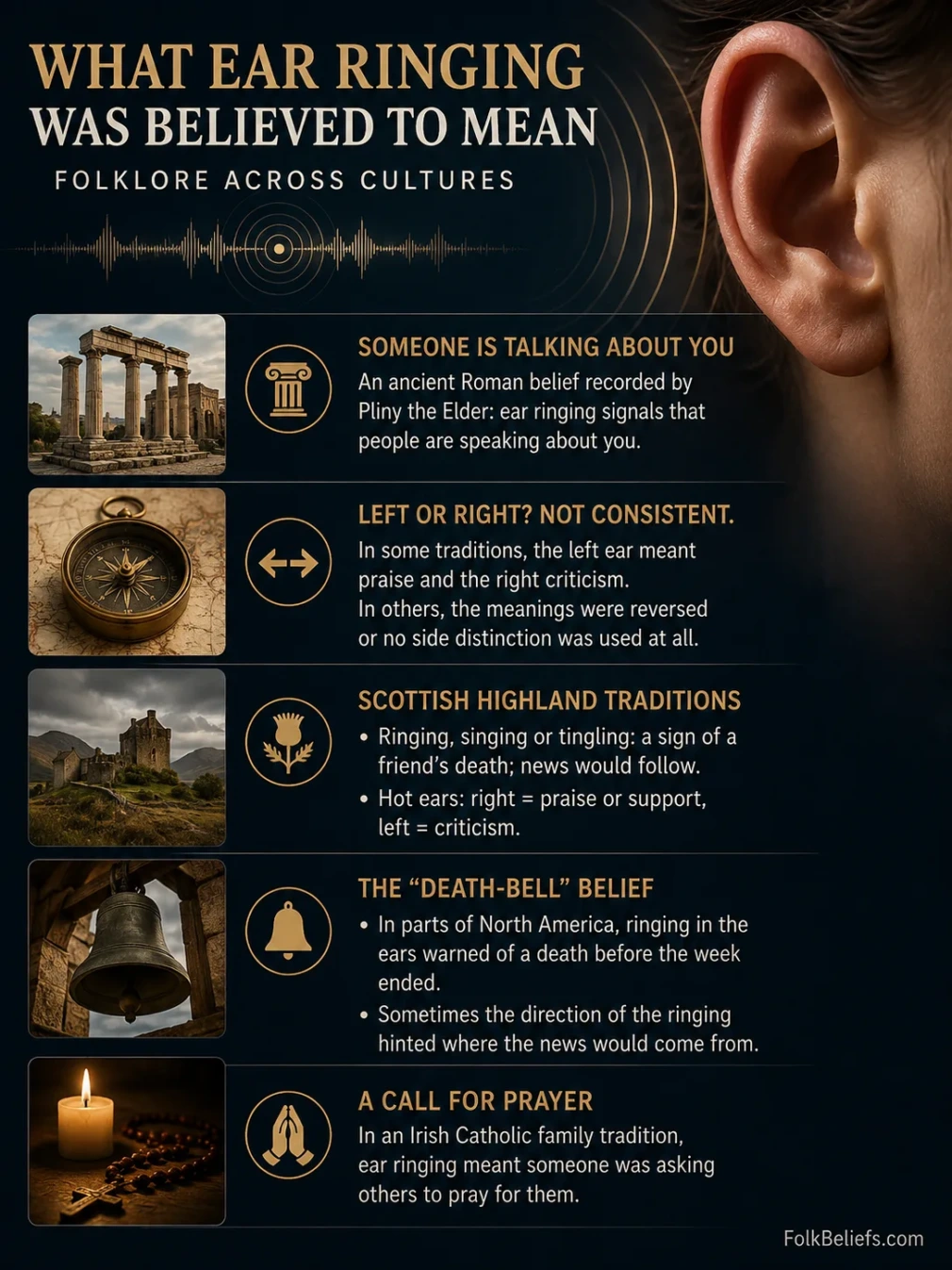
Ear ringing has carried very different meanings in recorded folklore. One of the oldest surviving Western references links the sensation with people speaking about an absent person, but later traditions also interpret it as praise, criticism, news of a death, a request for prayer, or a warning that calls for divination. Pliny the Elder recorded the distant-conversation belief in the first century CE.[1]
There is no single traditional rule saying that the right ear always has one meaning and the left ear another. Historical collectors found the assignments reversing from place to place, while some traditions did not use a left-right distinction at all.
The Roman Belief: Someone Is Talking About You
Pliny the Elder included ear ringing among everyday popular beliefs in Natural History, Book 28. His account says, in effect, that people accepted ringing in the ears as a way of sensing that absent people were talking about them.[1]
This early record matters because it contains the basic idea still familiar in later folklore: a sensation in the ear corresponds to distant speech about the person experiencing it. The surviving passage itself does not give the familiar rule that one ear means praise and the other criticism. Those directional interpretations appear in later records and are far less consistent.
Left and Right Meanings Can Reverse
G. F. Abbott encountered exactly this problem while recording folklore in the Greek-speaking parts of Macedonia around the beginning of the twentieth century. He wrote that ringing or tingling in the ears meant that absent friends were speaking about the person. In some localities, the left ear meant favorable speech and the right unfavorable speech. Elsewhere, Abbott found the interpretation reversed.[2]
So what does left or right ear ringing mean in superstition? The documented answer depends on the particular tradition. A fixed internet-style formula such as “right is always good, left is always bad” does not match the historical record.
Abbott also noted that comparable ideas were known in English districts and referred to an ancient Greek parallel. His account is especially useful because the disagreement was already present within the area he studied rather than appearing only when comparing distant countries.
Scottish Highland Folklore Separates Ringing From Hot Ears
John Gregorson Campbell’s collection from the Scottish Highlands and Islands gives ear sensations a different set of meanings. In the oral material he recorded, singing or tingling in the ears could foretell news of a friend’s death. The belief held that the friend had died around the time the sensation occurred and that word of the death would arrive later.[3]
Campbell separately described hot ears as a sign that somebody was discussing a person’s character. Here the right side was favorable: a hot right ear meant support or praise, while a hot left ear meant criticism.[3]
This distinction is easy to lose when old beliefs are retold today. Historical collections may speak of ears that ring, sing, tingle, burn, or become hot. A meaning documented for one sensation should not automatically be transferred to all the others.
The “Death-Bell” in North American Records
Death-related interpretations were not confined to Scotland. Fanny D. Bergen’s 1896 collection of English-speaking oral superstitions records the general statement that ringing in the ears was a sign of death. A more detailed Northern Ohio version said that the ringing meant a death would occur or become known before the week ended, and the sensation was called a “death-bell.” Bergen also recorded the term “death-bell” from Prince Edward Island and noted a variant in which the apparent direction of the ringing indicated where the news would come from.[4]
These records show why geographic precision matters. They document beliefs collected from particular English-speaking communities in the United States and Canada; they do not establish one rule shared by everyone in either country.
An Irish Catholic Family Tradition: A Request for Prayer
A much later record in the USC Digital Folklore Archives preserves a different interpretation from one informant raised in Wales by Irish parents. She recalled being taught that ringing in an ear meant souls in purgatory were calling for prayers. According to the account, her mother had learned the belief from the previous generation.[5]
This is best understood as a documented family and Irish Catholic folk tradition, not as a rule that can be assigned to all Irish people or all Catholics. Its meaning differs sharply from the gossip and death-omen interpretations found in other records.
An Italian Family Variant Adds a Guessing Practice
A 2021 USC folklore record from an Italian informant in Bologna preserves the familiar idea that ear ringing means someone is thinking or talking about you. In her family tradition, the right ear indicated positive talk and the left negative talk.[6]
The same account includes a small divinatory game. Someone present could choose a number from 1 to 21, which was matched with a letter and treated as the initial of the person supposedly doing the talking or thinking. The informant also associated this guessing process with making the ringing stop.[6]
Again, this is evidence for one transmitted family practice. It should not be expanded into a universal Italian superstition.
Early Chinese Divination Used Ear Ringing Differently
Material from early China shows that ear ringing could enter divination without carrying the European “someone is talking about you” explanation. Adam Craig Schwartz’s study of Shang-period Huāyuánzhuāng East oracle-bone inscriptions includes repeated divinations concerning a lord’s ringing ear. Some inscriptions test whether the ringing is “without harm”, placing the bodily sensation within a wider process of determining danger, well-being, and the proper response to uncertain events.[7]
This evidence belongs to a specific ancient divinatory setting. It does not support modern claims that there is one timeless “Chinese ear-ringing meaning” based on left versus right, time of day, luck, or gossip.
What the Different Records Associate With Ear Ringing
- Ancient Rome: absent people are talking about you.
- Greek-speaking Macedonia: absent friends are talking about you; favorable and unfavorable sides vary by locality.
- Scottish Highlands and Islands: ringing or tingling can announce a friend’s death, while hot ears relate to praise or criticism.
- Recorded North American traditions: ringing can function as a “death-bell” or omen of death news.
- One Irish Catholic family tradition: souls in purgatory are asking for prayer.
- One Italian family tradition: someone is thinking or talking about you, with right favorable and left unfavorable.
- Early Chinese oracle-bone divination: ear ringing can be treated as a bodily event whose possible harm is tested through divination.
Folklore and Tinnitus Are Different Questions
Folklore gives symbolic meanings to an unexplained bodily sensation; it does not establish its physical cause. In medical use, tinnitus means perceiving sound without an external sound source. It may be heard as ringing, buzzing, roaring, whistling, humming, clicking, hissing, or other sounds, and it can occur in one ear, both ears, or the head.[8]
Brief ear ringing therefore does not demonstrate that someone is speaking about you, that news is coming, or that an omen has occurred. Those interpretations belong to the documented folklore traditions above. Ringing that is persistent, worsening, or otherwise concerning is a health matter rather than something folklore can diagnose.
Sources and Records
- ↑1a ↑1b Pliny the Elder, Natural History, Book 28, section 24. The passage records the belief that ringing ears reveal conversations about an absent person.
- ↑2 G. F. Abbott, Macedonian Folklore,
- ↑3a ↑3b John Gregorson Campbell, Superstitions of the Highlands and Islands of Scotland,
- ↑4 Fanny D. Bergen, ed., Current Superstitions: Collected from the Oral Tradition of English-Speaking Folk,
- ↑5 USC Digital Folklore Archives, “Catholic-Irish ‘Ear Ringing’”,
- ↑6a ↑6b USC Digital Folklore Archives, “Ear Are Ringing, Words Are Singing”,
- ↑7 Adam Craig Schwartz, “A Glimpse of China’s Earliest Decision-Making: The Meaning of Zhēn 貞 ‘Test’ in the Huāyuánzhuāng East Oracular Inscriptions”,
- ↑8 National Institute on Deafness and Other Communication Disorders, “Tinnitus”,
Documented Locations
Countries: Argentina, Bahamas, Canada, Cuba, Dominica, France, Germany, Greece, Haiti, Iraq, Italy, Jamaica, Luxembourg, Mexico, Nepal, Peru, Philippines, Poland, Romania, Spain, Thailand, Turkey, Turkmenistan, United States
These labels identify where a version has been documented. They do not mean that everyone in the country, region, or community shares the belief.