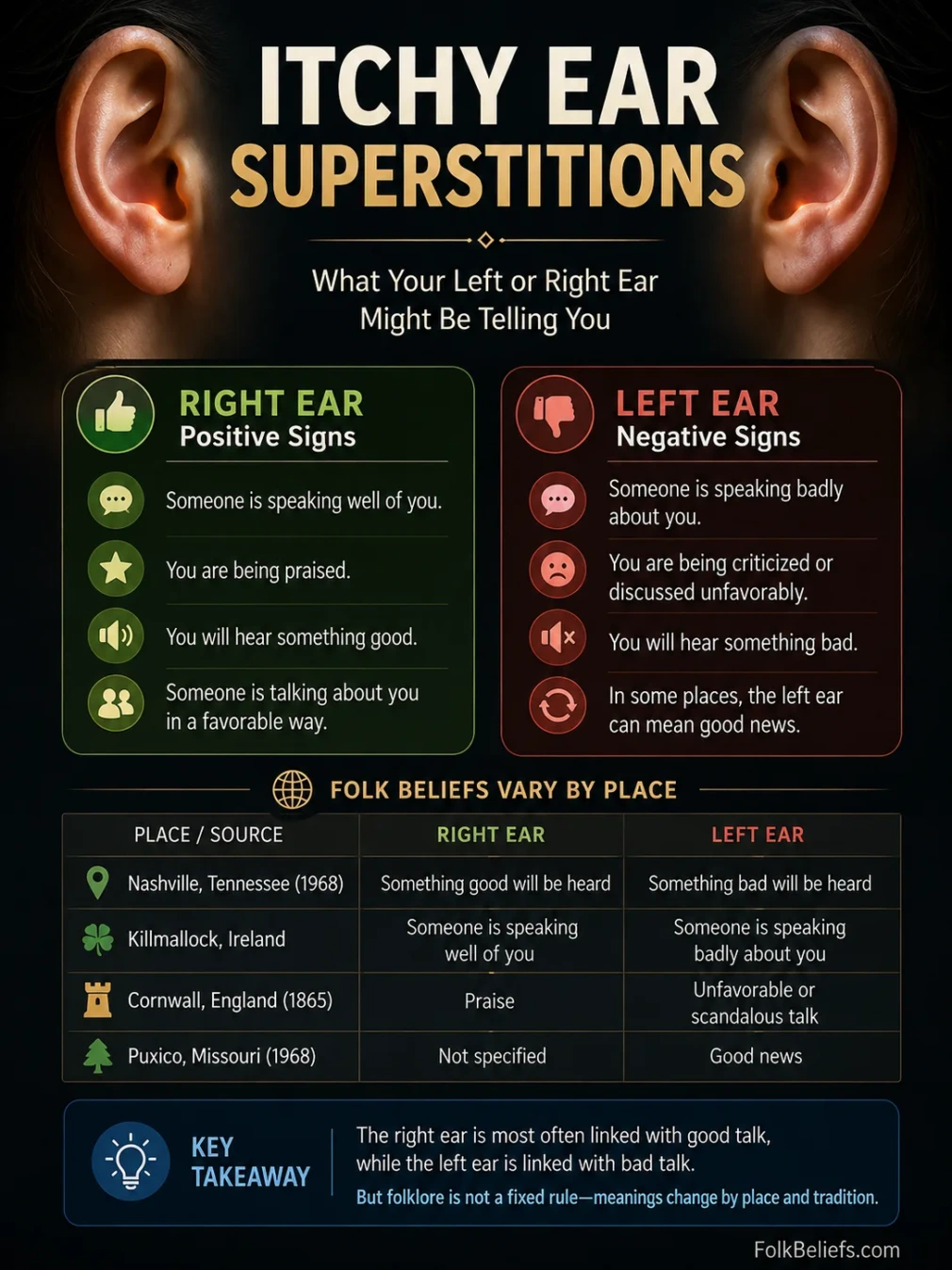
An itchy ear is often interpreted in folk belief as a sign that another person is talking about you. In one widely recorded pattern, the right ear is linked with praise, pleasant talk, or good news, while the left ear is linked with criticism, unpleasant talk, or bad news. Folklore records do not support treating that pattern as a universal rule. Some collections preserve different meanings, including a left-ear itch that predicts good news.[1]
What Does an Itchy Right Ear Mean?
The favorable interpretation of the right ear appears in several documented traditions. Records in the James T. Callow Folklore Archive include a belief learned in Nashville, Tennessee, in 1968 that an itching right ear means the person will hear something good. The same archive also preserves a version in which a right-ear itch means that somebody is saying good things about the person.[1]
An Irish record collected at Killmallock Convent School in County Limerick gives a closely related meaning: an itchy right ear was recorded as a sign that someone was speaking well of the affected person.[2]
Right Ear: Recorded Meanings
- Someone is speaking well of you.
- You are being praised.
- You will hear something good.
- Someone is talking about you, with the right side giving the favorable version.
The association is also present in nineteenth-century English-language folklore collections. Robert Hunt’s 1865 collection of Cornish traditions states that when the ears become red and itchy, the right ear means the person is being praised.[3]
What Does an Itchy Left Ear Mean?
The matching left-ear belief usually changes the tone of the unseen conversation. In the Nashville record paired with the favorable right-ear version, an itching left ear predicts hearing something bad. Other records connect the left side more directly with negative speech about the person.[1]
The Killmallock school collection likewise records an itchy left ear as a sign that someone is speaking badly about you.[2] Hunt’s Cornish account uses stronger wording: a red, itching left ear meant the person was being spoken about scandalously, while the right ear meant praise.[3]
Left Ear: Recorded Meanings
- Someone is speaking badly about you.
- You are being criticized or discussed unfavorably.
- You will hear something bad.
- In some local versions, the meaning changes completely and the left ear can predict good news.
The Left-versus-Right Rule Has Exceptions
Folklore does not operate as a single fixed code. Even records collected during the same period can disagree.
| Recorded Place or Source | Right Ear | Left Ear |
|---|---|---|
| Nashville, Tennessee, 1968 | Something good will be heard | Something bad will be heard |
| Killmallock, County Limerick | Someone is speaking well of you | Someone is speaking badly about you |
| Cornwall, published 1865 | Praise | Unfavorable or scandalous talk |
| Puxico, Missouri, 1968 | Not specified in the cited record | Good news |
The Missouri example is especially useful because it prevents the familiar left-equals-bad formula from being mistaken for a universal tradition. The Callow archive records a belief learned in Puxico in July 1968 stating simply that an itching left ear means good news is coming.[1]
A late nineteenth-century American collection shows both the durability of the favorable-right/unfavorable-left version and the way small additions could develop around it. Fanny D. Bergen’s Current Superstitions, published in 1896, records in Cambridge, Massachusetts, that an itching left ear meant someone was saying unpleasant things, while an itching right ear meant pleasant things. The same entry notes a rhyme giving both sides a favorable meaning at night.[4]
Why Is Ear Itching Connected With People Talking About You?
The recurring idea is based on a symbolic link between the ear as the organ of hearing and speech happening beyond the person’s awareness. An unexplained sensation in the ear becomes a sign of words that cannot actually be heard: praise, gossip, criticism, news, or the mention of one’s name.
This association appears in records that do not distinguish between left and right at all. The Callow archive contains several versions stating only that when an ear itches, somebody is talking about the person or mentioning that person’s name.[1]
William Henderson’s nineteenth-century collection from northern England offers another related form. It records itching of the ear as a sign of hearing sudden news, while tingling is given the more specific left-right division: the right ear indicates favorable speech and the left unfavorable speech.[5]
Itching, Burning, Tingling, and Ringing Are Not Always the Same Belief
Ear folklore often places itching beside burning, heat, tingling, or ringing, but historical records do not always assign identical meanings to those sensations. They should not automatically be merged into one superstition.
For example, Bergen’s collection gives the right-ear-good and left-ear-bad pattern for both burning and itching, but other historical sources distinguish itching from tingling or assign different outcomes to them.[4] The Callow archive also contains records in which itching predicts good or bad news, records where it means someone is talking, and other ear-sensation traditions with different outcomes.[1]
Folklore distinction: an itchy right ear does not have one fixed meaning everywhere, and neither does an itchy left ear. The most repeatedly documented contrast is favorable speech on the right and unfavorable speech on the left, but local and family traditions can reverse, simplify, or replace that interpretation.
Does an Itchy Ear Really Mean Someone Is Talking About You?
No evidence shows that an ear itch can reveal whether another person is praising, criticizing, or thinking about you. These meanings belong to folklore rather than to a physical mechanism.
Ear itching itself can have ordinary causes. Cleveland Clinic notes possibilities such as over-cleaning, skin conditions including eczema, infections, allergies, and irritation from materials such as nickel in earrings. Persistent itching, or itching accompanied by pain or discharge, can warrant medical attention rather than a folkloric interpretation.[6]
The left-versus-right meanings are best understood as recorded belief variants, not predictions. A person may inherit one version through family or local tradition even when a different version was documented nearby or during the same period.
Sources and Records
- ↑1a ↑1b ↑1c ↑1d ↑1e ↑1f University of Detroit Mercy Libraries, James T. Callow Folklore Archive, “Itching Ear” records,
- ↑2a ↑2b National Folklore Collection, UCD, “Local Omens,” Killmallock Convent School,
- ↑3a ↑3b Robert Hunt, Popular Romances of the West of England; or, The Drolls, Traditions, and Superstitions of Old Cornwall,
- ↑4a ↑4b Fanny D. Bergen, ed., Current Superstitions: Collected from the Oral Tradition of English Speaking Folk,
- ↑5 William Henderson, Notes on the Folk-Lore of the Northern Counties of England and the Borders,
- ↑6 Cleveland Clinic, “6 Causes and Remedies for Itchy Ears”,
Documented Locations
Countries: Afghanistan
These labels identify where a version has been documented. They do not mean that everyone in the country, region, or community shares the belief.