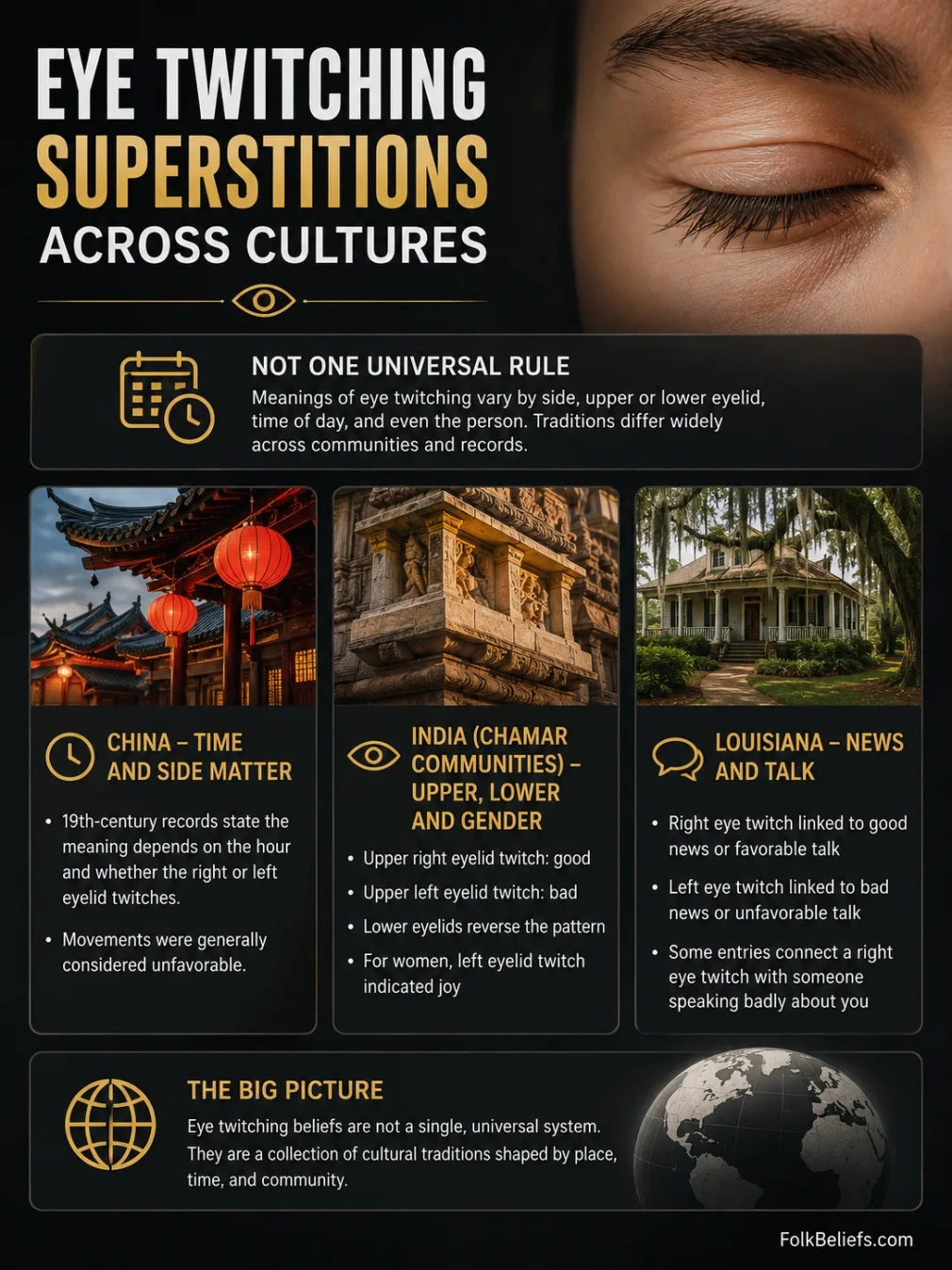
Eye twitching superstitions do not follow one worldwide rule. A twitch may be read through the left or right eye, upper or lower eyelid, time of day, or the person experiencing it. Historical collections also disagree with one another, and sometimes a single folklore record preserves conflicting meanings. The familiar idea that one eye is always lucky and the other always unlucky is therefore only one form of a much wider group of beliefs.
There Is No Universal Left-Eye or Right-Eye Meaning
Many modern explanations reduce eye-twitching folklore to a simple pair: one side predicts good fortune and the other predicts trouble. Older records are less tidy. Some make the meaning depend on the hour. Others distinguish the upper eyelid from the lower one. Gender can also change the interpretation.
This variation matters because an eye-twitching belief documented in one community should not automatically be described as the belief of an entire country. The surviving records show a collection of related omen traditions rather than a single system shared across cultures.
Chinese Records Combine the Side of the Eye with the Time
N. B. Dennys described bodily omens in The Folk-Lore of China, published in 1876. His account says that an eyelid moving involuntarily could indicate good or bad luck according to both the hour when it happened and whether the right or left eyelid moved. Dennys added that such movements were generally treated as unfavorable in the material he described.[1]
That historical description is more complicated than a popular Chinese saying encountered today, commonly expressed as the left eye bringing wealth and the right eye bringing trouble. The two should not be treated as identical traditions. The older record preserves a time-dependent system, while the modern saying compresses the omen into a left-versus-right formula.
What changes the Chinese interpretation? In the nineteenth-century record, the side of the eyelid alone was not enough. The time of the twitch also affected its meaning.[1]
A 1920 Chamar Record Separates Upper and Lower Eyelids
George Weston Briggs recorded a different pattern in his 1920 study The Chamars. In the community material he presented, twitching of the upper right eyelid indicated good, while the upper left indicated ill. For the lower eyelids, the meanings were reversed. The same passage separately states that twitching of a woman’s left eyelid indicated joy.[2]
This record shows why broad statements such as “in India, the right eye means good luck” lose important information. Briggs was documenting beliefs associated with Chamar communities, not establishing a rule followed by every population in India. His account also shows that upper versus lower eyelid could matter as much as left versus right.
| Documented Record | Feature Used to Read the Twitch | Recorded Interpretation |
|---|---|---|
| China, 1876 account | Right or left eyelid plus the hour | Good or bad fortune depended on both variables; the author described the omen as generally unfavorable. |
| Chamar communities, 1920 account | Upper or lower eyelid, right or left side, and in one entry gender | Upper right was favorable and upper left unfavorable; the lower lids reversed the pattern. |
| Louisiana, 1927 collection | Right or left eye | Entries connect eye jumping with news or with what another person is saying about the individual. |
Louisiana Folklore Links a Jumping Eye with News and Gossip
Hilda Roberts’s 1927 collection Louisiana Superstitions contains eye-jumping beliefs among hundreds of recorded omens. The material does not produce a perfectly consistent right-left code. One preserved entry associates a jumping right eye with someone speaking badly about the person.[3]
Other material from the same collection, discussed by anthropologist Krystal D’Costa, pairs a jumping right eye with hearing good news and a jumping left eye with hearing bad news. Another pairing connects the right eye with favorable talk and the left with unfavorable talk.[4]
The disagreement is useful folklore evidence in its own right. Oral beliefs can coexist in several forms. A superstition does not need a single fixed interpretation to circulate within a region.
Trinidadian Eye-Jumping Beliefs Center on Social News
D’Costa also describes eye “jumping” from her own Trinidadian cultural experience. In the versions she records, the right eye may anticipate good news, favorable comments, or seeing someone after a long absence. The left eye may be associated with bad news, criticism, concern about a friend or loved one, or something happening without the person’s knowledge.[4]
She explicitly notes that at least one interpretation can also be heard in reverse. That observation makes the Trinidadian material especially useful for understanding how superstition works in practice: people may recognize the same bodily sign while disagreeing about exactly what it predicts.
What Eye-Twitching Omens Commonly Predict
Although the rules differ, the documented examples tend to place an involuntary eyelid movement into a small number of everyday concerns:
- Good or bad fortune: the twitch becomes a general omen about what may happen next.
- News: some traditions connect the movement with receiving favorable or unfavorable information.
- Other people’s words: the twitch may supposedly indicate praise, criticism, or gossip taking place elsewhere.
- Social encounters: some versions associate it with meeting or hearing from another person.
- Timing: an otherwise identical twitch can receive a different meaning depending on when it occurs.
- Body location: left versus right, or upper versus lower eyelid, may completely reverse the omen.
These repeated themes help explain why two lists of “eye twitching meanings” can contradict each other without either reflecting an error in transmission. They may come from different local traditions, different informants, or different versions circulating at the same time.
Eye Twitching in Folklore Is Not a Medical Diagnosis
An omen interpretation belongs to folklore. An involuntary eyelid twitch also has an ordinary physical description: eyelid myokymia is a fine, involuntary contraction of an eyelid muscle. Medical sources associate episodes with factors such as tiredness, stress, insufficient sleep, eye strain, dry or irritated eyes, and caffeine. Mild episodes commonly resolve on their own.[5]
The folklore meanings do not establish that a twitch predicts wealth, visitors, gossip, bad news, or any other future event. Persistent twitching, difficulty opening the eye, changes in vision, or stronger spasms belong to eye care rather than omen interpretation.[5]
A 2026 Case Shows Why the Distinction Matters
The separation between belief and physical eye care became unusually visible in 2026. News reports described a man in Wuhan who became worried about the popular saying that a twitching right eyelid foretells trouble. According to the report, he repeatedly struck the area around the eye in an attempt to counter the perceived omen and later required treatment for a retinal detachment.[6]
The episode does not tell us whether the saying is representative of every Chinese community. It does show that the simplified “left brings wealth, right brings disaster” version remains recognizable enough to influence behavior. Folklore can be recorded and understood without treating a bodily sensation as a prediction or attempting to physically stop an omen.
Sources and Records
-
N. B. Dennys, The Folk-Lore of China, and Its Affinities with That of the Aryan and Semitic Races, Hong Kong: China Mail Office, 1876. The section on bodily omens records involuntary eyelid movement as dependent on the hour and the affected side.
Digitized copy
↑a ↑b -
George Weston Briggs, The Chamars, Religious Life of India series, Calcutta: Association Press, 1920. The bodily-omen material distinguishes right and left as well as upper and lower eyelids.
Digitized copy
↑ -
Hilda Roberts, “Louisiana Superstitions”,
JSTOR record
↑ -
Krystal D’Costa, “Anatomy of a Superstition: When Your Eye ‘Jumps’”, The discussion records Trinidadian variants and cites Roberts’s 1927 Louisiana collection.
Source page
↑a ↑b -
American Academy of Ophthalmology, “What Is an Eyelid Spasm or Twitching Eyelid?” Medical information on eyelid twitching, common triggers, and when evaluation may be appropriate.
American Academy of Ophthalmology
↑a ↑b -
South China Morning Post, “Fearing ‘bad luck’ omen, Chinese man repeatedly slaps twitching right eye, damaging vision”,
Source page
↑
Documented Locations
Countries: Afghanistan, Azerbaijan, Brazil, Chile, Cuba, Germany, Greece, Haiti, India, Iraq, Italy, Jamaica, Morocco, Nepal, Pakistan, Romania, Sri Lanka, Thailand, Turkey, United States
These labels identify where a version has been documented. They do not mean that everyone in the country, region, or community shares the belief.