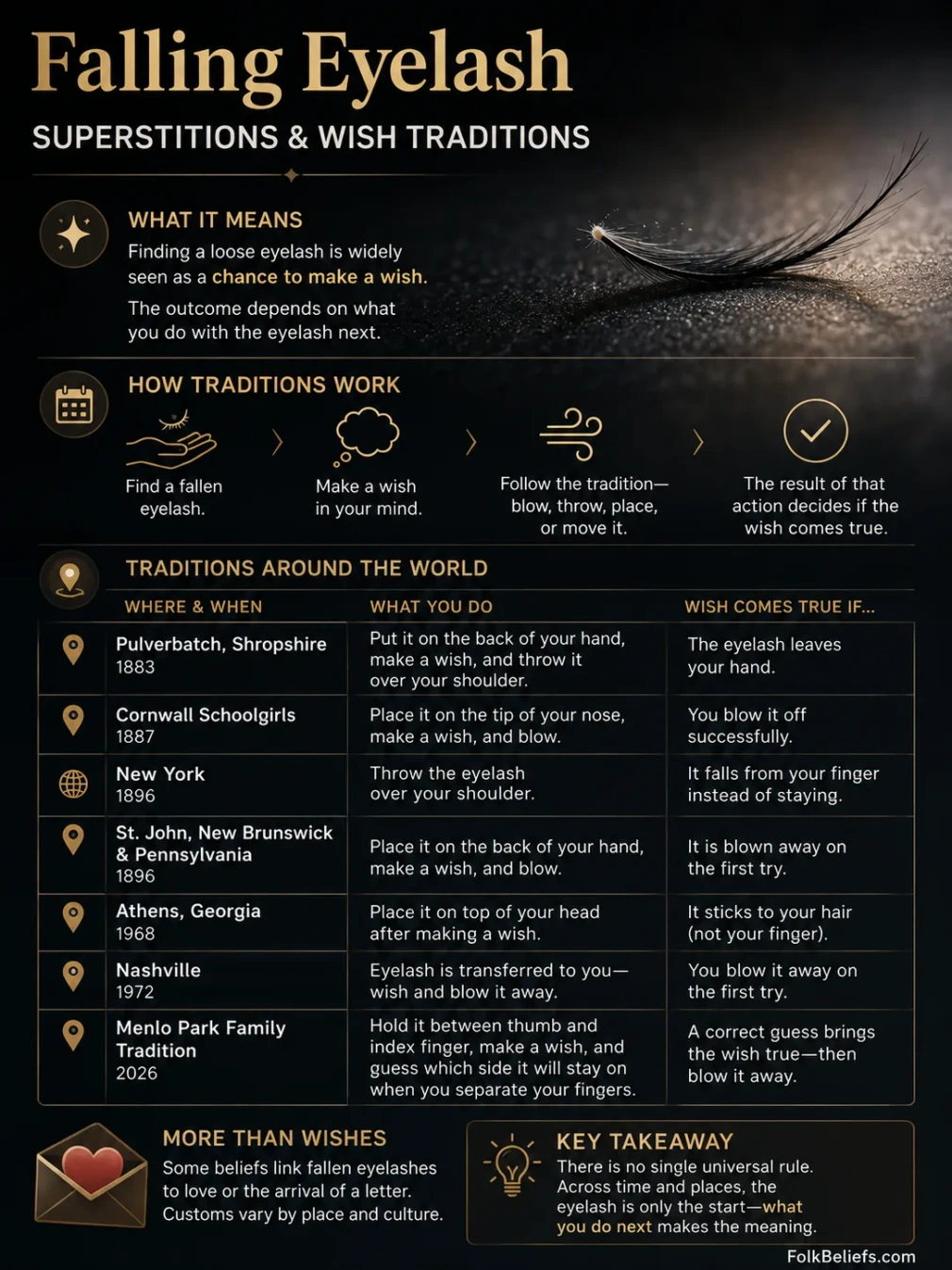
Finding a loose eyelash has often been turned into a small wishing ritual: make a wish, then blow the lash away, throw it over a shoulder, move it between the fingers, or place it on the hair. Historical and archival records show many different rules rather than one universal eyelash superstition. In some versions the lash offers a chance to make a wish; in others it becomes part of a love test or an omen about receiving a letter.
What Does a Falling Eyelash Mean in Superstition?
The most repeated meaning in the records examined here is a chance to make a wish. Late nineteenth-century examples from Pulverbatch in Shropshire, Cornwall, and several named North American localities all connect a loose or fallen eyelash with wishing, but each record gives its own method for deciding whether the wish will come true.[1][2][3]
The lash itself is usually only the starting point. What happens next matters. A tradition may require the eyelash to leave the hand, disappear over the shoulder, blow away on the first attempt, stick to the hair, or remain on a particular finger. The physical movement turns the wish into a small test of chance.
These records also do not establish a fixed rule in which a lash from the left eye always means one thing and a lash from the right eye always means another. In the documented examples below, the deciding detail is more often what is done with the eyelash after it is found.
Recorded Eyelash-Wish Rules by Place and Date
The following examples are individual local, family, or collected folklore records. They show how widely the procedure can vary without implying that everyone in the named place followed the same custom.
| Record | What Is Done With the Eyelash | Wish Rule |
|---|---|---|
| Pulverbatch, Shropshire, 1883 | Put it on the back of the hand, make a wish, and throw it over the shoulder. | If the eyelash leaves the hand, the wish is expected to come true.[1] |
| Cornwall schoolgirl tradition, 1887 | Put the fallen lash on the tip of the nose, wish, and blow at it. | Blowing it off successfully means the wish will be granted.[2] |
| New York, recorded in an 1896 collection | Throw the eyelash over the shoulder. | The wish comes true if the lash falls from the finger rather than remaining there.[3] |
| St. John, New Brunswick, and Pennsylvania, recorded in 1896 | Place the stray lash on the back of the hand, make a wish, and blow. | The wish succeeds if the eyelash is blown away on the first attempt.[3] |
| Athens, Georgia, learned in 1968 | Place the eyelash on top of the head after making a wish. | If it sticks to the hair, the wish will come true; if it remains on the finger, it will not.[4] |
| Nashville record, 1972 | An eyelash is plucked, transferred between two people, and the person who receives it wishes and blows it away. | Blowing the lash away on the first try is the successful outcome.[5] |
| Menlo Park family tradition, recorded in 2026 | Hold the eyelash between the thumb and index finger, make a wish, and guess which side it will remain on when the fingers separate. | A correct guess allows the wish to come true; the lash is then blown away.[6] |
The British records from the 1880s show that eyelash wishing was already being documented by folklorists in the late nineteenth century. They do not establish where the custom first began, and the differing instructions make a single place of origin difficult to support from these records alone.
Some Eyelash Traditions Are About Letters or Love
Not every loose-eyelash belief leads directly to an ordinary wish. Fanny D. Bergen’s 1896 collection includes a New England record in which an eyelash on the back of the hand signifies a letter. The person wishes to know who the letter will come from, passes the lash around the head three times, and throws it over the shoulder. The same collection also preserves a Maine instruction to put an eyelash, described there as an “eyewinker,” inside the clothing while making a wish.[3]
A different record in the University of Detroit Mercy’s James T. Callow Folklore Archive, learned in Nashville in 1968, turns the eyelash into a love-divination game. The lash is held between the thumb and forefinger, and the participant guesses which finger it will remain on when the fingers are opened. In that particular record, a correct guess is associated with the belief that the person’s boyfriend truly loves her.[5]
These examples are useful because they prevent the tradition from being reduced to one formula. A loose eyelash could become a wish token, a message omen, or a small form of romantic divination depending on the record.
Does the Eyelash Have to Fall Naturally?
Many documented versions begin with an eyelash that has already come out or is noticed loose on the face. The 1883 Shropshire record begins when an eyelash “comes out,” while the 1887 Cornwall account describes one that “falls out.”[1][2]
That does not make natural shedding a universal folklore requirement. The Nashville record learned in 1972 explicitly starts by plucking an eyelash before two people press their fingers together and determine who receives the lash and the wish.[5] Statements that an eyelash wish always becomes invalid if the lash is deliberately removed therefore go beyond what the collected evidence supports.
Blowing, Throwing, and Guessing Create Different Tests
The recurring feature is not one required movement but the idea that the wish is followed by an uncertain physical outcome. Some traditions use a blow. Others use the shoulder, the hair, or the fingers.
- Blowing: the lash must leave the nose, hand, or finger, sometimes on the first attempt.
- Throwing over the shoulder: success may depend on the eyelash leaving the hand and disappearing from view.
- Sticking to hair: one archived Georgia version treats the lash reaching the hair as the favorable result.
- Guessing between fingers: some later records turn the wish into a choice between two possible resting places for the lash.
This changing test is one reason two people may remember “wishing on an eyelash” but disagree about the correct procedure. Their versions may come from different families, school groups, places, or periods rather than one of them remembering the custom incorrectly.
The Tradition Can Continue Without Literal Belief
Modern folklore records also show that people may perform an eyelash wish because the custom is familiar or enjoyable rather than because they expect a supernatural result. A USC Digital Folklore Archives entry based on a Chinese-American informant from Arcadia, California, describes placing a stray eyelash on a finger, making a wish, and blowing it away. The informant said she did not literally believe the wish would be granted, yet continued the practice as a familiar routine learned in childhood.[7]
The informant’s Chinese-American identity should not be turned into evidence for a general Chinese eyelash tradition; the archive documents one person’s experience in California. Likewise, the 2026 Menlo Park record describes a version remembered through the informant’s mother and her peers, showing family and peer transmission without establishing a rule for a whole region.[6]
Sources and Records
- ↑1a ↑1b ↑1c Charlotte Sophia Burne, ed., Shropshire Folk-Lore: A Sheaf of Gleanings, from collections made by Georgina F. Jackson, Trübner & Co., 1883, p. 268. The eyelash record is identified with Pulverbatch.
- ↑2a ↑2b ↑2c M. A. Courtney, “Cornish Folk-Lore”,
- ↑3a ↑3b ↑3c ↑3d Fanny D. Bergen, ed., Current Superstitions: Collected from the Oral Tradition of English Speaking Folk,
- ↑4 University of Detroit Mercy, James T. Callow Folklore Archive, “Eyelash Superstition”,
- ↑5a ↑5b ↑5c University of Detroit Mercy, James T. Callow Folklore Archive, eyelash records under P438.12,
- ↑6a ↑6b USC Digital Folklore Archives, “Wishing on an Eyelash (Top or Bottom Fingers)”,
- ↑7 USC Digital Folklore Archives, “You have an eyelash on your face, make a wish!”,
Documented Locations
Countries: Chile, Iraq, Russia, United Kingdom
These labels identify where a version has been documented. They do not mean that everyone in the country, region, or community shares the belief.