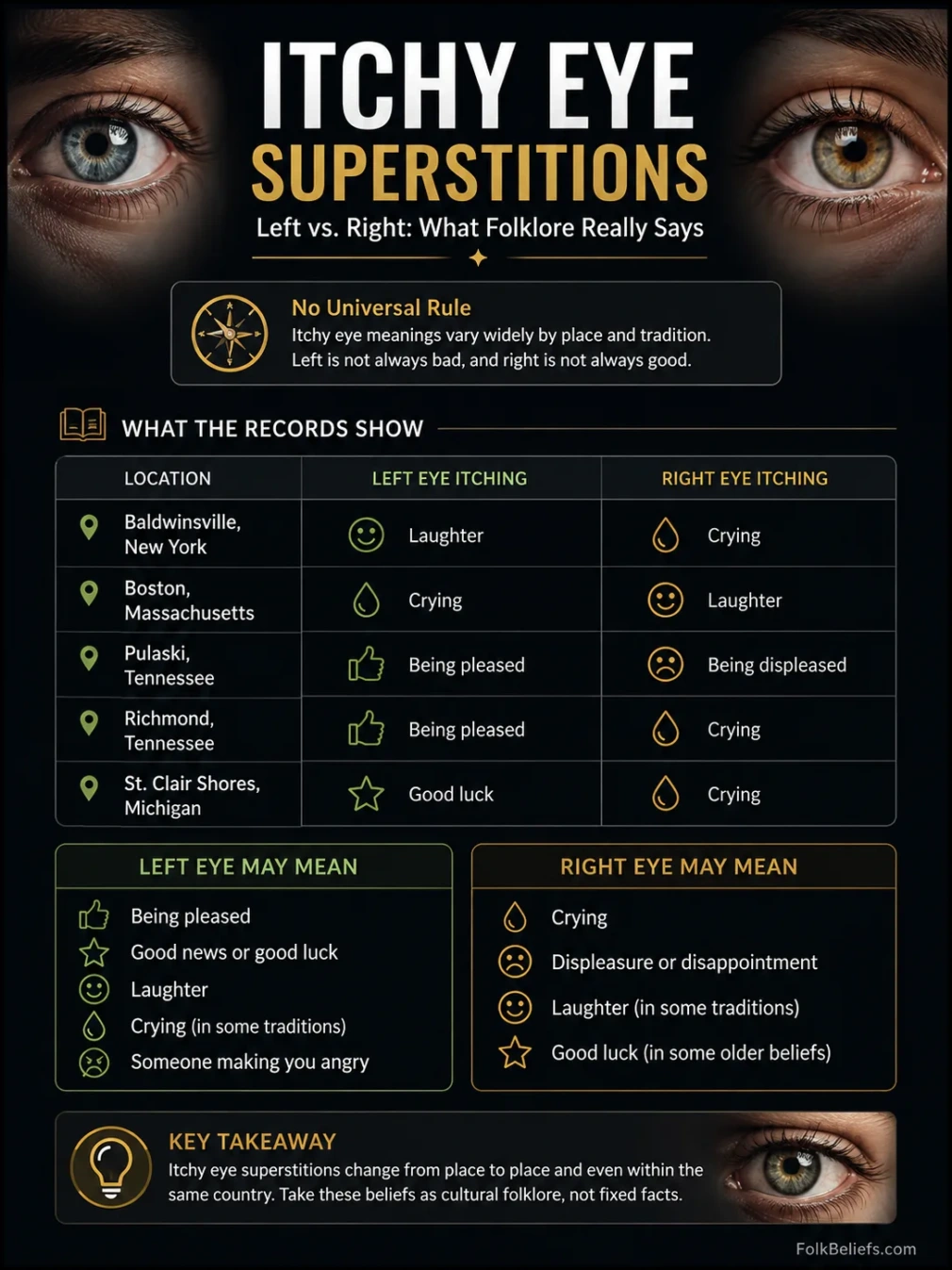
An itchy eye has been treated as an omen in several recorded folk traditions, but there is no universal rule saying that the left eye is unlucky and the right eye is lucky. Historical collections preserve opposite left-versus-right meanings even within the same country. Depending on the record, an itching eye may foretell laughter, tears, pleasure, disappointment, anger, good news, or simply an upcoming encounter.
The safest folklore reading: the meaning depends on the particular tradition and place where the belief was recorded. A modern claim such as “right eye always means good luck” or “left eye always means bad luck” does not match the surviving evidence.
Left Eye vs. Right Eye: What the Records Actually Say
One of the clearest examples comes from Fanny D. Bergen’s 1896 collection Current Superstitions. A belief recorded in Baldwinsville, New York, said that an itching right eye meant crying, while the left meant laughter. The collector even preserved a mnemonic explanation connecting “R” with “roar” and “L” with “laugh.” Yet the very next record, from Boston, Massachusetts, reverses the meaning: right eye for laughter, left eye for crying.[1]
| Recorded Place | Left Eye Itching | Right Eye Itching |
|---|---|---|
| Baldwinsville, New York | Laughter | Crying |
| Boston, Massachusetts | Crying | Laughter |
| Pulaski, Tennessee | Being pleased | Being displeased |
| Richmond, Tennessee | Being pleased | Crying |
| St. Clair Shores, Michigan | Good luck | Crying |
The Tennessee and Michigan examples come from the James T. Callow Folklore Archive at the University of Detroit Mercy. Its eye-itching records collected mainly during the 1960s and 1970s preserve several variations rather than one fixed formula.[2]
What Does an Itchy Left Eye Mean in Superstition?
The left eye cannot be assigned one reliable folkloric meaning. Several Callow Archive records associate it with pleasant outcomes. A 1968 record from Pulaski, Tennessee, says that the left eye itching means the person will be pleased. A similar record from Richmond, Tennessee, collected in 1973, gives the same interpretation. Another archive entry says that a left-eye itch foretells good news.[2]
Other records move in a different direction. An entry learned in Detroit in 1965 says that if the left eye itches, somebody will make the person angry. Bergen’s Boston record associates the left eye with crying rather than happiness.[1]
Positive Left-Eye Meanings
- Being pleased
- Receiving good news
- Good luck in one Michigan record
- Laughter in one New York record
Less Favorable Left-Eye Meanings
- Crying in one Massachusetts record
- Someone making you angry in a Detroit record
These are separate pieces of folklore, not parts of a single system. A belief recorded from one informant or locality should not be expanded into a rule for everyone living in that state, region, or country.
What Does an Itchy Right Eye Mean in Superstition?
The right eye is just as variable. Several American records connect a right-eye itch with crying, disappointment, or displeasure. Nashville and Richmond records in the Callow Archive predict crying, while the Pulaski record pairs the right eye with displeasure.[2]
That association is older than those twentieth-century records. T. F. Thiselton Dyer’s 1881 Domestic Folk-lore reports two competing ideas. He describes the itching right eye as a lucky omen in one strand of tradition, but also quotes an antiquarian rule in which the right eye predicts crying and the left predicts laughter.[3]
Bergen’s 1896 material again shows why a single answer is difficult: her Baldwinsville record assigns crying to the right eye, while the Boston record assigns laughter to it.[1]
Why Are Left and Right Meanings So Contradictory?
Folk beliefs are transmitted through families, neighborhoods, communities, and oral tradition. Small changes can become stable local variants. Eye-itching lore gives a particularly clear example because opposing meanings were documented close together geographically and historically.
The disagreement is not something that needs to be corrected. It is part of the evidence. Two people can inherit completely opposite versions of the same superstition and both versions can have genuine roots in oral tradition.
There is no evidence-based master chart for itchy eyes. Lists that assign fixed meanings to each eye, gender, weekday, hour, or eyelid often combine separate traditions into a single system. Historical collections instead show beliefs that vary by locality and informant.
Itching and Eye Twitching Are Related in Folklore, but They Are Not the Same Sensation
Modern discussions often use itching, jumping, and twitching as though they describe the same omen. Folklore archives do not always do this. The Callow collection separately indexes records for itching eyes and involuntary eye movements.
A well-documented Trinidadian example concerns an eye that “jumps,” meaning an involuntary twitch rather than an itch. Anthropologist Krystal D’Costa records versions in which the right eye may indicate good news or favorable talk, while the left may indicate bad news, betrayal, or trouble involving someone close. She also notes that at least one version circulates in reversed form.[4]
That Trinidadian material is useful for understanding the wider family of left-right eye omens, but it should not be silently converted into an eye-itching belief.
Does an Itchy Eye Predict Good or Bad Luck?
Recorded folklore supports both interpretations. A left-eye itch can be good luck in one record and a reason to expect tears in another. The right eye can predict laughter in one place and crying somewhere else.
So if a family tradition says, for example, “left eye means good news,” that version has parallels in documented folklore. A family saying the reverse may also have parallels. What cannot be supported is the claim that either interpretation is universally accepted.
Folklore Meaning and Physical Eye Itching
These interpretations are folk beliefs rather than medical explanations or predictions. Actual eye itching commonly has ordinary physical causes. MedlinePlus notes that allergic conjunctivitis can produce itchy, red, watery eyes after exposure to allergens such as pollen, dust mites, animal dander, or mold.[5]
Persistent itching, pain, unusual discharge, vision changes, or other concerning symptoms are therefore better treated as an eye-health matter rather than evidence that an omen is occurring.
Sources and Records
- ↑1a ↑1b ↑1c Fanny D. Bergen, Current Superstitions: Collected from the Oral Tradition of English Speaking Folk,
- ↑2a ↑2b ↑2c University of Detroit Mercy Libraries, James T. Callow Folklore Archive: Itching Eye Records,
- ↑3 T. F. Thiselton Dyer, Domestic Folk-lore,
- ↑4 Krystal D’Costa, “Anatomy of a Superstition: When Your Eye ‘Jumps’”,
- ↑5 MedlinePlus, “Allergic Conjunctivitis”,
Documented Locations
Countries: United States
Regions: Massachusetts (United States), New York (United States)
These labels identify where a version has been documented. They do not mean that everyone in the country, region, or community shares the belief.