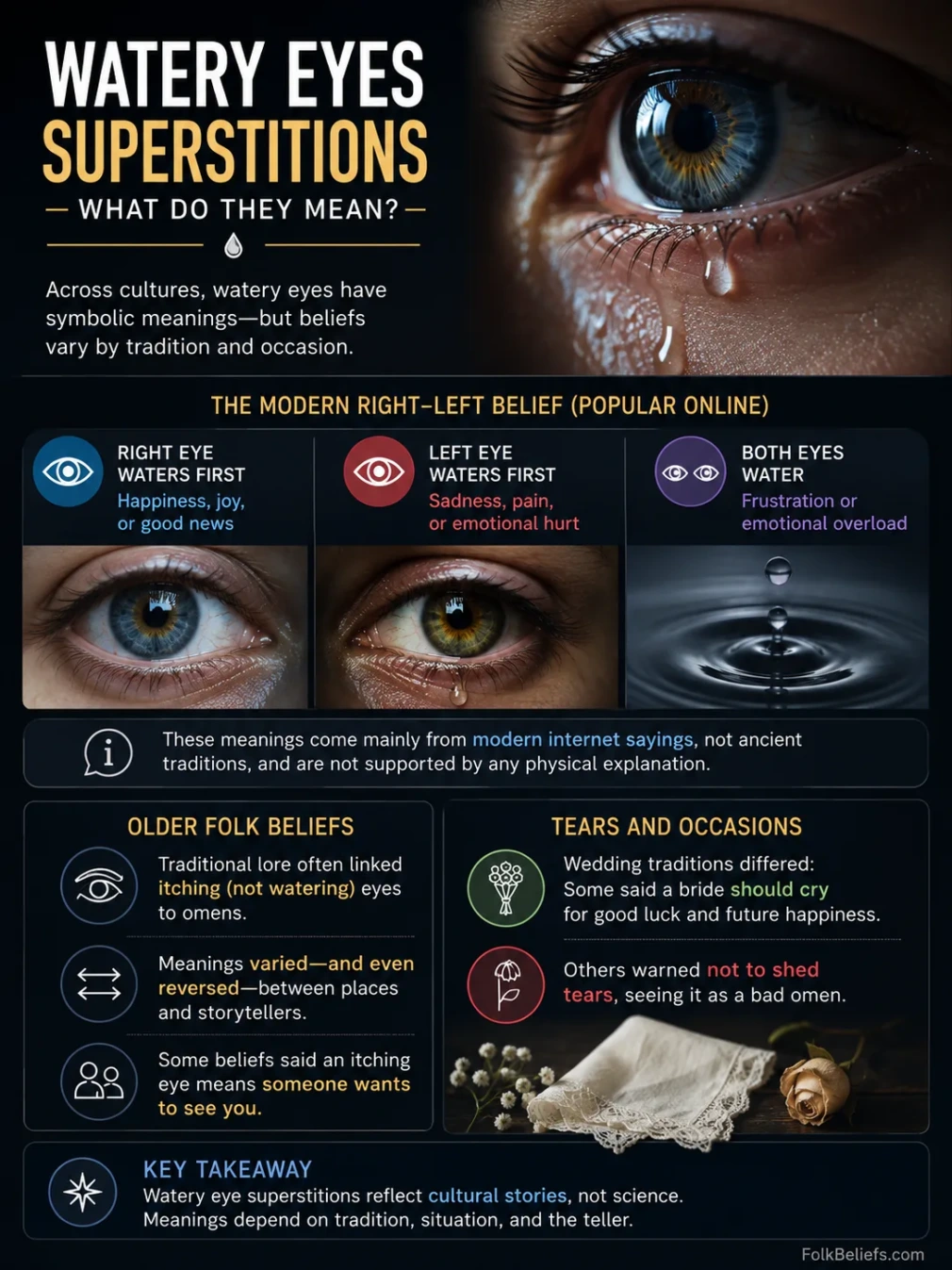
Watery eyes have picked up several folk meanings, but the familiar right-versus-left interpretations are not a single old rule shared across cultures. The most visible version today says that a tear beginning in the right eye means happiness, one beginning in the left eye means pain or sadness, and tears beginning in both eyes mean frustration. Available evidence places this particular formula mainly in modern internet circulation rather than in a clearly documented older folk tradition.[1]
Right and Left Watery Eye Meanings
| What Happens | Popular Meaning | Evidence Context |
|---|---|---|
| Right eye waters first | Happiness, joy, or positive emotion | A modern online saying; not established as a universal traditional belief |
| Left eye waters first | Pain, sadness, or emotional hurt | Usually appears with the same modern right-versus-left formula |
| Both eyes begin tearing | Frustration or emotional overload | Another part of the circulating internet version |
Africa Check traced versions of the first-tear claim through social-media posts from the 2010s and early 2020s. Its review also found no evidence that the eye producing the first tear identifies whether someone is happy, sad, or frustrated.[1]
This makes the belief better understood as modern circulating folklore than as a securely dated ancient rule. A saying can still function as folklore when people repeat, adapt, and remember it, but its popularity does not by itself establish an old cultural origin.
Older Eye Omens Point to a Different Tradition
Older English-speaking folklore does contain left-and-right eye omens, but the recorded sensation is often itching rather than watering. That distinction matters.
Fanny D. Bergen’s 1896 collection of oral superstitions records one belief from Baldwinsville, New York, in which an itching right eye foretold crying and an itching left eye foretold laughter. The very next entry, recorded in Boston, reverses the prediction: the right eye means laughter and the left means crying. A third entry from Peabody, Massachusetts, says an itching eye means someone wants to see you but cannot.[2]
These neighboring records are useful because they show how quickly a body omen can change even within the same broad language community. There was no stable rule in which one side always represented joy and the other always represented sorrow.
T. F. Thiselton Dyer’s Domestic Folk-Lore, published in 1881, preserves another version attributed to the antiquary Francis Grose: an itching right eye meant that the person would soon cry, while an itching left eye meant laughter. Dyer also notes an older literary association between an itching right eye and seeing a loved person.[3]
Itching, twitching, burning, and watering are separate sensations. A belief documented for an itching eye should not automatically be presented as a belief about tears or watery eyes. Modern retellings often blur these categories.
Tears Could Be Lucky or Unlucky Depending on the Occasion
Historical folklore sometimes gives tears a meaning because of when they appear rather than which eye produces them.
Dyer records a wedding belief that a bride should shed at least a few tears on her wedding day, with failure to do so treated by some people as unfavorable for her future happiness.[3]
Yet a 1911 item in the New Zealand Times gives almost the opposite instruction, warning a bride not to shed even a tear because tears were considered a bad omen.[4]
The contrast is typical of folk belief. Tears can symbolize future sorrow in one record and act as a protective or fortunate act in another. The meaning depends on the particular community, situation, and version being recorded.
What Does It Mean When Both Eyes Water?
The internet-era saying sometimes assigns frustration to tears beginning in both eyes, but there is no known physical mechanism by which bilateral tearing identifies that emotion.[1]
Outside folklore, tears normally cover both eyes as part of the tear film. The National Eye Institute explains that tears keep the eye surface wet and smooth, help with clear vision, and protect against irritants. Tears are produced by glands above the eyes and drain through small openings near the inner corners.[5]
For that reason, both eyes becoming watery at once does not need a symbolic explanation. Wind, smoke, allergies, emotion, or irritation can affect both eyes together.
When Only One Eye Keeps Watering
A single watery eye can feel unusual enough to invite an omen-based interpretation, especially when it happens suddenly. Folklore, however, does not provide a dependable rule that a right watery eye brings good news or that a left watery eye warns of sadness.
Persistent watering has an ordinary physical name: epiphora. It can occur when the eye produces more tears than usual or when tears do not drain normally. Possible causes include irritation, allergies, dry eye, eyelid problems, infection, or a blocked tear duct.[6]
Watery-eye interpretations belong to folklore rather than diagnosis or prediction. An occasional unexplained tear can be treated as a curious folk sign if that tradition is meaningful to someone, but recurring watering, pain, redness, swelling, or changes in vision have physical causes worth treating as health symptoms rather than omens.
Sources and Records
- ↑1a ↑1b ↑1c Kirsten Cosser, “No, there’s no meaning behind the first tear being shed from one’s left or right eye”,
- ↑2 Fanny D. Bergen, ed., Current Superstitions: Collected from the Oral Tradition of English Speaking Folk,
- ↑3a ↑3b T. F. Thiselton Dyer, Domestic Folk-Lore,
- ↑4 “Bridal Superstitions,” New Zealand Times,
- ↑5 National Eye Institute, “How Tears Work”,
- ↑6 Cleveland Clinic, “Epiphora (Watery Eyes): Types, Causes & Treatment”,