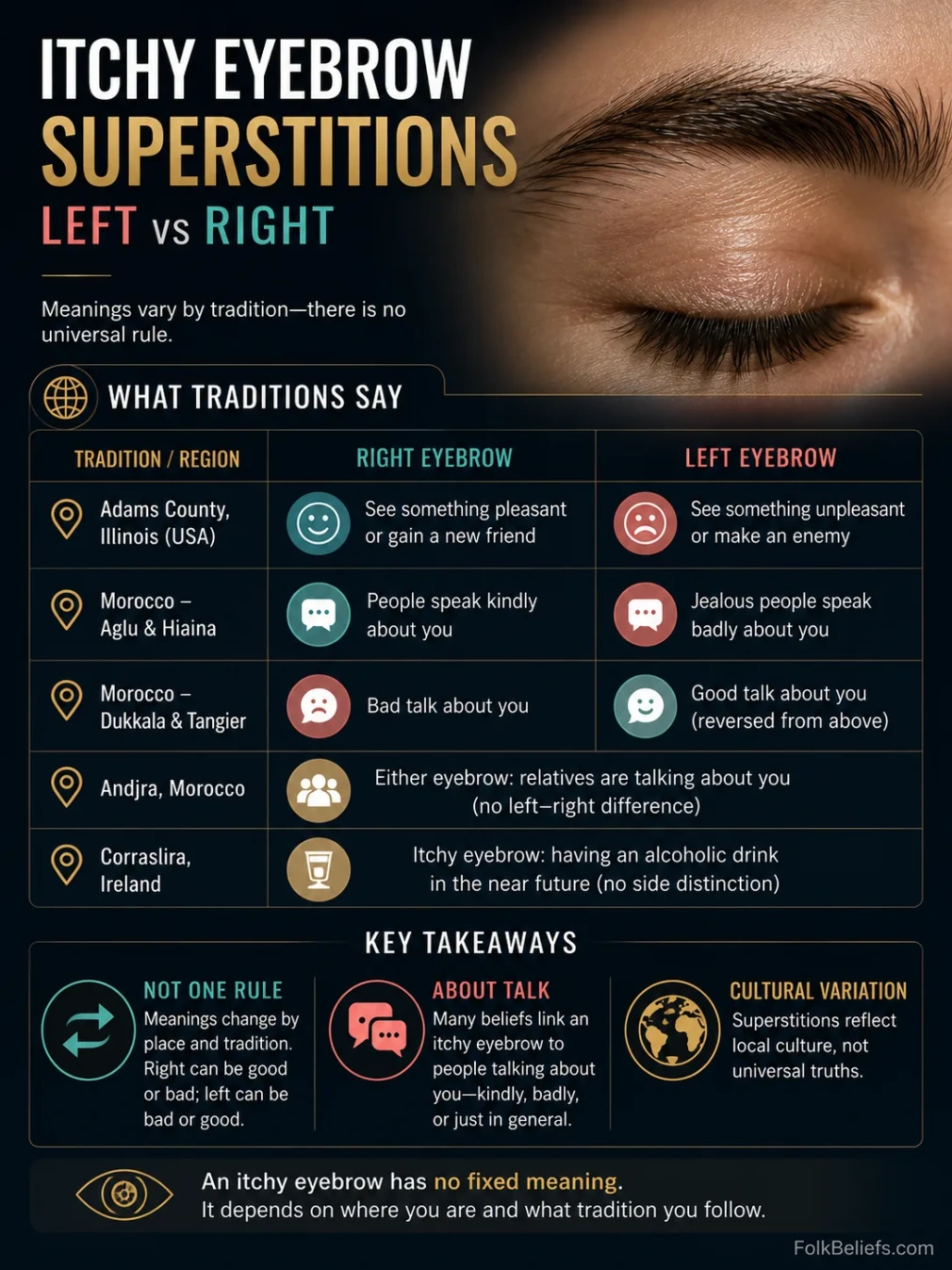
An itchy eyebrow does not have one fixed superstition. Some recorded traditions give the right eyebrow a favorable meaning and the left an unfavorable one, but other records reverse that pattern or ignore the left-right distinction entirely. The meaning depends on the particular folklore tradition rather than on a universal rule.
Left vs. Right Eyebrow Meanings in Recorded Folklore
| Recorded Tradition | Right Eyebrow | Left Eyebrow |
|---|---|---|
| Adams County, Illinois | Seeing something pleasant; in another entry, gaining a new friend | Seeing something unpleasant; in another entry, making an enemy[1] |
| Moroccan records from Aglu and Hiaina | People speaking kindly about you | Jealous people speaking badly about you[2][3] |
| Moroccan records from Dukkala and Tangier | Bad talk about you | Good talk about you; the Aglu and Hiaina meanings are reversed here[2] |
| Andjra, Morocco | Either eyebrow could mean that relatives were talking about the person; no right-left contrast was required.[2] | |
| Corraslira, County Roscommon, Ireland | An itchy eyebrow was associated with having an alcoholic drink in the near future, without assigning separate meanings to the two sides.[4] | |
What Does an Itchy Right Eyebrow Mean?
The familiar interpretation of a right eyebrow itch as a favorable omen is supported by some historical folklore records. Harry Middleton Hyatt’s collection from Adams County, Illinois, includes separate sayings that connect an itching right eyebrow with seeing something pleasant and with the arrival of a new friend.[1]
That positive meaning also appears in part of the Moroccan material collected by Edward Westermarck. In accounts from Aglu and Hiaina, an itching right eyebrow could mean that someone was speaking kindly about the person.
It would be misleading, however, to turn this into a rule that the right eyebrow always predicts good luck. Westermarck recorded the opposite interpretation in Dukkala and Tangier, where the right eyebrow could indicate unfavorable talk.
What Does an Itchy Left Eyebrow Mean?
In the Adams County collection, the left eyebrow carries the contrasting interpretation. An itch on that side was recorded as a sign that the person would see something unpleasant, while another version said it foretold making an enemy.
A similar right-left contrast occurs in the Aglu and Hiaina material, where the left eyebrow was associated with jealous or unkind talk. Yet the Dukkala and Tangier accounts reverse the sides and give the left eyebrow the favorable meaning.
Left eyebrow itching therefore cannot be treated as a universal bad omen. It has negative meanings in some records and positive meanings in others.
Does an Itchy Eyebrow Mean Someone Is Talking About You?
This interpretation has clear support in the Moroccan folklore material. The important detail is that the identity and tone of the supposed conversation change from place to place.
Kind or Unkind Talk
Accounts from Aglu and Hiaina distinguish between kind talk associated with the right eyebrow and jealous talk associated with the left. Dukkala and Tangier preserve the same general idea of people talking about you but reverse which side carries which meaning.[3]
Relatives Talking
The Andjra version does not divide the omen into good and bad sides. An itch in either eyebrow was said to indicate that relatives were speaking about the person.
These local differences matter because the phrase “someone is talking about you” is often presented as though it has one established left-right formula. The older records instead preserve several formulas.
Why Do Left and Right Meanings Contradict Each Other?
Folklore is transmitted through families, communities and local traditions rather than through a single authority. A bodily sensation can therefore acquire different interpretations even in nearby places.
The Moroccan records make this especially clear. A right eyebrow itch can mean kind words in one locality and unfavorable words in another. Another locality removes the distinction and gives both eyebrows the same meaning. These are not errors that need to be reconciled; they are separate recorded variants of the belief.
The Illinois material shows another form of the omen. Instead of being mainly about what other people are saying, the eyebrow predicts whom or what the person may encounter. The right side is connected with pleasant sights and friendship, while the left side carries the contrasting possibilities.
Not Every Eyebrow Superstition Uses Left and Right
The Irish Schools’ Collection provides a useful example. A record collected at Corraslira in County Roscommon says simply that an itchy eyebrow means the person will have an intoxicating drink in the near future. The record distinguishes right and left for other body omens on the same page, but not for the eyebrow belief.[4]
This shows why an itch in both eyebrows does not automatically require a separate symbolic interpretation. In some documented traditions, the eyebrow itself is the omen and the side is irrelevant.
Do Gender or Time of Day Change the Meaning?
The historical records cited here do not establish a general rule in which eyebrow meanings change according to gender, morning versus night, or a particular hour of the day. Such details may exist in individual traditions, but they should not be attached to every itchy-eyebrow superstition without a record that specifically supports them.
The clearest documented distinctions in these sources concern right versus left, favorable versus unfavorable encounters, and whether other people are supposedly talking about the person. Even those meanings vary by locality.
When an Eyebrow Itch Has a Physical Cause
Folklore interpretations do not explain why skin actually itches. The American Academy of Dermatology notes that seborrheic dermatitis can affect the eyebrows and may cause itching, scaling or irritation.[5] A persistent or troublesome eyebrow itch is therefore better treated as a physical symptom rather than as evidence that a folk prediction is coming true.
Sources and Records
- ↑1a ↑1b Harry Middleton Hyatt, Folk-Lore from Adams County, Illinois,
- ↑2a ↑2b ↑2c Edward Westermarck, Ritual and Belief in Morocco, Vol. II,
- ↑3a ↑3b SuperstitionsMap, “Moroccan Superstitions”,
- ↑4a ↑4b National Folklore Collection, UCD, “Superstitious Sayings and Omens”,
- ↑5 American Academy of Dermatology, “Seborrheic Dermatitis: Signs and Symptoms”,
Documented Locations
Countries: Morocco
These labels identify where a version has been documented. They do not mean that everyone in the country, region, or community shares the belief.