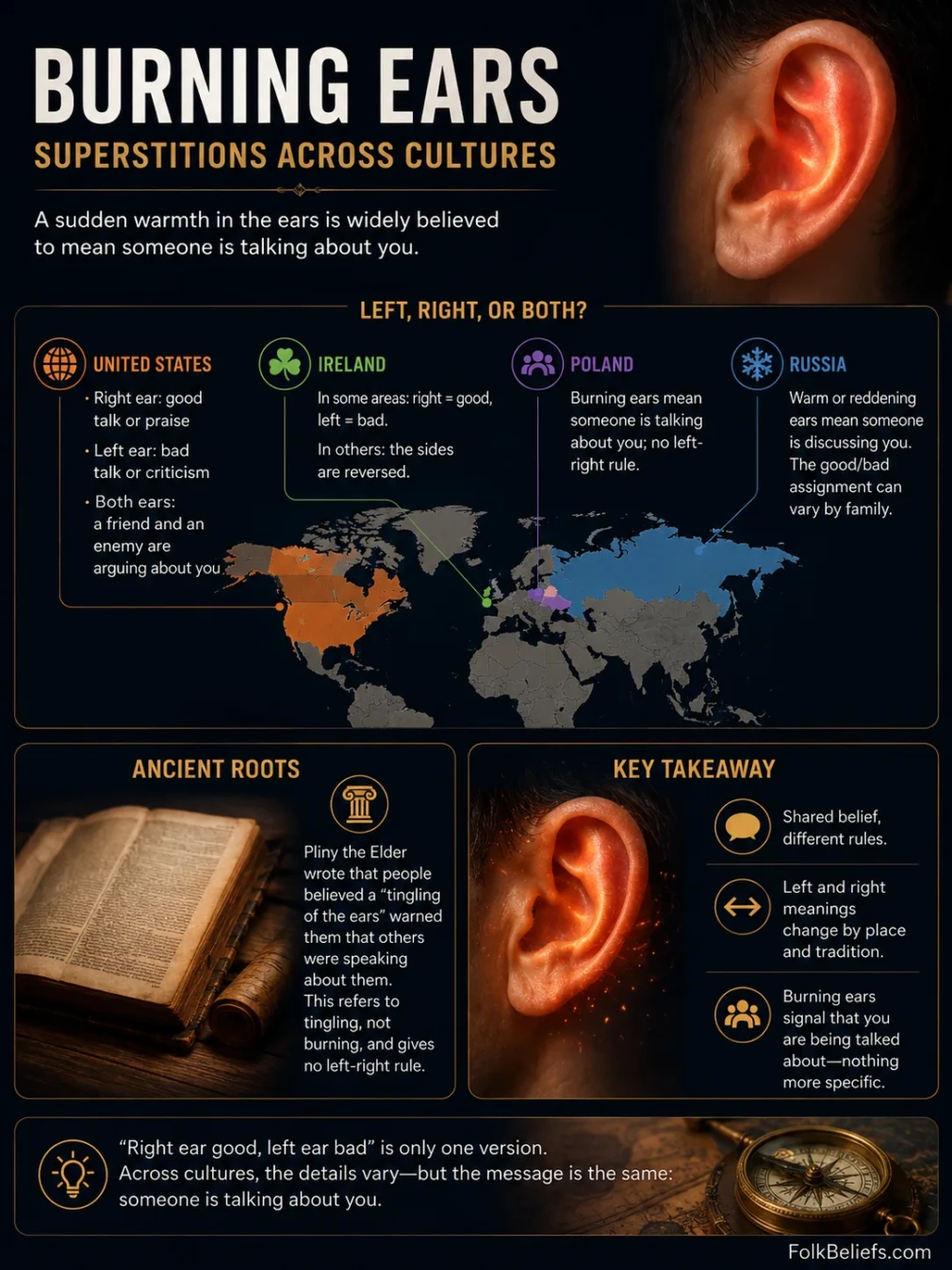
In many folk traditions, a sudden feeling of heat in the ears is read as a social sign: someone is talking about you somewhere else. The familiar version assigns praise to the right ear and criticism to the left, but surviving records do not agree on that division.
American collections, Irish archival records, a Polish oral account, and later Russian folklore compilations preserve related ideas with different rules. Some distinguish left from right, some reverse the sides, and some say only that burning ears mean you are being discussed.
What Does a Burning Right or Left Ear Mean?
A familiar pattern in English-language collections is easy to remember: the right ear is linked with kind words or praise, while the left ear is linked with criticism, unkind talk, or gossip. That pattern is well documented, but it is not a universal code.
| Documented setting | Burning-ear meaning in the record |
|---|---|
| United States, 1896 collection | One entry gives right ear = speaking well and left ear = speaking ill; nearby entries preserve other variations, including speaker gender and both ears burning.[1] |
| Drumlease, County Leitrim, Ireland | Right ear burning = someone talking good about you; left ear burning = someone talking bad about you.[2] |
| Corraslira, County Roscommon, Ireland | The sides are reversed: a hot or itchy right ear is linked with bad talk, while the left is linked with good talk.[3] |
| Polish informant recorded in 2011 | Burning ears mean someone is talking about you; the recorded saying does not assign separate meanings to left and right.[4] |
| Russian folklore compilation | Warm or reddening ears mean another person is discussing you; the source notes that praise-and-criticism assignments can differ between households.[5] |
These records show why “right means good, left means bad” works best as one recorded version, not as a rule for every place or family. Even two entries in the Irish Schools’ Collection can give opposite answers.
The Roman Passage Is About Tingling, Not Burning
Pliny the Elder is often brought into discussions of burning ears because Natural History preserves an older idea that an ear sensation reveals distant speech. In Book XXVIII, the English translation by John Bostock and H. T. Riley says that absent people were thought to receive warning that others were speaking of them through the “tingling of the ears.”[6]
That passage matters, but its limits matter too. It does not say that an ear is burning, and it does not give the later right-ear-praise and left-ear-criticism formula. It is safer to treat it as an early relative of the later burning-ear superstition rather than proof that the modern rule existed unchanged in Roman times.
American Records Preserve More Than One Version
Fanny D. Bergen’s 1896 Current Superstitions places several ear beliefs next to one another. Alongside the broad United States entry linking the right ear with good talk and the left with bad talk, a Pennsylvania version says the right ear means someone is thinking well of you and the left means someone is thinking unkindly. If both ears burn, that same entry says a friend and an enemy are arguing about you.
Other entries change the question entirely. A Maine and Pennsylvania version assigns the right ear to a woman speaking of you and the left to a man. New Hampshire material says burning ears mean people are speaking well of you without giving a left-right split.[1]
Irish Records Show the Left-Right Rule Reversing
The Schools’ Collection held by the National Folklore Collection at University College Dublin is especially useful because it preserves local statements rather than forcing them into one national rule. A Drumlease record in County Leitrim gives the familiar right-good, left-bad reading.[2]
A Corraslira record from County Roscommon says the opposite: a hot or itchy right ear means someone is talking badly about you, while the left means someone is talking well.[3] The two records alone show that a local version should not be expanded into a single “Irish” interpretation.
Some Traditions Do Not Divide the Ears at All
A 2011 entry in the USC Digital Folklore Archives records a Polish informant saying, in simple form, that when your ears burn, someone is talking about you. She said she learned the belief from her parents during primary school. The recorded formula does not say that the left and right ears carry different messages.[4]
A current Russian folklore compilation likewise keeps the central idea—warm or red ears mean that you are being discussed—while warning that household versions may assign praise and criticism to different sides.[5]
What Does It Mean If Both Ears Burn?
There is no broadly documented meaning that applies everywhere. The clearest historical example in Bergen’s American collection comes from Pennsylvania: if both ears burn, “friend and foe” are said to be contending about the person.[1] Other records simply treat burning ears, plural, as a sign that somebody is talking, without turning two burning ears into a separate omen.
Guessing Who Is Talking About You
Some versions do more than interpret the heat. They add a small action meant to identify or affect the unseen speaker. Bergen records a belief that pinching the ear will make the person talking about you bite their own tongue.[1]
Later American oral records keep the same social logic. The University of Detroit Mercy’s James T. Callow Folklore Archive includes Nashville and Tennessee records stating simply that burning ears mean someone is talking about you, as well as a 1972 formula paired with touching the ear when good talk is suspected.[7] These gestures belong to the folklore record; they do not provide a way to verify who is actually speaking.
Burning Ears as Folklore and as a Physical Sensation
Folklore explains a sudden bodily sensation by connecting it to another person’s words. Medicine treats ear heat, redness, pain, or burning as physical symptoms instead. For example, DermNet describes red ear syndrome as an uncommon condition involving episodes of ear redness and pain, often with burning discomfort; heat, touch, or rubbing can be triggers in some cases.[8]
A brief warm ear does not prove that anyone is praising, criticizing, or thinking about you. The folklore records are evidence that people have interpreted the sensation in those ways, not evidence that distant conversation causes it.
Sources and Records
- ↑1a ↑1b ↑1c ↑1d Fanny D. Bergen, ed., Current Superstitions: Collected from the Oral Tradition of English Speaking Folk,
- ↑2a ↑2b National Folklore Collection, UCD, “Superstitions,” Drumlease,
- ↑3a ↑3b National Folklore Collection, UCD, “Superstitious Sayings and Omens,” Corraslira,
- ↑4a ↑4b USC Digital Folklore Archives, “Folk Belief – Polish”,
- ↑5a ↑5b SuperstitionsMap, “Russian Superstitions”,
- ↑6 Pliny the Elder, The Natural History of Pliny, Volume V,
- ↑7 University of Detroit Mercy Libraries, James T. Callow Folklore Archive,
- ↑8 DermNet, “Red Ear Syndrome”,
Documented Locations
Countries: Brazil, Chile, Greece, Italy, Jamaica, Romania, Russia, United Kingdom, United States, Uruguay
These labels identify where a version has been documented. They do not mean that everyone in the country, region, or community shares the belief.