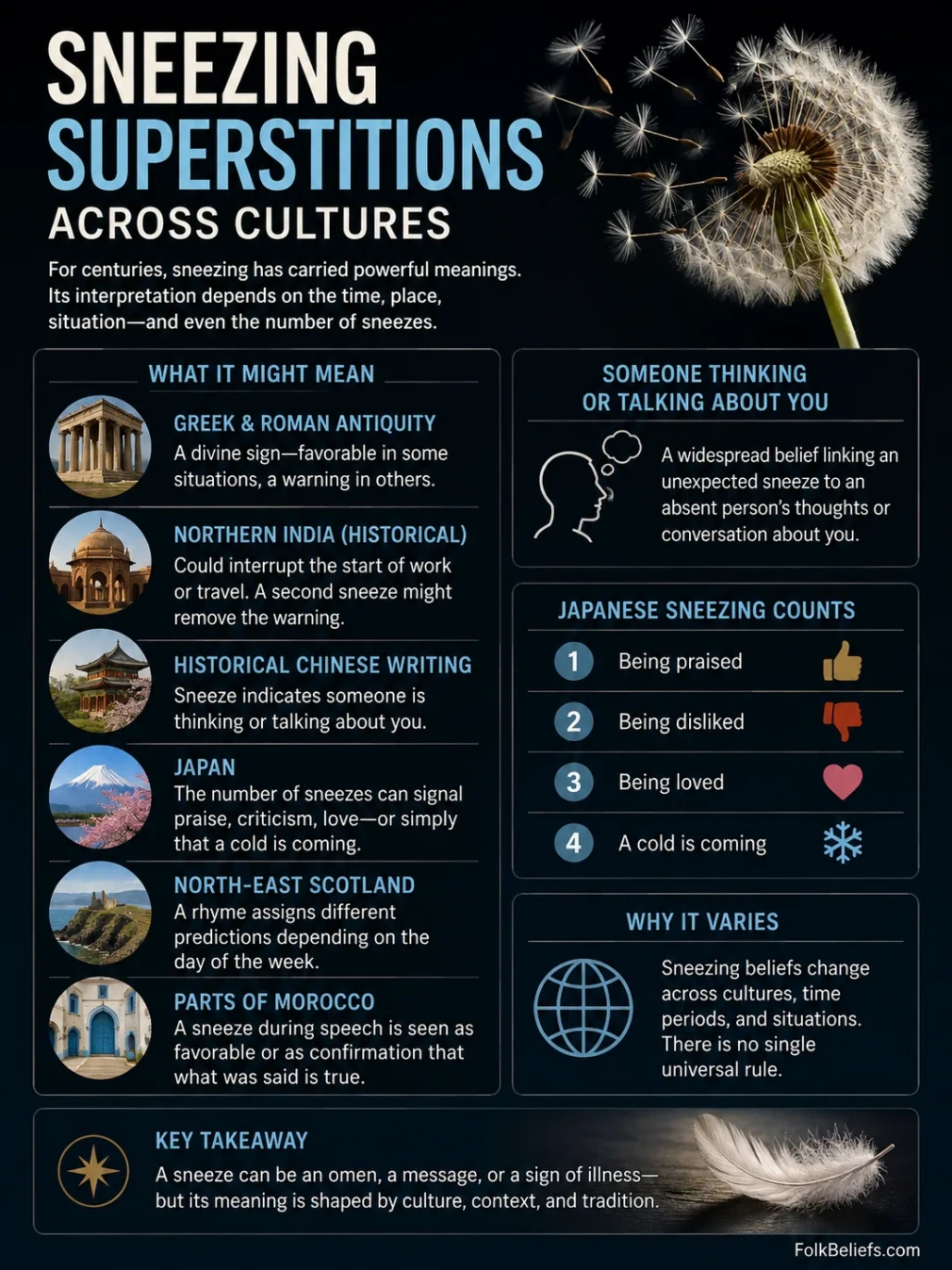
A sneeze has carried very different folk meanings depending on where, when, and in what situation it occurred. Recorded traditions have treated sneezing as a favorable omen, a warning to delay a journey, confirmation that spoken words are true, evidence that someone is thinking or talking about you, or a sign whose meaning changes with the number or day of sneezes. There is no single cross-cultural rule.
What Does Sneezing Mean in Superstition?
The surrounding moment often matters more than the sneeze itself. A sneeze during a speech could be interpreted differently from one heard while somebody was leaving home. Some traditions counted consecutive sneezes, while others attached meanings to the day of the week.
| Recorded Setting | Folklore Meaning | Scope of the Record |
|---|---|---|
| Greek and Roman antiquity | A sneeze could function as a divine or divinatory sign, favorable in some situations and cautionary in others. | Classical literary and historical evidence |
| Northern India, historical collections | A sneeze could interrupt the start of work or travel; some recorded versions treated a second sneeze as removing the warning. | Regional material collected in the nineteenth century |
| Historical Chinese writing | Sneezing was connected with another person thinking or speaking about the sneezer. | Literary commentary preserving an older motif |
| Japan | The number of sneezes can indicate praise, criticism, affection, or simply a cold, depending on the version. | Proverb and popular folk-belief variants |
| North-east Scotland | A rhyme assigned different predictions to sneezing on different weekdays. | Nineteenth-century regional folklore collection |
| Parts of Morocco | A sneeze during speech could be read as favorable fal or as confirmation that something said was true. | Specific regional records, including Dukkala and Tangier |
Sneezing as an Omen in Greek and Roman Antiquity
Greek and Roman sources give sneezing a strong divinatory role. Pieter W. van der Horst’s survey of ancient evidence notes that a sneeze could be understood as a sign from the gods about what might happen or as a warning against an intended action. Its interpretation could depend on details such as who sneezed, when it happened, and the circumstances around it.[1]
Two classical episodes show why a simple label such as “good luck” is too broad. In the Odyssey, Telemachus sneezes immediately after Penelope speaks about punishment for the suitors, and she takes it as confirmation of her words. Xenophon records another favorable sneeze during a speech to Greek soldiers. These examples show a sneeze operating as a response to a particular moment rather than carrying one permanent meaning.[1]
Someone Is Thinking or Talking About You
One of the most familiar sneezing beliefs connects an unexplained sneeze with an absent person’s thoughts or conversation. Historical Chinese material provides an early form of this idea, although the surviving evidence should not be turned into a claim about every Chinese community or period.
A Chinese Literary Record
A passage preserved in the Chinese Text Project’s edition of Qi Xiu Xu Gao discusses a line associated with the Book of Poetry and explains it with the idea that one person thinking of another causes the other to sneeze. The writer then observes that people of his own time said somebody must be speaking about them when they sneezed. The same passage refers to earlier writings about divination from sneezing and ringing ears, showing that the association had a literary history rather than being merely a recent internet saying.[2]
Japanese Sneezing Counts
Japanese proverbial tradition gives the “someone is talking about you” motif a numerical form. One recorded saying interprets one sneeze as being praised, two as being disliked, three as being loved, and four as the beginning of a cold.[4]
The wording is not fixed. Another familiar version begins with criticism rather than praise: one sneeze means somebody is speaking badly of you, two that somebody is laughing about you, three that somebody is in love with you, and four that you have a cold. The variation matters. A chart claiming that “two sneezes always mean someone misses you,” for example, would erase the contradictory forms found within Japanese folk sayings.
A Sneeze Before a Journey
Historical records from northern India show a different pattern. William Crooke described several sneeze omens in his collection of regional religion and folklore. In one recorded rule, a person beginning work would pause if somebody sneezed. Another version said that one sneeze could be ominous when setting out, while two sneezes allowed the journey to continue. Crooke also recorded contrasting interpretations in which sneezing itself could be considered favorable.[3]
This is a good example of why “Indian sneezing superstition” is too broad a label. Crooke was compiling historical and regional material, including references to Bombay and northern Indian traditions. His records do not establish a rule followed throughout India today.
The important feature of the departure belief is its timing. An ordinary sneeze later in the day does not carry the same recorded meaning. The omen occurs at the moment an activity or journey is about to begin, and some versions contain their own way of neutralizing the warning by waiting or by treating a second sneeze differently.
When the Day of the Week Changes the Meaning
British regional folklore offers another method of interpreting sneezes: the calendar. Walter Gregor’s nineteenth-century collection from north-east Scotland records a rhyme in which sneezing on different weekdays predicts different events. Monday is associated with a letter, Wednesday with kissing a stranger, Thursday with danger, Friday with sorrow, and Saturday with seeing or kissing a sweetheart soon, depending on the recorded wording.[5]
Other British collections preserve noticeably different weekday verses. That variation suggests an adaptable oral rhyme rather than a single fixed national system. The memorable rhythm was part of the tradition: the sneeze supplied the occasion, while the weekday determined the prediction.
When a Sneeze Confirms What Someone Said
Not every sneezing belief is about the sneezer’s future. In several Moroccan records, the sneeze comments on words being spoken at that moment. Historical material associated with Dukkala describes sneezing during speech as good fal, or favorable augury. A Tangier record gives the event a more precise meaning: the sneeze could indicate that the statement being made was true.[6]
These are localized records rather than a rule for Morocco as a whole. They also resemble the logic found in some ancient Greek examples, where a sneeze arriving immediately after a statement can appear to validate the words. Similar structure does not prove that the traditions share a single historical origin.
Is Sneezing Good Luck or Bad Luck?
Folklore gives no universal answer. The same physical event can carry opposite readings:
- Favorable: a sneeze may confirm words, accompany an auspicious moment, or remove uncertainty.
- Unfavorable: a sneeze at departure may interrupt an intended journey or activity.
- Social: it may mean that somebody elsewhere is thinking, praising, criticizing, or talking about the sneezer.
- Predictive: its meaning may depend on the number of sneezes or the day on which they occur.
Even within one language or region, more than one interpretation can circulate. Folk beliefs are often learned through families, sayings, jokes, local custom, and older written traditions, so variation is normal rather than an error that needs to be corrected.
Sneezing Folklore and the Physical Reflex
Folklore meanings describe cultural interpretations, not physical causes. Medically, sneezing is a protective reflex that expels air through the nose and mouth, most often after irritation of the nasal lining. Bright light and other stimuli can also trigger the reflex in some people.[7]
A spontaneous sneeze can therefore have an ordinary physical cause even when a family saying gives it a second, playful meaning. In living tradition, the two ideas can easily coexist: somebody may know perfectly well why sneezing happens and still joke that an absent friend must be talking about them.
Sources and Records
- ↑1a ↑1b Pieter W. van der Horst, “The Omen of Sneezing”,
- ↑2 Qi Xiu Xu Gao, Volume 6, “Sneezing”,
- ↑3 William Crooke, The Popular Religion and Folk-Lore of Northern India,
- ↑4 Jitenon, “一に褒められ二に憎まれ三に惚れられ四に風邪ひく”,
- ↑5 Walter Gregor, Notes on the Folk-Lore of the North-East of Scotland,
- ↑6 SuperstitionsMap, “Moroccan Superstitions”,
- ↑7 Murat Songu and Cemal Cingi, “Sneeze Reflex: Facts and Fiction”,
Documented Locations
Countries: Barbados, Colombia, Eritrea, Fiji, France, Germany, Greece, Iceland, India, Iraq, Italy, Jamaica, Japan, Madagascar, Malta, Morocco, Nepal, Pakistan, Philippines, Romania, Russia, Sri Lanka, Turkey, Turkmenistan, Tuvalu, Uganda, United States, Vanuatu
These labels identify where a version has been documented. They do not mean that everyone in the country, region, or community shares the belief.