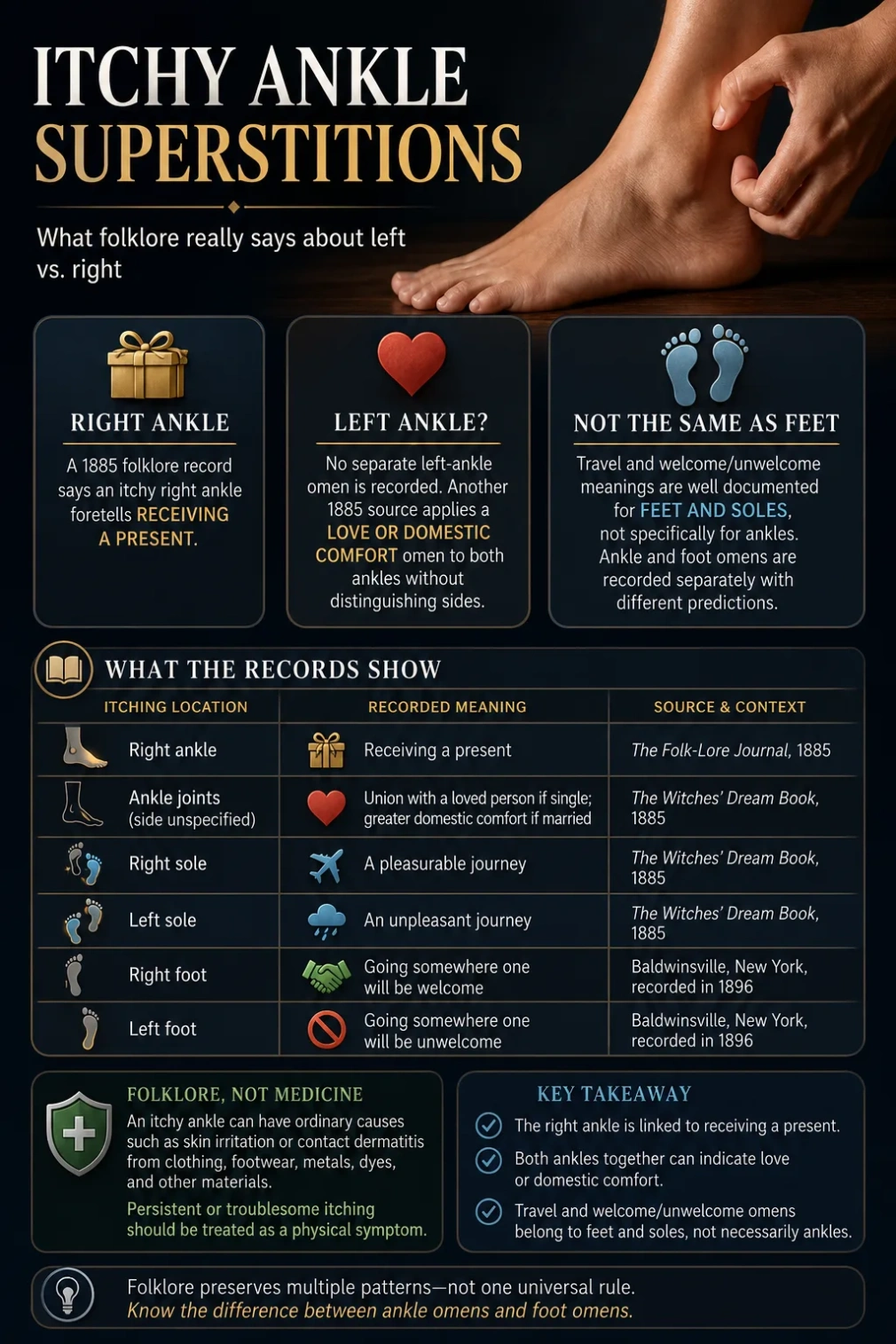
An itchy ankle has appeared in English-language omen lore, but the surviving records do not support a neat rule in which the right ankle always means good luck and the left ankle always means bad luck. The clearest historical record gives a specific meaning to the right ankle, while another period fortune-telling text treats both ankles together. Older folklore about the feet does make left-versus-right distinctions, which may help explain why ankle and foot interpretations are often blended today.
What Does an Itchy Right Ankle Mean?
A direct ankle-specific belief appears in the 1885 volume of The Folk-Lore Journal. In a group of bodily itching omens contributed by folklorist R. C. Hope, the entry states that an itch of the right ankle foretells receiving a present.[1]
The same record places the ankle omen beside beliefs about itching of the nose, shoulder, hand, and foot. A short rhyme about rubbing the itching place on materials such as wood, brass, or brick follows the group of omens.[1]
Right ankle: the clearest historical ankle-specific record found here associates the itch with receiving a present, not with travel, money, or a general prediction of good fortune.
What Does an Itchy Left Ankle Mean?
The historical evidence for a separate left ankle superstition is much thinner. The 1885 Folk-Lore Journal record specifies the right ankle but gives no matching prediction for the left. This should not be turned automatically into an opposite omen. A source that says “right ankle = a present” does not, by itself, establish “left ankle = loss,” “bad luck,” or another reversed meaning.
That distinction matters because many bodily omens do use opposite meanings for the two sides. Ankles, however, were not always recorded that way.
An Older Belief Treats Both Ankles the Same
The Witches’ Dream Book; and Fortune Teller, also published in 1885, includes an extensive list of bodily sensations used as auguries. Its ankle entry does not distinguish left from right. Instead, itching of the “ankle joints” is associated with love and domestic life: an unmarried person is told to expect union with someone loved, while a married person is promised greater comfort at home.[2]
This gives a second period interpretation of itchy ankles:
Right Ankle
One folklore record from 1885 says an itch foretells receiving a present.
Left Ankle
No equivalent left-only meaning is supplied in that record. A separate 1885 fortune-telling text applies a love or domestic-comfort omen to the ankles without separating the sides.
Why Travel Meanings Are Often Attached to Itchy Ankles
Travel and movement are better documented in older sources for the foot or sole than for the ankle itself. Immediately after its ankle-joint prediction, The Witches’ Dream Book says an itching right sole foretells a pleasurable journey, while an itching left sole foretells an unpleasant journey.[2]
A later collection gives another left-right foot variant. Fanny D. Bergen’s Current Superstitions, published in 1896 from oral traditions of English-speaking people, records a belief from Baldwinsville, New York: an itching right foot means going somewhere one will be welcome, while an itching left foot means going somewhere one will be unwelcome. A related Alabama entry associates an itching left foot while visiting someone with not being welcome there.[3]
Ankle and foot folklore are not interchangeable. Historical collections sometimes record an ankle omen and a foot omen separately, with different predictions. Calling every left-right foot belief an “ankle superstition” makes the tradition appear more uniform than the records support.
Left vs Right in the Surviving Records
| Itching location | Recorded meaning | Context |
|---|---|---|
| Right ankle | Receiving a present | The Folk-Lore Journal, 1885 |
| Ankle joints, side unspecified | Union with a loved person if single; greater domestic comfort if married | The Witches’ Dream Book, 1885 |
| Right sole | A pleasurable journey | The Witches’ Dream Book, 1885 |
| Left sole | An unpleasant journey | The Witches’ Dream Book, 1885 |
| Right foot | Going somewhere one will be welcome | Baldwinsville, New York, recorded in 1896 |
| Left foot | Going somewhere one will be unwelcome | Baldwinsville, New York, recorded in 1896 |
The records therefore preserve several different omen patterns rather than one universal ankle code. The right ankle has a documented present-related meaning. Both ankles together also appear in a love-related prediction. Left-versus-right journey meanings are clearly attested for feet and soles, but those should remain identified as foot folklore unless a source specifically names the ankle.
Folklore Meaning and an Actual Itch
These interpretations belong to superstition and fortune-telling traditions; they do not explain why skin physically itches. An itchy area around the ankle or foot can have ordinary causes, including skin irritation or an allergic reaction to something touching the skin. The American Academy of Dermatology notes that clothing, footwear, fabrics, dyes, metals, and other materials can contribute to contact dermatitis and itching on the legs or feet.[4] Persistent, recurring, or troublesome itching is better treated as a physical symptom rather than as evidence that a folklore prediction is occurring.
Sources and Records
- ↑1a ↑1b R. C. Hope, “Notes and Queries,” The Folk-Lore Journal, Vol. III,
- ↑2a ↑2b A. H. Noe, The Witches’ Dream Book; and Fortune Teller,
- ↑3 Fanny D. Bergen, ed., Current Superstitions: Collected from the Oral Tradition of English Speaking Folk,
- ↑4 American Academy of Dermatology, “Itchy Rash Could Be Contact Dermatitis”,
Documented Locations
Countries: United States
Regions: Illinois (United States)
These labels identify where a version has been documented. They do not mean that everyone in the country, region, or community shares the belief.