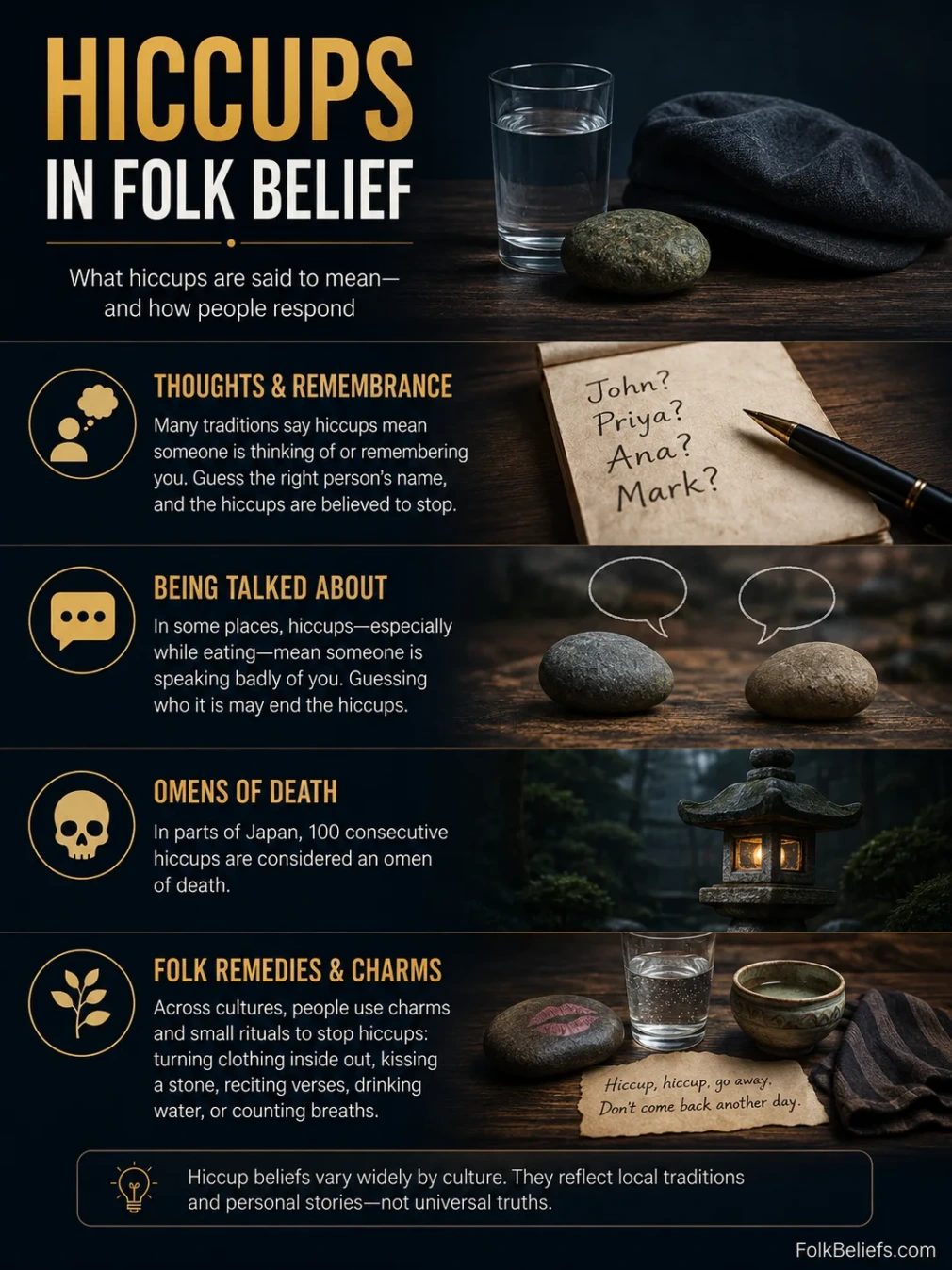
Hiccup superstitions do not carry one fixed meaning across cultures. A recurring idea is that an absent person is thinking about, remembering, or speaking about you. Some versions turn the hiccup into a guessing game: identify the right person and the hiccups are expected to stop. Other records treat repeated hiccups as an omen or attach a small ritual to ending them.
The surviving evidence is often local. A folklore archive may preserve the belief of one informant, family, district, or historical collection. Such records show that a variant existed in that setting; they do not mean that everyone in the wider country or culture shared it.
When Hiccups Point to Someone Else
A record in the James T. Callow Folklore Archive at the University of Detroit Mercy gives one of the clearest examples. The entry says the belief was learned in Hungary and lists 1897 as the date learned. According to the record, hiccups mean that someone is thinking of you. The person with the hiccups can try to guess who it is, with the correct name supposedly making the hiccups stop.[1]
A broader historical comparison appears in Biren Bonnerjea’s 1927 A Dictionary of Superstitions and Mythology. Its entry for hiccoughs reports the idea that someone is thinking of the sufferer in material associated with Great Britain, Bohemia, and India. The same entry records a different Macedonian interpretation: hiccups or choking while eating or drinking could mean that a person was being spoken badly of, and guessing the supposed speaker’s name formed part of the response.[2]
A Russian variant follows a closely related pattern. SuperstitionsMap records a belief in which hiccups prompt the idea that someone remembers the person who is hiccuping. Names may then be tried until the hiccups stop. Here the physical reflex becomes a small social guessing ritual rather than simply an omen with a fixed meaning.[3]
Family and Informant Versions From South Asia
Modern folklore archives preserve similar ideas at a much narrower, personal level. A University of Southern California folklore record describes an American student’s Indian friend saying that hiccups mean somebody who loves you is thinking about you. The informant said he had learned the belief from his mother.[4]
A Dartmouth folklore interview with a Punjabi informant from Lahore records another family-level variant. The informant associated both sneezing and hiccuping with the idea that someone is remembering you.[5] These two records are useful examples of transmitted personal folklore, but neither by itself establishes a belief shared throughout India or Pakistan.
Japan’s Hundred-Hiccup Omen
Not every hiccup belief involves another person’s thoughts. The folklore database of the International Research Center for Japanese Studies contains a Shizuoka record published in 1998 stating that 100 consecutive hiccups were believed to mean death.[6]
This variant works differently from the thinking-and-remembering beliefs. Its meaning depends on reaching a particular number rather than identifying an absent person. The record belongs to a regional collection of folk beliefs and should be read as a documented superstition, not as a medical prediction.
Charms and Folk Ways of Stopping Hiccups
Many hiccup traditions are less concerned with explaining why hiccups started and more concerned with making them stop. Ethnographic material from the Basque Country preserves several such practices. Zuriñe Goitia’s review of local records describes turning a garment, beret, or other item backwards or inside out. Material from Berastegi and Hondarribia describes kissing a stone and placing the kissed side against the ground, while a Hiriberri record combines three movements of an object with a spoken verse. Water and breath-counting practices also appear, with details changing between localities.[7]
English folklore also attached words to the attempt to stop hiccups. T. F. Thiselton-Dyer’s 1880 English Folk-lore records a short rhyme that was to be repeated secretly as a hiccup cure.[8] The secrecy of the words was part of the recorded practice, making the response more like a charm than an ordinary household remedy.
An Irish Schools’ Collection manuscript preserved by the National Folklore Collection at University College Dublin gives a much simpler instruction: a person with hiccups should take nine mouthfuls of water.[9] Numbers, repeated actions, spoken formulas, reversed clothing, and water therefore appear in different hiccup traditions without forming one shared ritual system.
What Changes Between the Recorded Beliefs?
The records show several distinct ways in which ordinary hiccups have been interpreted:
- Thinking or remembering: an absent person is believed to have the hiccuping person in mind.
- Talking about someone: the social meaning can become less affectionate, as in the historical Macedonian backbiting version.
- Name guessing: the hiccups become a test in which names are tried until the reflex stops.
- A numbered omen: the Japanese Shizuoka record attaches meaning to reaching 100 consecutive hiccups.
- A charm or folk cure: water, counting, spoken verses, or altered clothing are used without requiring any particular supernatural explanation for the hiccup itself.
Even closely related versions can therefore carry different emotional meanings. Being remembered by someone, being loved, and being spoken badly of are not interchangeable interpretations. The resemblance between the traditions is worth noting, but the available records do not establish a single origin from which every hiccup superstition spread.
Folklore Meaning and Physical Hiccups Are Different Questions
MedlinePlus describes a hiccup as an involuntary movement of the diaphragm followed by a quick closing of the vocal cords, producing the familiar sound.[10] The beliefs recorded above belong to folklore: they explain, interpret, or respond to the experience culturally, but they are not physiological explanations for why hiccups occur.
Sources and Records
- ↑1 University of Detroit Mercy Libraries, “James T. Callow Folklore Archive: HICCUP”,
- ↑2 Biren Bonnerjea, A Dictionary of Superstitions and Mythology,
- ↑3 SuperstitionsMap, “Russian Superstitions”,
- ↑4 Timothy Clayton, “Love Hiccups”,
- ↑5 Dartmouth Folklore Archive, “Miscellaneous Superstitions”,
- ↑6 International Research Center for Japanese Studies, “Folk Belief: Hiccups”,
- ↑7 Zuriñe Goitia, “Hip, hip, hip,… hiccup!”,
- ↑8 T. F. Thiselton-Dyer, English Folk-lore,
- ↑9 National Folklore Collection, UCD, “Hiccup”,
- ↑10 National Library of Medicine, “Hiccups”,
Documented Locations
Countries: Argentina, Brazil, Cuba, France, Germany, Greece, India, Italy, Japan, Nepal, Nicaragua, Nigeria, Philippines, Russia, United States
These labels identify where a version has been documented. They do not mean that everyone in the country, region, or community shares the belief.