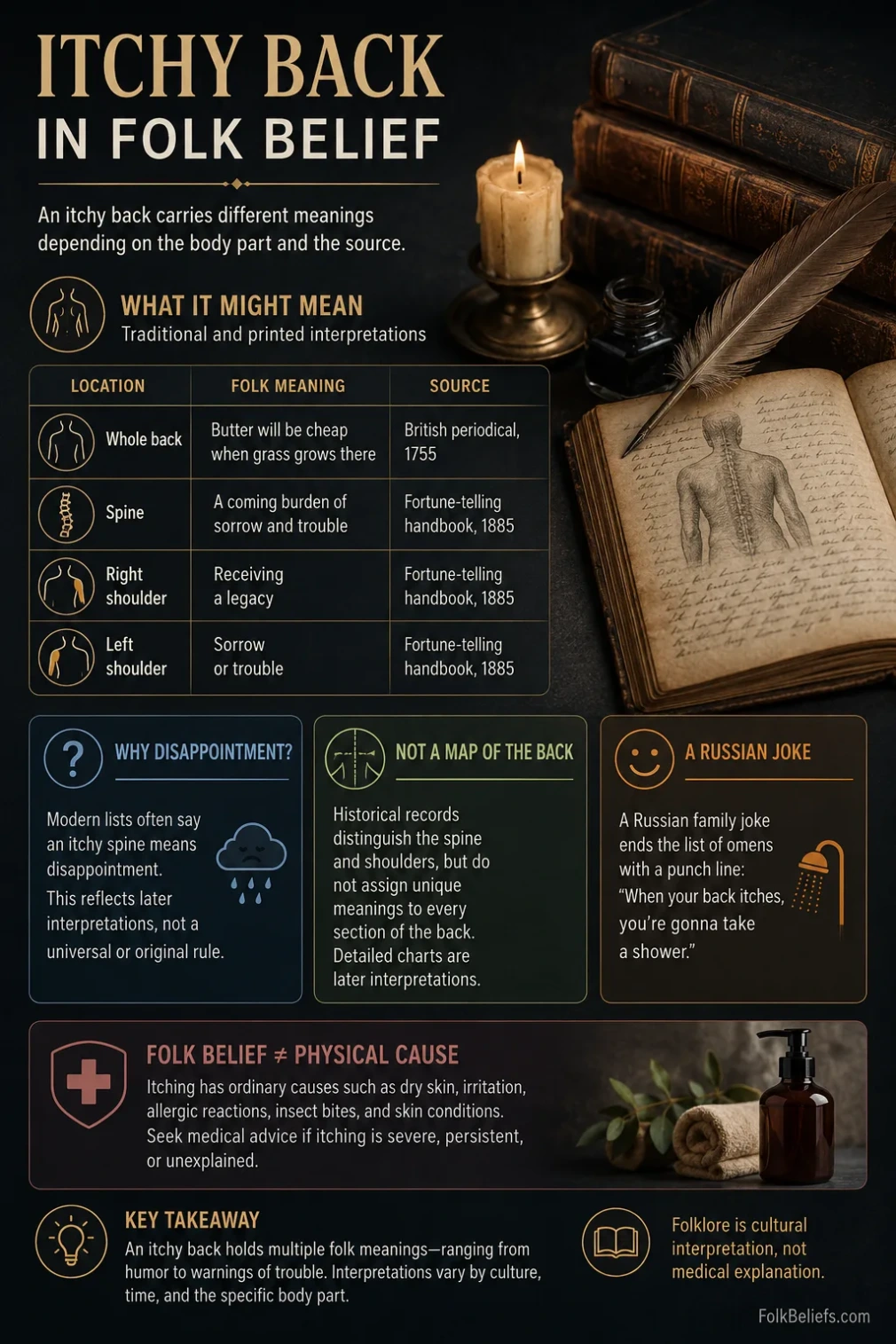
An itchy back has no single fixed meaning in superstition. A British printed record from 1755 treats the sensation as the subject of a comic saying, while a New York fortune-telling handbook from 1885 assigns an itching spine an omen of sorrow and trouble.[1][2] The familiar modern idea that an itchy back predicts disappointment is another version, not a universal rule found across folklore.
What Does an Itchy Back Mean in Superstition?
The meaning depends on what part of the back is meant and which record is being followed. Older printed material distinguishes between the whole back, the spine, and the shoulders rather than treating every back itch as the same omen.
| Location | Recorded Folk Meaning | Context |
|---|---|---|
| Whole back | A humorous saying about butter becoming cheap when grass grows on the back | British periodical, 1755 |
| Spine | A coming burden of sorrow and trouble | Fortune-telling handbook, 1885 |
| Right shoulder | Receiving a legacy | Fortune-telling handbook, 1885 |
| Left shoulder | Sorrow or trouble | Fortune-telling handbook, 1885 |
An Eighteenth-Century Back-Itch Saying
The Connoisseur, No. 59, dated March 13, 1755, presents a household whose members interpret everyday events and bodily sensations as omens. Among sayings about itching hands, knees, feet, and other parts of the body is the line that if a person’s back itches, “butter will be cheap when grass grows there.”[1]
The saying is deliberately comic. Grass is not expected to grow on a person’s back, so the phrase does not function like a straightforward prediction of good or bad luck. It resembles a teasing response to an itch rather than a practical omen.
The 1755 piece describes the family’s beliefs as traditional and places the narrator’s aunt somewhere in “the North.” Because The Connoisseur was a literary and satirical periodical, this is best treated as an early printed witness to the saying, not proof that everyone in northern England shared it.
The Itching Spine as an Omen of Trouble
A different interpretation appears in A. H. Noe’s The Witches’ Dream Book; and Fortune Teller, published in New York in 1885. Its section on signs and auguries says that itching along the spine of the back foretells having to bear sorrow and trouble.[2]
The same book gives nearby body areas their own meanings. An itching right shoulder is connected with receiving a legacy, while an itching left shoulder is associated with sorrow and trouble. These are separate entries, so the shoulder beliefs should not automatically be extended to the entire right or left side of the back.
This printed system also shows why broad statements such as “right-back itching is lucky” or “left-back itching means betrayal” should be treated cautiously. The dated record supports a right-versus-left distinction for the shoulders, not a complete map of the back.
Why Is an Itchy Back Sometimes Said to Mean Disappointment?
The shorter interpretation “an itchy spine means disappointment” circulates in later popular superstition lists. One online omen list published in 2008 records that exact basic meaning.[3]
That wording is close in tone to the older 1885 prediction of sorrow and trouble, but the two should not be treated as identical records. The 1885 text does not use “disappointment” for the spine; it reserves a form of that word for a different bodily omen involving the left elbow.[2]
For that reason, disappointment is a documented modern popular meaning for an itchy spine, but it is not the only historical interpretation of an itchy back.
Do Upper, Lower, Left, and Right Back Itches Mean Different Things?
The dated records above do not establish a stable traditional system in which every section of the back has its own meaning. They distinguish the spine and shoulders, but they do not provide matching rules for the upper back, middle back, lower back, left back, and right back.
Detailed charts that assign separate predictions to all of these locations are therefore better understood as later interpretations unless a specific tradition or historical record is supplied for them. An old shoulder omen, for example, should not be relabeled as an “upper-right-back superstition” without evidence supporting that change.
A Back-Itch Joke in a Russian Family Tradition
Not every folk use of an itchy back treats it as a serious omen. A 2013 record in the USC Digital Folklore Archives documents a joke supplied by an informant identified as Russian. After several conventional-sounding predictions for itching hands and the nose, the sequence ends with the punch line that when your back itches, “you’re gonna take a shower.”[4]
The record describes the saying as a joke learned from the informant’s father. It is evidence for that particular transmitted joke, not evidence that Russians generally interpret an itchy back this way. Its humor works because the final explanation abandons fortune-telling and gives the itch an ordinary physical response.
Folklore Meaning and Physical Itching Are Different
Superstitions about an itchy back are cultural interpretations, not explanations of what physically causes itching. MedlinePlus notes that itching can have ordinary causes such as dry skin, irritation, allergic reactions, insect bites, and skin conditions. It also advises contacting a healthcare provider when itching is severe, does not go away after a few weeks, or has no clear explanation.[5]
Sources and Records
Documented Locations
Countries: United States
Regions: Illinois (United States)
These labels identify where a version has been documented. They do not mean that everyone in the country, region, or community shares the belief.