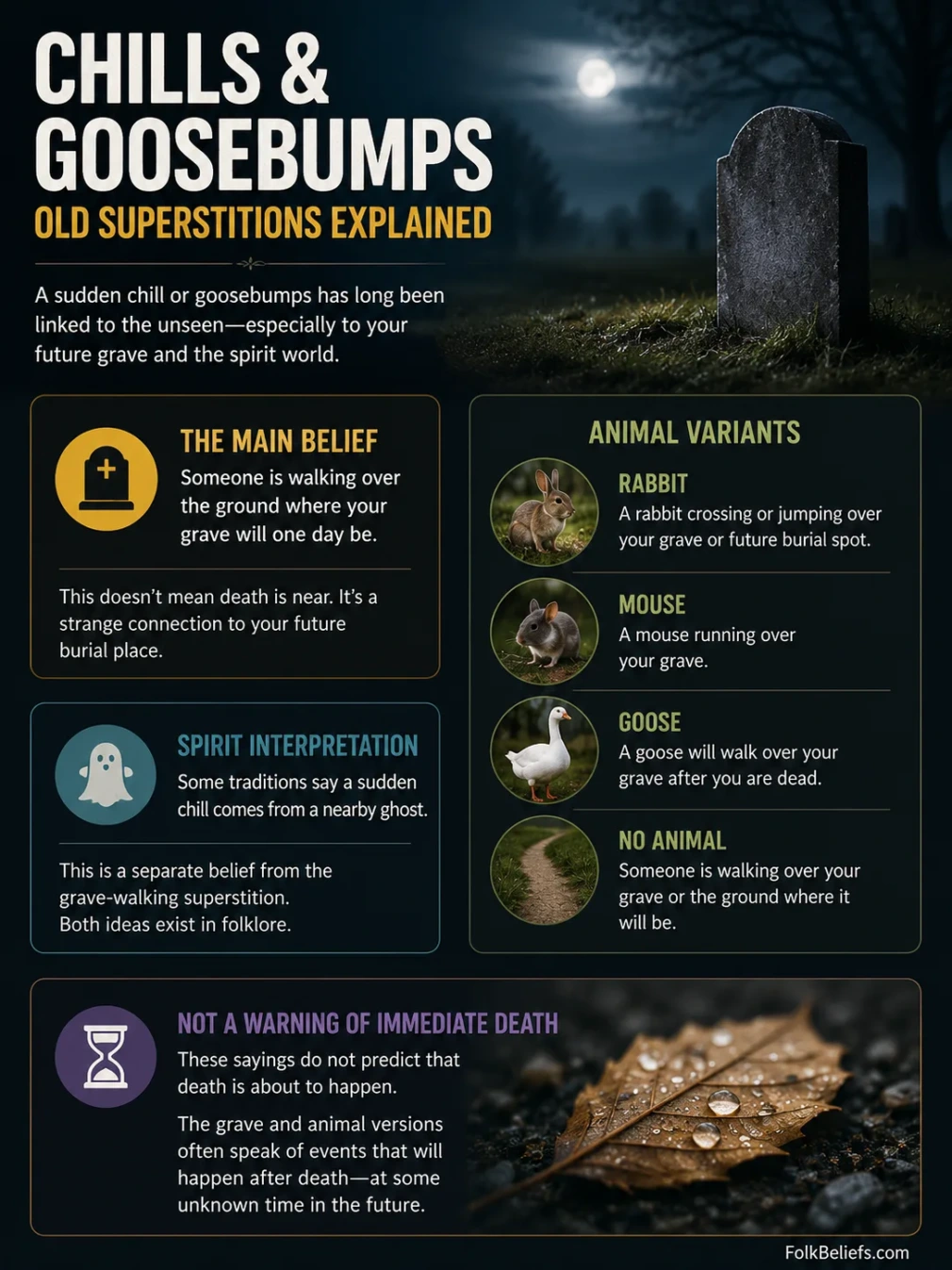
A sudden chill or burst of goosebumps has one especially well-documented folklore meaning in English-speaking tradition: someone is walking over the ground where your grave will one day be. The saying does not usually predict that death is about to happen. Instead, it turns an unexplained shiver into a strange connection with a future burial place.
By 1738, Jonathan Swift could place the line “there’s somebody walking over my grave” in a character’s mouth immediately after she shudders, showing that the expression was already recognizable in English conversation.[1]
Someone Walking Over Your Future Grave
The best-recorded interpretation links an unexplained shiver to the physical spot where the person will eventually be buried. The detail about the future grave matters. In this version, nobody is disturbing an existing grave belonging to the living person. Folklore imagines that the burial place somehow already has a connection to them.
A Dutch folklore note sent from Amsterdam and published in Notes and Queries in 1851 gives a very precise version: a sudden shivering sensation in the back means somebody is walking over the person’s future grave.[2]
The belief was also recorded in the United States. Fanny D. Bergen’s 1896 collection Current Superstitions, based on oral traditions gathered from English-speaking Americans, states that when a person shivers, someone is walking over the place where their grave is to be. The entry labels this version as “General in the United States.”[3]
These records should not be read as proof that everyone in England, the Netherlands, or the United States shared one identical belief. They show that closely related explanations for sudden chills circulated in several documented settings over a long period.
Why Some Versions Mention a Goose, Rabbit, or Mouse
The person walking over the grave is not the only form of the superstition. American folklore records preserve several animal variants, and the animal changes from one account to another.
- Rabbit: Detroit and Nashville records connect a sudden chill, shudder, or “chill bumps” with a rabbit crossing or jumping over the person’s grave or future burial spot.
- Mouse: One Detroit record says that a sudden chill up the spine means a mouse has run over the person’s grave.
- Goose: A Lexington, Kentucky record says that shivering when it is not cold means a goose will walk over the person’s grave after death.
- No animal: Other Tennessee and Michigan records keep the simpler formula that somebody is walking over the grave or over the ground where the grave will eventually be.
These variants appear together in the University of Detroit Mercy Libraries’ James T. Callow Computerized Folklore Archive, where chills, shivering, goosepimples, burial imagery, and several different animals are preserved as separate collected beliefs.[4]
The differences are useful because they show how folklore changes through oral transmission. There is no need to choose the goose, rabbit, mouse, or human-footstep version as the single correct form. Each record belongs to the setting in which it was collected.
Can Sudden Chills Mean a Spirit Is Nearby?
A spirit-related interpretation is also documented, but it should not be treated as a universal rule for unexplained chills.
A local folklore collection concerning West Prince, Prince Edward Island, records the saying that getting a chill can come from a nearby ghost. On the same page, a separate belief says that an unexplained shiver means somebody is walking over your grave.[5]
This local pairing helps explain why modern discussions sometimes associate goosebumps with an unseen presence. In the documented material, however, “a ghost is nearby” and “someone is walking over your grave” are distinct sayings. One should not automatically be presented as the original meaning of the other.
Does the Superstition Mean Death Is Near?
The grave imagery can sound like a warning of imminent death, but the wording of the most common recorded form does not give such a prediction. The person may be imagined as walking over the land where the shivering individual will someday be buried, with no indication of when that burial will occur.
The animal variants make this even clearer. One Kentucky record places the goose walking over the grave after the person is dead, while several Tennessee and Michigan accounts simply connect the sensation to a future grave site.[4]
So, within these records, a sudden chill is better understood as a piece of burial-related folklore than as a dependable prediction that something bad is about to happen.
Why Chills and Goosebumps Became Part of the Same Belief
Folklore records do not always separate a shiver, a chill down the spine, and visible goosebumps. Some collected versions specifically mention both goosepimples and shivering. That overlap makes sense because the sensations can occur together.
Physically, goosebumps are an involuntary reaction known as piloerection. The small muscles associated with hair follicles contract and raise the hairs. Cold can trigger the response, but fear, excitement, and other strong emotional reactions can also produce it through the autonomic nervous system.[6]
The bodily reaction and the superstition belong to different kinds of explanation. Goosebumps can have ordinary physical or emotional triggers; the grave, animal, and ghost interpretations belong to folklore and should not be treated as evidence of a supernatural event.
Sources and Records
- ↑1 Jonathan Swift, A Complete Collection of Genteel and Ingenious Conversation, Dialog I, first published in 1738; transcription of the passage containing the shudder and grave expression.
- ↑2 Notes and Queries, No. 81, “Dutch Folk-Lore”, May 17, 1851. The Amsterdam contribution records the future-grave interpretation of a sudden shiver in the back.
- ↑3 Fanny D. Bergen, ed., Current Superstitions: Collected from the Oral Tradition of English Speaking Folk, American Folk-Lore Society, Houghton, Mifflin and Company, 1896, entry 1229.
- ↑4a ↑4b University of Detroit Mercy Libraries, James T. Callow Computerized Folklore Archive, P842.21, collected records concerning chills, shivering, goosebumps, graves, rabbits, mice, and geese.
- ↑5 History and Folklore of West Prince, “Ghosts and Forerunners”, Canadian Digital Collections preserved by Library and Archives Canada; local Prince Edward Island supernatural-belief records.
- ↑6 Cleveland Clinic, “Why You Have ‘Goosebumps’ on Your Skin”, February 24, 2025. Medical overview of piloerection and common physical and emotional triggers.
Documented Locations
Countries: Canada, United States
Regions: Newfoundland (Canada)
These labels identify where a version has been documented. They do not mean that everyone in the country, region, or community shares the belief.