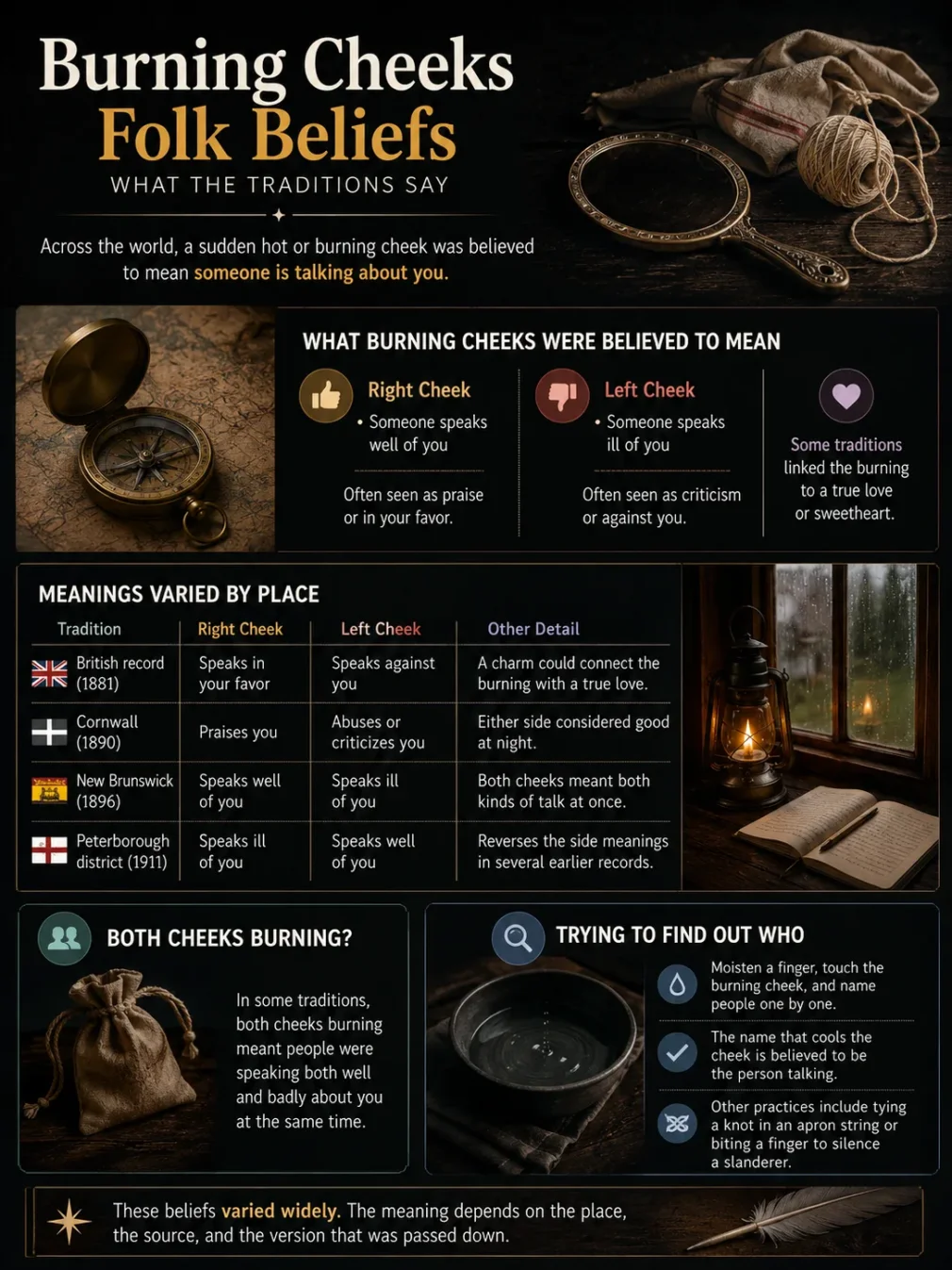
In recorded folk belief, suddenly hot or burning cheeks were often interpreted as a sign that another person was speaking about you. Praise, criticism, gossip, and thoughts of a sweetheart all appear in historical versions. The details were never fully fixed, however. Even closely related English-speaking traditions disagree about which cheek meant praise and which meant criticism.
What Burning Cheeks Meant in Recorded Folklore
One well-documented British form appears in T. F. Thiselton-Dyer’s Domestic Folk-lore, published in 1881. Dyer records a rule attributed to the antiquarian Francis Grose: a burning right cheek meant someone was speaking to the person’s advantage, while a burning left cheek meant someone was speaking to their disadvantage. He also gives a spoken charm in which the burning might ultimately be welcomed if it came from one’s true love.[1]
This pattern makes the sensation less an omen about future events than a supposed indication of a conversation happening somewhere else. The cheek was imagined as reacting to another person’s words even though the speaker was absent.
Right and Left Cheek Meanings Were Not Universal
Historical collections show why a single online rule for left-versus-right cheek burning can be misleading. The meaning changes between recorded local traditions.
| Recorded tradition | Right cheek | Left cheek | Other detail |
|---|---|---|---|
| British record in Thiselton-Dyer, 1881 | Someone speaks in your favor | Someone speaks against you | A charm could connect the burning with a true love |
| Cornwall, 1890 | Someone praises you | Someone abuses or criticizes you | Either side could be considered good at night |
| New Brunswick, recorded in 1896 | Someone speaks well of you | Someone speaks ill of you | Both cheeks meant both kinds of talk at once |
| Peterborough district, 1911 | Someone speaks ill of you | Someone speaks well of you | This reverses the side meanings found in several earlier records |
Margaret Ann Courtney’s 1890 collection of Cornish folklore gives the right-cheek-for-praise and left-cheek-for-abuse pattern. It adds an unusual time-related variation: either cheek was regarded favorably at night. The same passage records the practice of tying a knot in an apron string so that a person speaking badly would supposedly bite their tongue.[2]
A later Peterborough-area collection reverses the sides. Charles Dack recorded in 1911 that a burning left cheek meant someone was speaking well of you, while a burning right cheek meant someone was speaking ill. His list also includes the short formula that connected each burning cheek with a friend on the opposite side.[4]
There is therefore no single historical left-cheek or right-cheek meaning. The safest interpretation is to preserve the version together with the place and source in which it was recorded.
What Does It Mean if Both Cheeks Burn?
Fanny D. Bergen’s 1896 collection preserves a particularly clear New Brunswick version. In that record, the right cheek meant favorable speech and the left meant unfavorable speech. When both cheeks burned, people were supposedly speaking both well and badly about the person at the same time.[3]
This is a documented local interpretation rather than a rule that should automatically be assigned to every place where burning-cheek folklore occurs.
Trying to Identify Who Was Talking
Some versions went beyond interpreting the sensation and offered a way to discover the supposed speaker. The New Brunswick record says that the person could moisten a finger, touch the burning cheek, and name suspected people one by one. The name spoken when the cheek seemed to cool was taken to reveal who had been talking.[3]
Other collections preserve actions aimed at a hostile speaker rather than identifying one. Cornish folklore associated tying a knot in an apron string with causing a slanderer to bite their tongue, while the Peterborough collection records biting one’s finger for a similar purpose.[2][4]
Why the Belief Is Often About Gossip or Praise
The surviving records repeatedly connect cheek burning with social attention happening out of sight. Someone may be praising you, criticizing you, discussing you, or thinking about you as a lover. The physical sensation becomes a folk signal for words that the person experiencing it cannot actually hear.
The little charms and tests attached to the belief also show that people did not always treat the burning itself as a complete message. They sometimes tried to determine whether the unseen attention was friendly or hostile, or to discover who was responsible.
Does a Burning Left Cheek Always Mean Someone Is Gossiping?
No. Some recorded traditions do give the left cheek an unfavorable meaning, including the New Brunswick and Cornish examples. Yet the Peterborough record gives the left cheek the favorable meaning instead. Treating either side as a universal symbol removes the local variation that the historical sources preserve.
Does a Burning Right Cheek Mean Someone Loves You?
Romantic attention appears in some cheek-burning lore, but it is not the only interpretation. The 1881 British material includes a charm that allows the burning to come from one’s true love, while other records describe the right cheek more simply as a sign of praise or favorable speech.[1]
Claims that one particular cheek always means that a lover is thinking about you go beyond what these records support.
Folklore and the Physical Sensation Are Different Things
Burning-cheek beliefs describe traditional interpretations, not a physical mechanism. Facial flushing can occur when blood flow to the cheeks rises, and warmth may accompany ordinary reactions such as strong emotions, exercise, temperature changes, or other physical causes.[5] A persistent or uncomfortable burning sensation is therefore better treated as a bodily symptom rather than evidence that someone is talking about you.
Sources and Records
- ↑1a ↑1b T. F. Thiselton-Dyer, Domestic Folk-lore,
- ↑2a ↑2b Margaret Ann Courtney, Cornish Feasts and Folk-lore,
- ↑3a ↑3b Fanny D. Bergen, ed., Current Superstitions: Collected from the Oral Tradition of English Speaking Folk,
- ↑4a ↑4b Charles Dack, Weather and Folk Lore of Peterborough and District,
- ↑5 Cleveland Clinic, “Skin Flushing”,
Documented Locations
Countries: Canada
Regions: New Brunswick (Canada)
These labels identify where a version has been documented. They do not mean that everyone in the country, region, or community shares the belief.