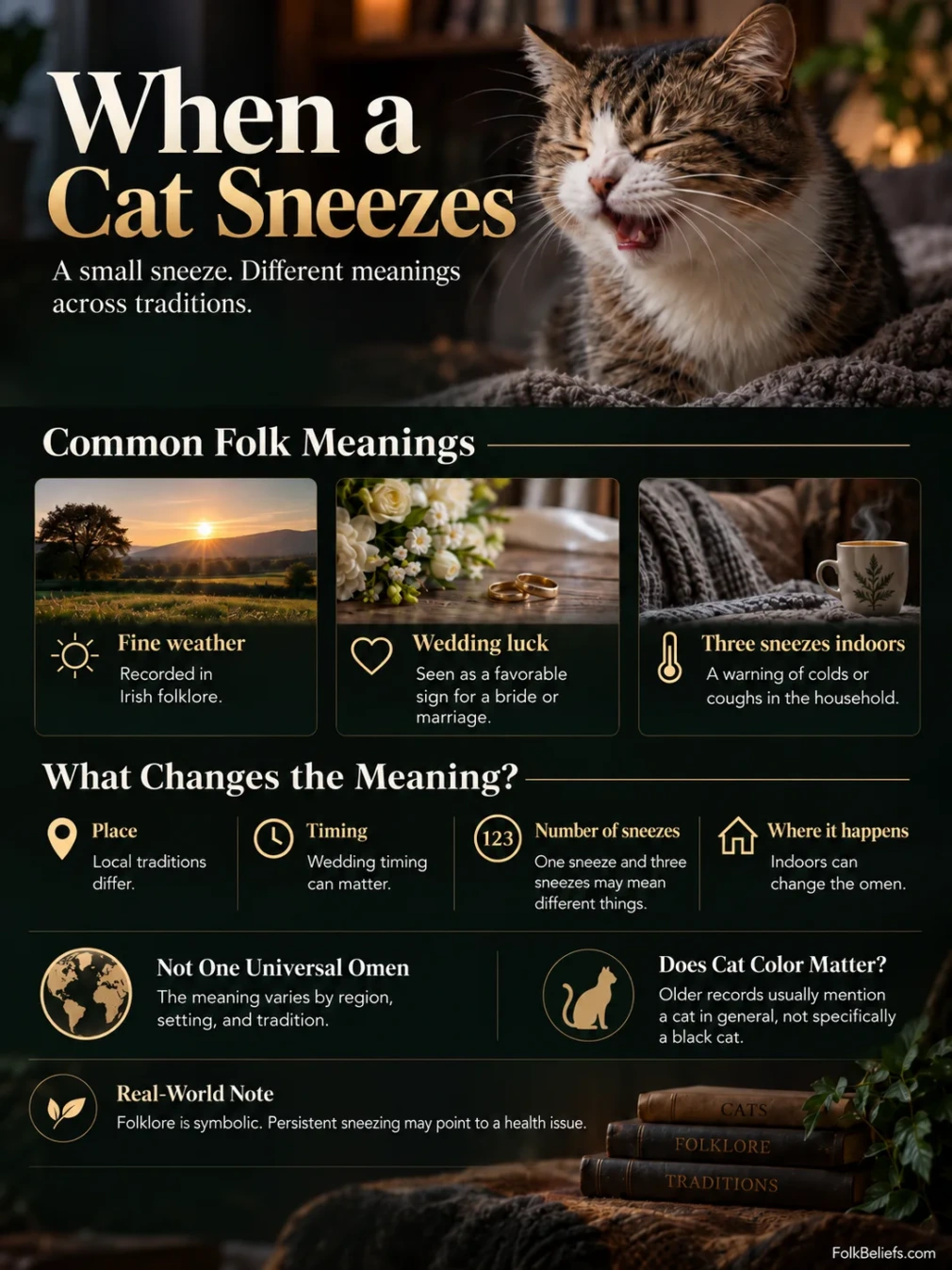
A cat’s sneeze has carried several different meanings in folk belief. In some records it promises good weather or good fortune; in others, repeated sneezing warns that illness may soon pass through the household. Wedding traditions form another distinct branch, where a cat sneezing near a bride was treated as a favorable marriage omen.
These meanings do not belong to one universal tradition. Surviving records from Ireland, England, and older European folklore show that the interpretation changes with place, occasion, and even the number of sneezes.
What Does a Cat Sneezing Mean in Folklore?
| Recorded Situation | Folk Meaning | Context |
|---|---|---|
| A cat sneezes | Fine weather | Recorded in County Galway, Ireland |
| A cat sneezes before a wedding | Lucky omen for the bride | Older British and European folklore collections |
| A cat sneezes three times in the house | Household members will suffer colds or coughs | Recorded as a Sussex belief |
| A cat sneezes near a bride | Good luck for the marriage | Reported in Italian superstition |
A Cat Sneezing as a Sign of Fine Weather
One unusually specific record comes from Ballinderreen in County Galway, Ireland. Material collected for the Irish Schools’ Collection in the 1930s includes the statement that “a cat sneezing is a sign of fine weather.” The belief was supplied by Mrs Thomas Moran of Cartron, who was recorded as being 85 years old.[1]
This is useful because it ties the omen to an identified place and informant rather than presenting it as a rule followed throughout Ireland. The same collection page places it among other short household and animal signs, suggesting that the sneeze belonged to the everyday weather lore remembered in that locality.
The belief also fits a wider pattern in which ordinary cat behavior was used to anticipate weather. Historical folklore collections contain many predictions based on cats washing their faces, scratching their ears, sitting near a fire, or changing their behavior before rain or wind. The Galway record shows that sneezing could enter this weather-sign tradition as well.
The Sneezing Cat and Wedding Luck
The best-attested cat-sneeze omen concerns marriage. John Brand’s nineteenth-century collection of British popular antiquities states that a cat sneezing was considered lucky for a bride who was to be married the following day. Brand also preserved an older Latin reference describing the sneeze as a favorable omen for the approaching marriage.[2]
Later folklore writers continued to record the same idea. Robert Means Lawrence, writing in 1898 about beliefs surrounding sneezing, described the sneeze of a cat on the eve of a wedding as an auspicious sign found in older European tradition.[3]
The timing matters in the older records. The omen was not simply “a sneezing cat means marriage.” It was connected specifically with a bride and the period immediately before her wedding.
Modern retellings often shift the timing from the wedding eve to the wedding day itself. An Italian superstition record, for example, describes a cat sneezing near a bride on her wedding day as a lucky sign for the marriage.[4] This should be treated as a related variant rather than proof that every European version used the same timing.
Why Three Sneezes Could Be an Unlucky Sign
Not every sneezing-cat belief promised good fortune. A documented Sussex tradition gave repeated sneezing a much less welcome meaning.
Folklore collector William Henderson recorded that a cat which sneezed inside the house could cause concern because three sneezes were believed to foretell colds and coughs among the people living there. Lawrence later repeated the Sussex tradition, describing three feline sneezes as an omen concerning the health of the household.[3]
The older account even says that a much-loved cat might be put outdoors after it began sneezing so that it would not complete the feared third sneeze inside the house. The belief therefore depended not only on the animal sneezing but also on where it happened and how many times.
This Sussex version differs sharply from the bridal omen. The contradiction is normal in folklore. A single action can become favorable in one setting and unwelcome in another because the meanings were transmitted through different local traditions rather than through one fixed system.
Is Hearing a Cat Sneeze Considered Good Luck?
Yes, in some traditions, but the claim needs a location or context. The marriage belief clearly treats the sneeze as favorable, and modern Italian superstition records also associate a cat sneezing near a bride with good luck.[4]
Broader modern lists sometimes say that simply hearing any cat sneeze brings luck or money. Those versions are widespread in popular retellings, but they are harder to trace to a particular historical community than the Galway weather record, the Sussex three-sneeze belief, or the older wedding omen. For that reason, “a cat sneeze always means good luck” is too broad.
Does the Color of the Cat Change the Omen?
The older bridal and Sussex records do not require a black cat. They refer to a cat generally. Black cats have their own large body of luck and misfortune folklore, and later popular accounts sometimes merge the two subjects by describing a sneezing black cat as especially fortunate.
That combination should not be projected backward onto records that never mention coat color. In the documented wedding omen, the meaningful elements are the sneeze, the bride, and the timing around the marriage.
Why Sneezing Became an Omen
Sneezing already carried a long history of supernatural and predictive interpretations before it became attached to cats. European folklore assigned meanings to human sneezes according to timing, number, circumstance, and the events taking place around them. Lawrence’s survey of sneezing beliefs records lucky sneezes, unlucky sequences, marriage-related signs, and predictions of illness from several regions.[3]
Cats also had an established place in domestic omen lore. Their grooming, movements, cries, arrival at a house, and reactions to weather were repeatedly interpreted as signs. A cat’s sneeze therefore joined two already familiar strands of folk belief: meaning attached to sneezing and meaning attached to feline behavior.
No single origin is needed to explain every version. The surviving records point instead to local variants that attached different predictions to the same ordinary behavior.
A Real Cat Sneeze Is Not a Prediction
The beliefs above are folklore rather than veterinary explanations. Cats sneeze for physical reasons, and repeated sneezing can occur with upper respiratory problems. Cornell University’s Feline Health Center lists sneezing among signs that can accompany disorders affecting the upper respiratory tract.[5]
An occasional sneeze may be brief and harmless, but persistent sneezing accompanied by nasal discharge, noisy or difficult breathing, poor appetite, or other changes should be considered in terms of the cat’s health rather than as an omen.
Sources and Records
- ↑1 National Folklore Collection, UCD, “Superstitions,” Baile an Doirín (C), The Schools’ Collection,
- ↑2 John Brand, Observations on the Popular Antiquities of Great Britain,
- ↑3a ↑3b ↑3c Robert Means Lawrence, The Magic of the Horse-Shoe, with Other Folk-Lore Notes,
- ↑4a ↑4b SuperstitionsMap, “Italian Superstitions”,
- ↑5 Cornell University College of Veterinary Medicine, Feline Health Center, “Nasopharyngeal Polyps”,
Documented Locations
These labels identify where a version has been documented. They do not mean that everyone in the country, region, or community shares the belief.