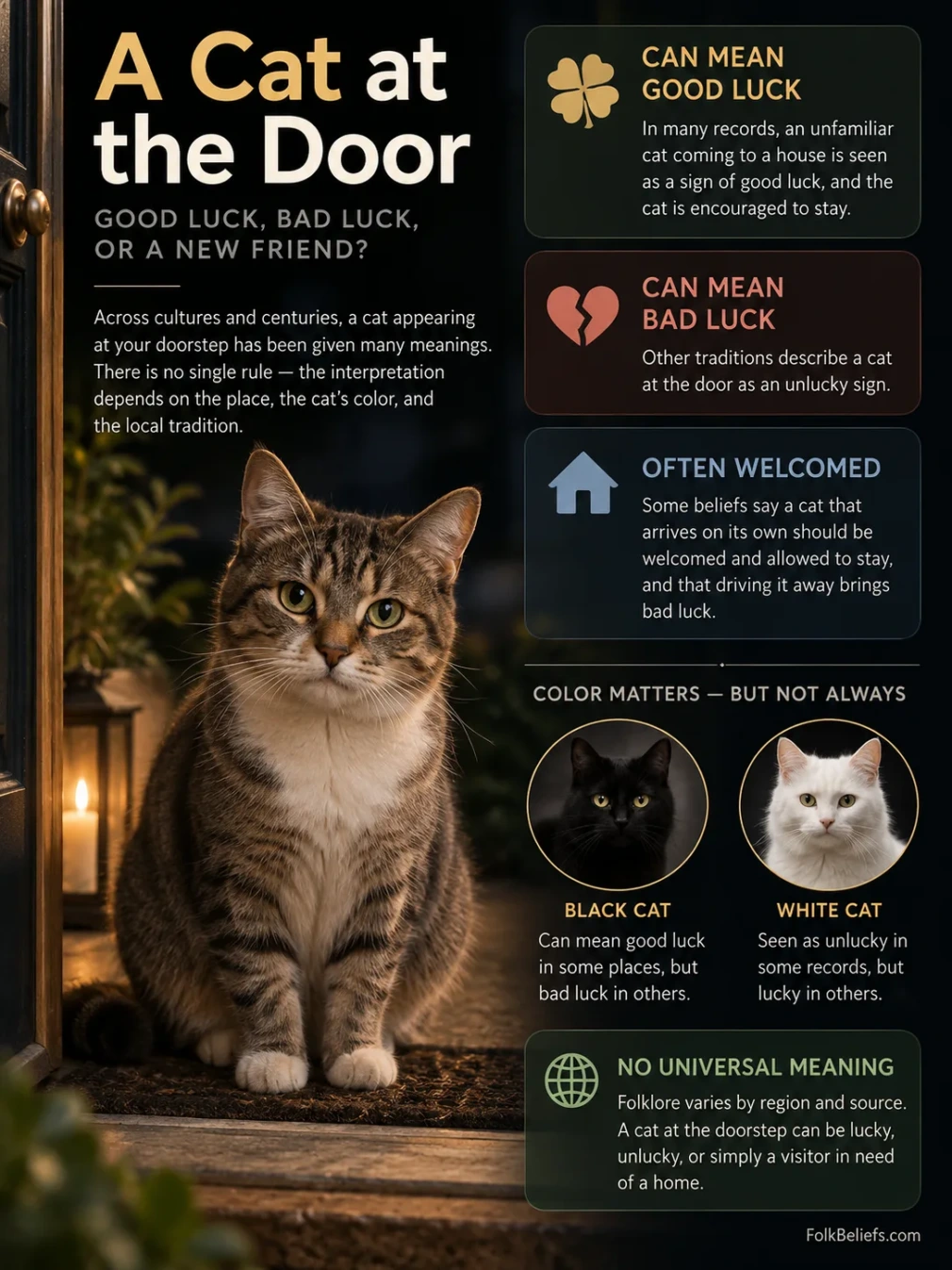
A cat appearing at the doorstep has no single folklore meaning. In documented records, an unfamiliar cat arriving at a home can be treated as lucky, unlucky, or as an animal that should be welcomed and allowed to stay. The cat’s color matters in some local versions, but the meanings reverse from one record to another.
The wording also matters. Older sources more often say that a cat “comes to the house,” “strays to the house,” or “comes into the house.” Those are closer to a doorstep visit than the separate superstition about a cat crossing someone’s path.
What the Recorded Superstitions Say
The Irish National Folklore Collection’s Schools’ Collection is especially useful because it preserves local reports rather than presenting one national rule. The collecting scheme involved pupils from about 5,000 primary schools between 1937 and 1939, with children recording folklore from their own districts.[1]
| Recorded Place | Cat at the House | Meaning in That Record |
|---|---|---|
| Glencar, County Donegal | A black cat comes to the house | Good luck is said to come with it; if the cat leaves, the luck is said to leave too.[2] |
| Oranmore, County Galway | A strange white cat enters; a black cat enters | The white cat is treated as unlucky, while the black cat is linked with good luck and is to be encouraged to stay.[3] |
| Dundalk, County Louth | A black cat comes into the house | The arrival is recorded as a sign of bad luck.[4] |
| California survey material, 1907 | A strange cat or stray cat comes to the house | Opposite versions appear together: one links a strange cat with good luck, while another links a stray cat with bad luck.[5] |
| Adams County, Illinois | A cat comes voluntarily to the house | Several collected versions treat the arrival as lucky, including black-cat and white-cat variants; another says driving away a voluntarily arriving cat causes bad luck.[6] |
These records show why “a cat at the door means good luck” and “a cat at the door means bad luck” can both be found in folklore. They belong to different recorded versions. Neither can safely be turned into a universal rule.
Why Black Cat Meanings Reverse from Place to Place
A black cat arriving at a home is not consistently unlucky. The Glencar record from Donegal makes the black cat a bearer of household luck. The Oranmore record also favors the black cat. Yet a Dundalk record from the same broad archival collection gives the opposite reading and calls a black cat entering the house a bad-luck sign.[4]
This difference is important because the records come from named local settings. A belief collected in Donegal does not establish what everyone in Ireland believed, just as one household rule from Illinois does not define American cat folklore. Even Fletcher Bascom Dresslar’s 1907 collection places good-luck and bad-luck versions of a cat coming to the house side by side.[5]
What About a White Cat at the Door?
White cats also resist a fixed interpretation. The Oranmore record says that a strange white cat coming into the house foretells bad luck, in direct contrast with its favorable treatment of a black cat.[3]
Harry Middleton Hyatt’s Folk-lore from Adams County, Illinois, published in 1935, preserves the reverse pattern in several entries: a white cat coming to the house is connected with good luck, and one version adds that the luck depends on the cat remaining.[6] Color alone therefore cannot identify the meaning without knowing which local tradition or record is being discussed.
Does It Matter Whether the Cat Stays?
In some doorstep and house-arrival beliefs, staying is part of the omen. The Donegal record does not stop at the cat’s arrival: it says the household’s good luck departs if the black cat goes away.[2]
The Adams County collection contains a related idea in a different form. One item says that driving away a cat that came voluntarily brings bad luck, while nearby entries treat black cats that arrive at the house as lucky.[6] This is one reason later retellings sometimes focus not only on the cat appearing, but also on whether it is welcomed, remains nearby, or leaves.
Doorstep, Threshold, or Inside the House?
These situations are related, but they should not automatically be treated as the same superstition.
- A cat comes to the house: this is the closest archival wording to a cat arriving or waiting at the doorstep.
- A cat comes into the house: this is narrower. The animal has crossed indoors, and some records attach the omen specifically to that act.
- A cat crosses your path: this is a separate omen pattern about an encounter while traveling or walking, not about the cat choosing a home or doorway.
The difference helps explain why a person may hear that a black cat at a home is lucky while also hearing that a black cat crossing a path is unlucky. Those statements can belong to separate folk-belief patterns rather than one coherent rule.
Is a Cat at the Door a Spiritual Message?
The historical records support a simpler claim: people have attached luck and omen meanings to cats arriving at homes. They do not establish one universal message about protection, prosperity, intuition, a coming life change, or unseen forces.
For a source-based reading, the most defensible meaning is the one actually recorded in a named place and context. In one locality the visiting cat may be welcomed as lucky; in another, the same color of cat may be treated with suspicion. The contradiction is part of the folklore rather than an error that needs to be resolved.
When a Real Cat Keeps Visiting the Door
A repeated visit has an ordinary explanation to consider before treating it as an omen. Cats Protection notes that an unfamiliar cat near a home may be an owned cat roaming its neighborhood, a lost cat, or a stray that previously had an owner. A healthy-looking visitor may already have a home, while a cat that seems lost or in need can be checked for identification or a microchip and its owner can be sought locally.[7]
Folklore can give the doorstep encounter a cultural meaning, but the animal’s presence by itself does not predict future events. The older records are best read as evidence of how different communities interpreted an unexpected feline visitor.
Sources and Records
- ↑1 National Folklore Collection, “The NFC Collections — The Schools’ Collection”,
- ↑2a ↑2b National Folklore Collection, “Beliefs and Old Sayings Still Common in Donegal”,
- ↑3a ↑3b National Folklore Collection, “Superstitions,” Oranmore,
- ↑4a ↑4b National Folklore Collection, “Superstitions,” Dundalk,
- ↑5a ↑5b Fletcher Bascom Dresslar, Superstition and Education, p. 34,
- ↑6a ↑6b ↑6c Harry Middleton Hyatt, Folk-lore from Adams County, Illinois,
- ↑7 Cats Protection, “Found a Cat? What to Do Next”,
These are records of folk belief, not evidence that a cat’s arrival causes good luck, bad luck, or any other predicted event.
Documented Locations
Countries: United States
These labels identify where a version has been documented. They do not mean that everyone in the country, region, or community shares the belief.