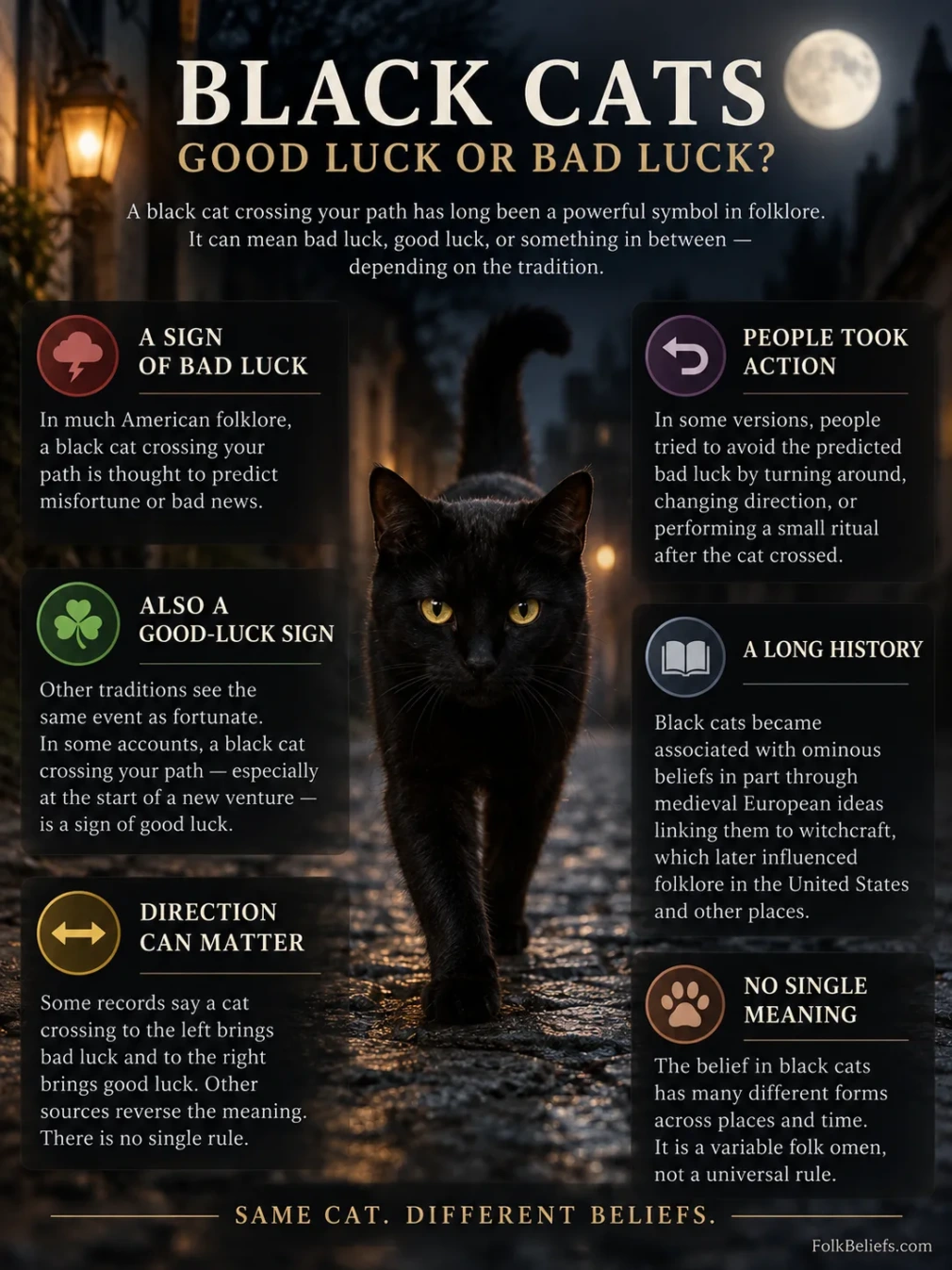
A black cat crossing your path is often described as a sign of bad luck, especially in American folk belief, but that is not the only recorded meaning. Historical collections preserve good-luck versions, direction-based versions, and different ways of responding to the encounter. The belief therefore has no single meaning that applies across every place or tradition.
Why Is a Black Cat Crossing Your Path Considered Bad Luck?
The bad-luck version has a clear place in documented American folklore. Fletcher Bascom Dresslar’s 1907 collection Superstition and Education includes black-cat beliefs among material gathered from young people and lists versions in which a black cat crossing in front of someone predicts misfortune or bad news.[1]
Later university folklore collections preserve the same basic idea. Records from Michigan, Ohio, New York, Louisiana, and other parts of the United States describe a black cat crossing the road or a person’s path as a warning of bad luck. The expected duration is not consistent: some records simply say that bad luck follows, while others limit it to the rest of the day or attach another condition to the encounter.
The variation matters. Folklore records document what particular people or communities reported. They do not show that every person in a state, country, or cultural group shared the same belief.
A Black Cat Can Also Be a Good-Luck Sign
The opposite interpretation is documented as well. In Signs, Omens and Superstitions, published in 1918, Astra Cielo explicitly noted conflicting beliefs about black cats. One entry says that if a person sets out on new work or a hunt and a black cat crosses the path, the undertaking will be lucky.[2]
This older printed record is useful because it shows that the familiar modern formula—black cat crosses the path = bad luck—was never the only version in circulation. Even within English-language folklore, the same event could be treated as fortunate or unfortunate.
A black cat crossing the path should therefore be understood as a variable folk omen, not as one universal superstition with one fixed interpretation.
Does the Direction of the Cat Matter?
Some versions make direction the deciding detail. A record preserved by the James T. Callow Folklore Archive from Winston-Salem, North Carolina, states that a black cat crossing toward the left brings bad luck, while crossing toward the right brings good luck.[3]
Other archive records assign the directions differently. One Michigan record says that a crossing from left to right is unlucky while the opposite direction is not. These conflicting forms make it unsafe to present either directional rule as the standard meaning.
| Documented Form | Meaning in That Record |
|---|---|
| Black cat crosses the path | Bad luck follows |
| Black cat crosses during the start of an undertaking | Good luck in a 1918 printed collection |
| Cat crosses toward the left | Bad luck in one North Carolina record |
| Cat crosses toward the right | Good luck in the same North Carolina record |
| Left-to-right crossing | Bad luck in a different Michigan record |
What Were People Supposed to Do After the Cat Crossed?
Some forms of the superstition include a small action intended to prevent the predicted bad luck. These responses vary almost as much as the omen itself.
A Louisiana record in the James T. Callow Folklore Archive says that when a black cat crosses in front of a person driving along a road, the traveler should turn around and take another route.[4] Other records in the collection mention changing direction, turning a hat around, making a gesture, or performing another brief counteraction.
These practices are recorded pieces of folklore rather than steps that need to be followed. Their variety is another sign that the superstition circulated through families and local communities in changing forms.
How Did Black Cats Become Connected With Ominous Beliefs?
The exact origin of the crossing-path rule cannot safely be reduced to one event. There is, however, an older body of European material connecting animals with witchcraft and supernatural familiars.
Historian Helen Parish’s study of English witch trials shows that early modern accounts described familiars in several animal forms, including cats, dogs, mice, and toads. Cats were therefore part of a much broader set of animal-familiar beliefs rather than the sole or universal companion assigned to witches.[5]
That distinction is important. Evidence that cats appeared in witchcraft narratives does not by itself prove when the specific rule about a black cat crossing a person’s path began. The surviving crossing-path records should be treated as their own folklore evidence rather than given a precise medieval origin that the records cannot establish.
Why Has the Bad-Luck Version Survived?
Short omens are easy to pass from one person to another because they require little explanation: an ordinary event happens, and a meaning is attached to it. A 2018 Dartmouth Folklore Archive entry records an American informant who learned from his mother that seeing a black cat cross the path was unlucky. The account shows the belief moving through a family even though the household was otherwise comfortable around cats.[6]
A current source-backed collection of American superstitions likewise lists a black cat crossing the path as a familiar bad-luck sign while noting that some families regard black cats as lucky instead.[7] That difference fits the older archival evidence: the animal stays the same, but the interpretation changes with the tradition in which the encounter is understood.
Sources and Records
- ↑1 Fletcher Bascom Dresslar, Superstition and Education,
- ↑2 Astra Cielo, Signs, Omens and Superstitions,
- ↑3 University of Detroit Mercy Libraries, James T. Callow Folklore Archive, “Black Cat” directional belief,
- ↑4 University of Detroit Mercy Libraries, James T. Callow Folklore Archive, black-cat road-crossing record,
- ↑5 Helen Parish, “Paltrie Vermin, Cats, Mise, Toads, and Weasils: Witches, Familiars, and Human-Animal Interactions in the English Witch Trials”,
- ↑6 Max Hunter, “Black Cat Crossing Your Path”,
- ↑7 SuperstitionsMap, “United States Superstitions”,
Documented Locations
Countries: Argentina, Brazil, Canada, Cuba, Cyprus, France, Italy, Paraguay, Peru, Spain, Turkey, United Kingdom, United States, Uzbekistan, Venezuela
These labels identify where a version has been documented. They do not mean that everyone in the country, region, or community shares the belief.