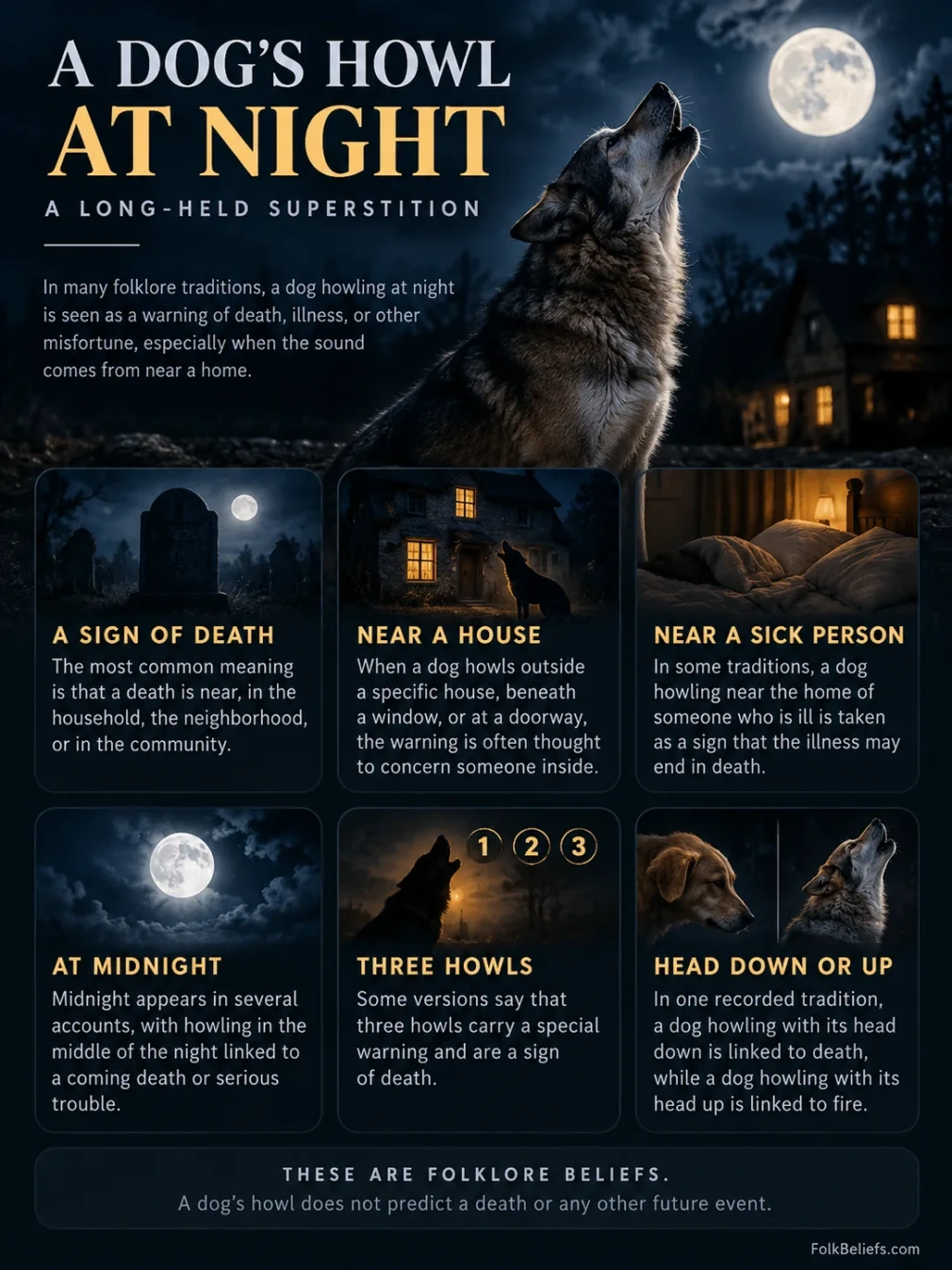
A dog howling at night is often treated in superstition as a warning of death, illness, or misfortune, especially when the sound comes from close to a home. Fletcher Bascom Dresslar’s 1907 collection preserves several versions of the belief, including nighttime howling as a warning of trouble, three howls as a death sign, and repeated howling outside a house as an omen connected with someone inside.[1] These meanings belong to folklore. A dog’s howl does not predict a death or other future event.
What a Dog Howling at Night Can Mean in Folklore
Across the records used here, death is the meaning that appears most often, but the details change from one account to another. Some versions place the expected death in the household, some in the neighborhood, and others simply say that a death is near. A few records give the howl a different meaning, such as bad luck or fire.
| Recorded form | Folklore interpretation |
|---|---|
| Howling in the middle of the night | A death is expected or believed to have occurred. |
| Howling near a house | The omen is attached to someone in the household or nearby. |
| Howling near a sick person’s home | The sound is treated as a warning that the illness may end in death. |
| Three howls | Some collected versions interpret the number as a death sign. |
| Head lowered while howling | One archived Hungarian version links this posture with death. |
| Head raised while howling | The same Hungarian record links this posture with fire rather than death. |
The James T. Callow Folklore Archive at the University of Detroit Mercy contains several records showing how narrow these variants can be. Entries collected in Michigan connect nighttime howling with death or serious trouble, while a record learned in Hungary distinguishes between a dog howling with its head down and one howling with its head up.[2]
Why the House Matters in Many Versions
Many recorded forms do not treat every distant howl as an omen. The belief becomes more specific when the dog is outside a particular house, beneath a window, at a doorway, or near someone who is already ill. Dresslar’s 1907 list includes several such house-centered forms, showing that location could determine who the warning was thought to concern.[1]
An Irish example appears in Lady Wilde’s Ancient Legends, Mystic Charms, and Superstitions of Ireland, published in 1887. Her collection describes a belief that a dog howling near the house of a sick person was taken as a warning that the person would not recover.[4] This is evidence for a recorded Irish tradition, not proof that the belief was shared by every household in Ireland.
Does Midnight Make the Howl More Ominous?
Midnight appears in several collected versions, but there is no single rule that makes midnight different from the rest of the night. In the Callow archive, one Dearborn, Michigan entry says that hearing a dog howl in the middle of the night foretells a death. Dresslar’s older collection also includes a version centered on a dog howling before a door at midnight.[2][1]
The timing is therefore part of some traditional formulas rather than a universal rule. Other records simply mention a dog howling, without specifying midnight at all.
What Does It Mean if a Dog Howls Three Times?
The idea that three howls carry a special warning is recorded, but it is only one variant. Dresslar’s 1907 collection includes “the howling of a dog three times” among death signs.[1] Other archive records make no reference to the number three, so it should not be treated as a fixed rule of dog-howling folklore.
Head Down, Head Up, and Other Directional Variants
Some traditions assign meaning to the dog’s posture as well as the sound. A Callow Archive record learned in Hungary states that a dog howling with its head pointed down means someone will die, while a dog howling with its head pointed up means there will be a fire in the area.[2]
That distinction shows why folklore about dog howling cannot be reduced to one rule. The same action may be interpreted differently depending on posture, place, timing, and the tradition in which the account was learned.
Does a Howling Dog Mean It Sees a Spirit?
Some family traditions connect the howl with a soul or unseen presence. The USC Digital Folklore Archives records a Peruvian-American informant who remembered her mother saying that a dog howling at night could be the soul of someone who was about to die or was crossing to the next world. The informant described this as a belief taught within her family, which had roots in rural Peru.[3]
This record supports a particular family tradition. It does not establish a single Peruvian interpretation for every region or community. In other records, spirits are not mentioned at all; the howl is simply treated as a warning of death or bad luck.
What Nighttime Howling Usually Means in Dog Behavior
Outside folklore, howling is a normal form of canine communication. The ASPCA notes that dogs may howl to attract attention, make contact with others, announce their presence, or respond to high-pitched sounds such as sirens and musical instruments. Howling can also occur with separation anxiety.[5]
A sudden change deserves practical attention rather than an omen-based interpretation. The ASPCA advises ruling out illness or injury when a dog starts howling or howls more than usual.[5]
Does a Dog Howling at Night Predict Death?
No evidence shows that a dog’s nighttime howl can predict a human death. What the historical and modern folklore records show is the persistence of a death-omen interpretation in particular families, places, and collections. The records preserve how people understood an unsettling nighttime sound; they do not establish supernatural prediction.
If a dog howls outside a house at night, the folkloric meaning depends on the version being told. It may be interpreted as a death warning, bad luck, a nearby spirit, or another omen. For the dog itself, however, the sound is best understood first as communication or as a possible response to its environment, emotions, or physical condition.
Sources and Records
- ↑1a ↑1b ↑1c ↑1d Fletcher Bascom Dresslar, Superstition and Education,
- ↑2a ↑2b ↑2c University of Detroit Mercy Libraries, James T. Callow Folklore Archive,
- ↑3 USC Digital Folklore Archives, “Howling Dogs”,
- ↑4 Lady Wilde, Ancient Legends, Mystic Charms, and Superstitions of Ireland,
- ↑5a ↑5b ASPCA, “Howling”,
Documented Locations
Countries: Brazil, Colombia, Costa Rica, Cuba, France, Germany, Ghana, Greece, India, Iraq, Italy, Jamaica, Mexico, Peru, Philippines, Turkey, United States, Venezuela, Vietnam
These labels identify where a version has been documented. They do not mean that everyone in the country, region, or community shares the belief.