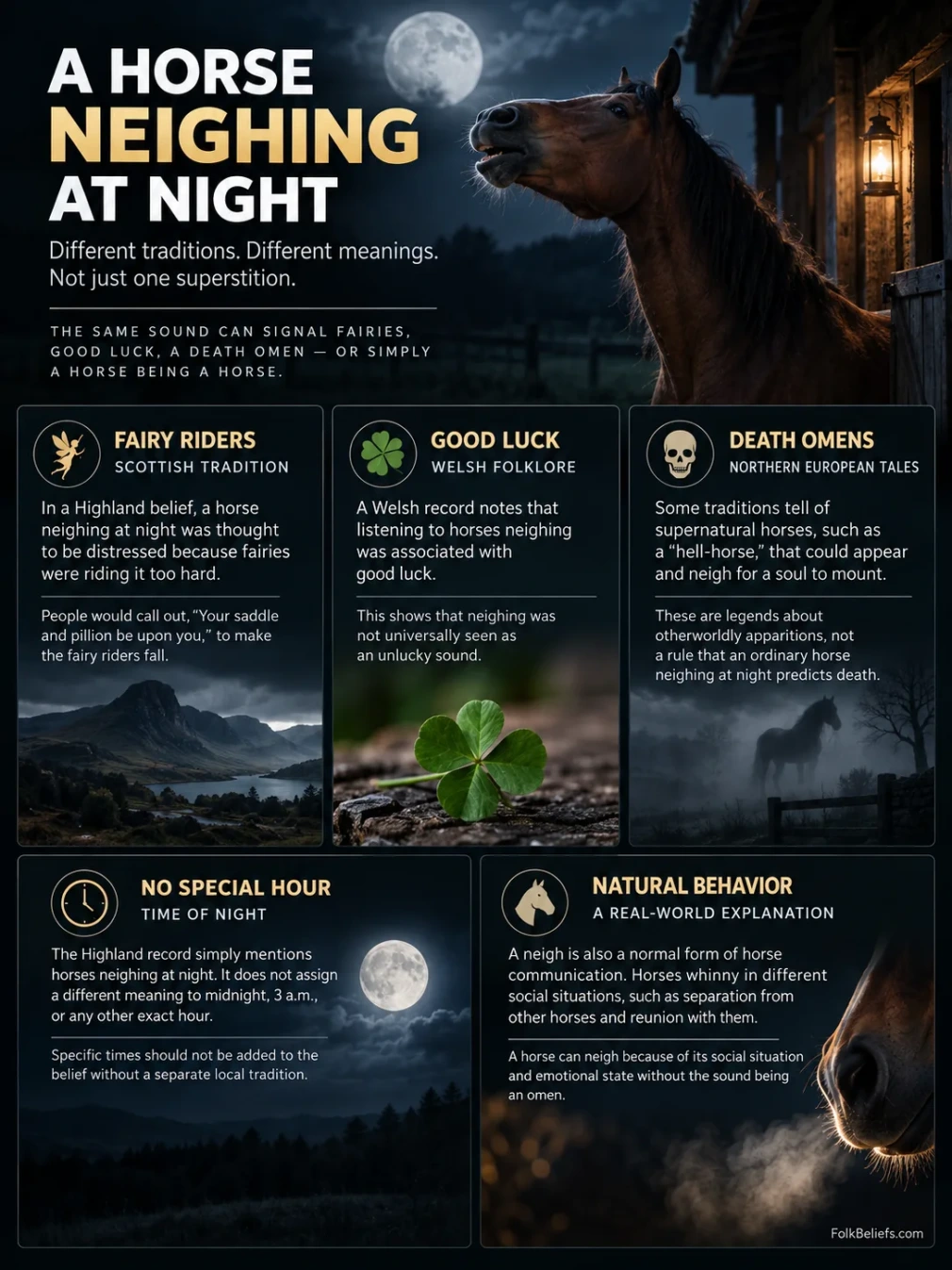
A horse neighing at night does not carry one fixed meaning across folklore. In a recorded Scottish Highland belief, nighttime neighing was interpreted as the cry of a horse being ridden too hard by fairies. Other traditions gave horse neighing very different meanings, including good luck. The time of night, the behavior of the horse, and the local tradition all matter when tracing the superstition.
The Scottish Highland Belief About Horses Neighing at Night
One of the clearest historical records comes from John Gregorson Campbell’s Superstitions of the Highlands and Islands of Scotland, published in 1900 from material described as collected from oral traditions.
Campbell records the belief that horses neighing at night were being ridden by fairies and pressed too hard. The sound was understood as a cry of distress rather than as a prediction of something that would happen to the person hearing it.[1]
The same record gives a response for someone who heard the distressed horse. The listener was to call out, “Your saddle and pillion be upon you,” followed in Campbell’s text by the Gaelic Do shrathair ’s do phillein ort. According to the belief, this caused the fairy riders to fall from the horse.[1]
This record supports a specific interpretation: nighttime neighing as evidence of unseen fairy riding. It should not be expanded into a claim that Scottish tradition generally treated every horse heard after dark as a bad omen.
Why Fairies and Night-Riding Became Connected With Horses
The Highland record belongs to a wider group of British traditions in which supernatural beings were blamed for unexplained changes in horses overnight.
T. F. Thiselton-Dyer’s 1884 Folk-lore of Shakespeare describes traditions in which fairies were believed to trouble horses at night and tangle their manes. He also recounts a West of England belief that “piskie people” rode a farm horse during the night, with knots in its mane interpreted as fairy stirrups. Other local traditions blamed witches for riding horses at night when animals were found exhausted or sweaty the next morning.[2]
These beliefs help explain why an unexpected neigh from a stable after dark could acquire a supernatural interpretation. The sound was sometimes treated as one part of a larger story about invisible riders, tangled manes, restless horses, and unexplained exhaustion.
Was Nighttime Neighing Always Considered Bad Luck?
No. A Welsh record shows how easily the meaning changes between traditions. Marie Trevelyan’s Folk-lore and Folk-stories of Wales, published in 1909, states that people who listened carefully to horses neighing could regard the sound as announcing good luck.[3]
Trevelyan does not identify this particular belief as a nighttime rule. It therefore should not be turned into a claim that Welsh folklore specifically considered a horse neighing at night lucky. What it does show is that neighing itself was not universally an unlucky sound.
| Recorded Tradition | Meaning Given to the Neighing | Night Specifically Mentioned? |
|---|---|---|
| Scottish Highland record collected by John Gregorson Campbell | The horse was believed to be distressed because fairies were riding it too hard. | Yes |
| Welsh folklore recorded by Marie Trevelyan | Listening to horses neighing was associated with good luck. | No |
Does a Horse Neighing at Night Mean Death?
Death-related horse legends do exist, but they should not be confused with every instance of nighttime neighing.
S. Baring-Gould’s 1892 Strange Survivals describes traditions from Denmark and northern Germany concerning a supernatural “hell-horse.” In the account, this otherworldly horse could appear near a house and neigh for a soul to mount it. The same discussion includes headless or spectral horses treated as death tokens.[4]
That is a belief about a supernatural horse apparition, not a rule saying that an ordinary living horse neighing in its stable after dark predicts a death. The Scottish Highland record gives a different explanation entirely: fairy riding and the horse’s distress.
Does Neighing at Midnight or 3 A.M. Have a Special Meaning?
The documented Highland account does not assign a separate meaning to midnight, 3 a.m., or any other exact hour. Campbell simply records the event as horses neighing at night.[1]
Claims that the superstition changes at a particular hour should therefore be treated separately unless they can be tied to another identifiable local tradition. An exact clock time should not be added to the Highland belief when the historical record does not contain one.
What a Horse’s Neigh Can Mean Outside Folklore
A neigh or whinny is also ordinary horse communication. Research on domestic horses has found that whinnies occur in different social situations, including separation from other horses and reunion with them. Features of the calls can carry information related to emotional arousal and whether the situation is experienced positively or negatively.[5]
The study was not about nighttime superstition, but it provides an important distinction. A horse can neigh because of its social situation and emotional state without the sound functioning as an omen. Folklore records explain how communities interpreted such sounds; they do not establish supernatural causes for the behavior.
Sources and Records
- ↑1a ↑1b ↑1c John Gregorson Campbell, Superstitions of the Highlands and Islands of Scotland,
- ↑2 T. F. Thiselton-Dyer, Folk-lore of Shakespeare,
- ↑3 Marie Trevelyan, Folk-lore and Folk-stories of Wales,
- ↑4 S. Baring-Gould, Strange Survivals: Some Chapters in the History of Man,
- ↑5 Elodie F. Briefer et al., “Segregation of Information About Emotional Arousal and Valence in Horse Whinnies”,