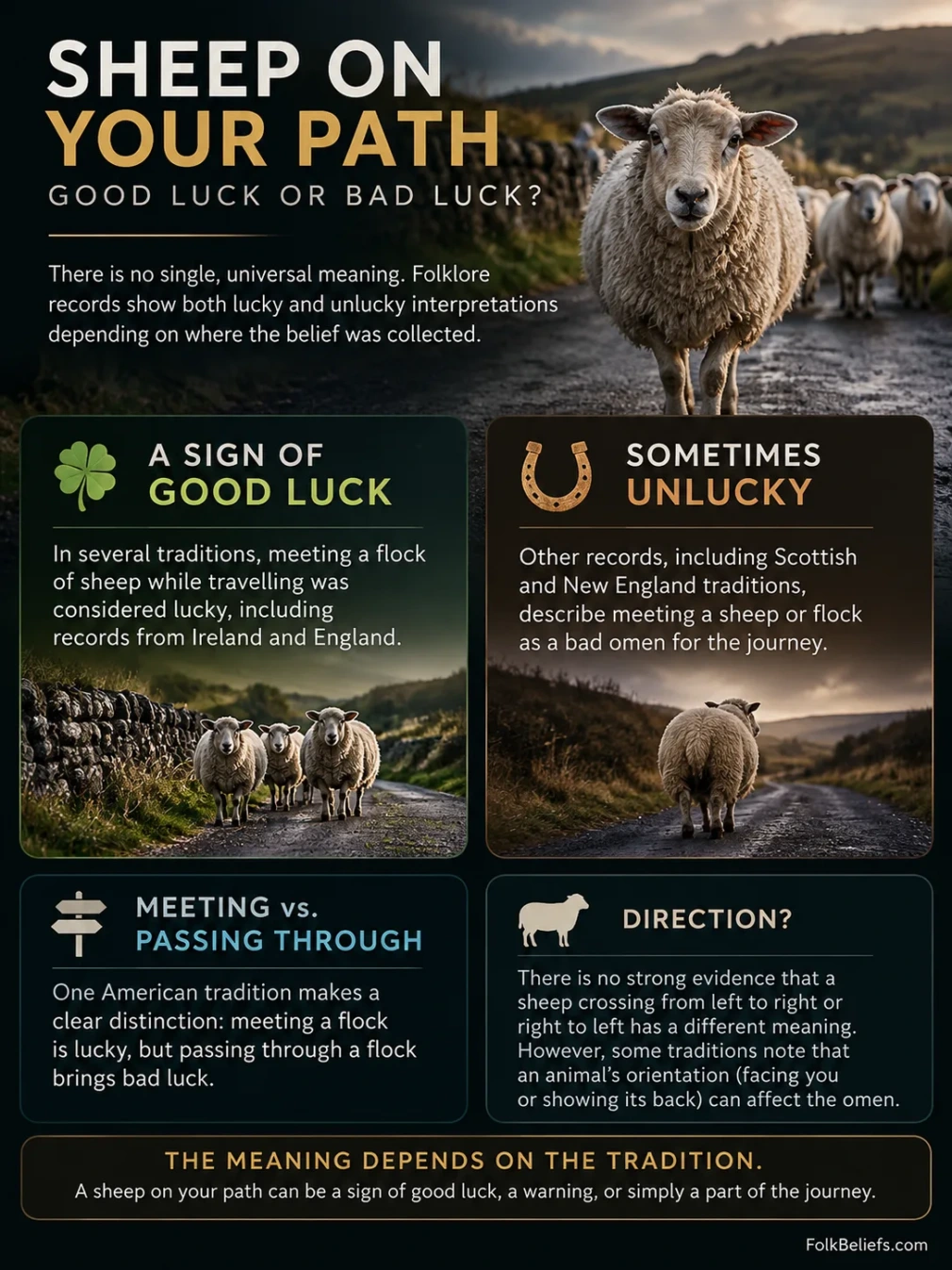
If a sheep or flock crosses your path, the safest folklore answer is that there is no single universal omen. Several recorded traditions treat meeting sheep while travelling as lucky, especially in England and Irish local collections. Other records reverse the meaning and call the same encounter unlucky. The details depend on where the belief was collected and, in one American collection, even on whether a person merely met the flock or actually passed through it.
When Sheep on the Road Meant Good Luck
A belief collected at Friarstown, County Leitrim, in the Irish Schools’ Collection states that meeting a flock of sheep while going on a journey was a sign of good luck.[1] Another Schools’ Collection record from Garryhill, County Carlow, independently lists meeting a flock of sheep among things considered lucky.[2]
The same idea appears in an English folklore survey published in 1913. Elizabeth Mary Wright recorded that meeting a flock of sheep on the highway while making a journey was considered lucky.[3]
For a modern “sheep crossing your path” question, these records are the closest documented match: encountering sheep on the road, especially while setting out or travelling, could be read as a favorable journey omen.
The Omen Could Also Be Unlucky
That favorable meaning was not shared everywhere. John Gregorson Campbell’s collection of oral traditions from the Scottish Highlands and Islands describes omens watched for at the beginning of a journey. In that setting, meeting a sheep was among the encounters believed to warn that the journey would not prosper. The orientation of an animal also mattered: an animal first seen with its back toward the traveller made the omen worse, while facing the traveller could make an unfavorable encounter less ominous.[4]
A New England collection published by Clifton Johnson in 1896 gives another reversal. Its section on luck simply records that meeting a flock of sheep was unlucky.[5]
Meeting a Flock and Passing Through It Were Not Always the Same
Harry Middleton Hyatt’s Folk-lore from Adams County, Illinois preserves an unusually useful pair of beliefs. One entry says meeting a flock of sheep is a sign of luck. The very next entry says that passing through a flock of sheep brings bad luck.[6]
This distinction matters for the phrase “sheep crossing your path.” Historical records often speak of meeting sheep rather than describing an animal literally walking from one side of a path to the other. A flock appearing ahead of a traveller, a traveller moving through the flock, and a single sheep crossing the road should therefore not automatically be treated as identical folklore events.
| Recorded Setting | Encounter | Folklore Meaning |
|---|---|---|
| County Leitrim, Ireland | Meeting a flock while going on a journey | Good luck |
| County Carlow, Ireland | Meeting a flock | Lucky |
| English folklore survey | Meeting a flock on the highway during a journey | Lucky |
| Scottish Highlands and Islands | Meeting a sheep at the outset of a journey | Unlucky |
| New England | Meeting a flock | Unlucky |
| Adams County, Illinois | Meeting a flock | Lucky |
| Adams County, Illinois | Passing through a flock | Bad luck |
Does the Sheep’s Direction Change the Meaning?
The records above do not support a broad rule that a sheep crossing from left to right means one thing and right to left means another. Direction-based interpretations are well documented for some other animal omens, but they should not be transferred to sheep without evidence.
The Scottish Highland account does preserve a related detail: whether the first animal faced the traveller or showed its back could affect the omen.[4] That is an orientation belief, not a general left-versus-right sheep-crossing rule.
What About a Single Sheep?
Many of the clearest records concern a flock, but not all do. Campbell’s Scottish material specifically includes meeting “a sheep” among journey omens, while some English collections describe meeting a sheep as favorable. The number of animals therefore cannot be assumed to carry the same meaning in every tradition.
For someone encountering one sheep today, calling it a universal sign of prosperity, danger, love, money, or an approaching life event would go beyond the historical evidence. The documented meanings are much narrower: sheep could function as luck omens connected with travel and chance encounters, with the interpretation changing between local traditions.
Why the Meanings Conflict
Folk beliefs were often transmitted locally rather than maintained as a single fixed system. A belief recorded from one family, district, county, or region could differ from one collected elsewhere. The contrast is especially clear here: two Irish records and an English survey associate encountering sheep with good luck, while Scottish Highland and New England records preserve an unfavorable reading.
Even within American folklore, Hyatt’s Illinois collection shows how a tiny change in the action could reverse the interpretation: seeing or meeting the flock was lucky, while going through it was unlucky.[6]
These are records of traditional belief rather than evidence that an animal encounter predicts future events. A sheep crossing a road has no demonstrated ability to cause good or bad fortune.
Sources and Records
- ↑1 National Folklore Collection, UCD, The Schools’ Collection: Drumlease, record collected from Martin Gallagher of Friarstown, County Leitrim. The entry records a flock of sheep met on a journey as a sign of good luck.
- ↑2 National Folklore Collection, UCD, The Schools’ Collection: Garryhill, Volume 0905, page 307, County Carlow. “Meet a flock of sheep” appears among locally recorded lucky encounters.
- ↑3 Elizabeth Mary Wright, Rustic Speech and Folk-Lore, Humphrey Milford, Oxford University Press, 1913. The work records meeting a flock of sheep on the highway during a journey as lucky.
- ↑4a ↑4b John Gregorson Campbell, Superstitions of the Highlands and Islands of Scotland, James MacLehose and Sons, Glasgow, 1900. Campbell’s journey-omen material was collected from oral sources in the Scottish Highlands and Islands.
- ↑5 Clifton Johnson, What They Say in New England: A Book of Signs, Sayings, and Superstitions, Lee and Shepard, Boston, 1896. Digitized by the Library of Congress.
- ↑6a ↑6b Harry Middleton Hyatt, Folk-lore from Adams County, Illinois, Alma Egan Hyatt Foundation, 1935, entries 2084–2085.
Documented Locations
Countries: Ireland
These labels identify where a version has been documented. They do not mean that everyone in the country, region, or community shares the belief.