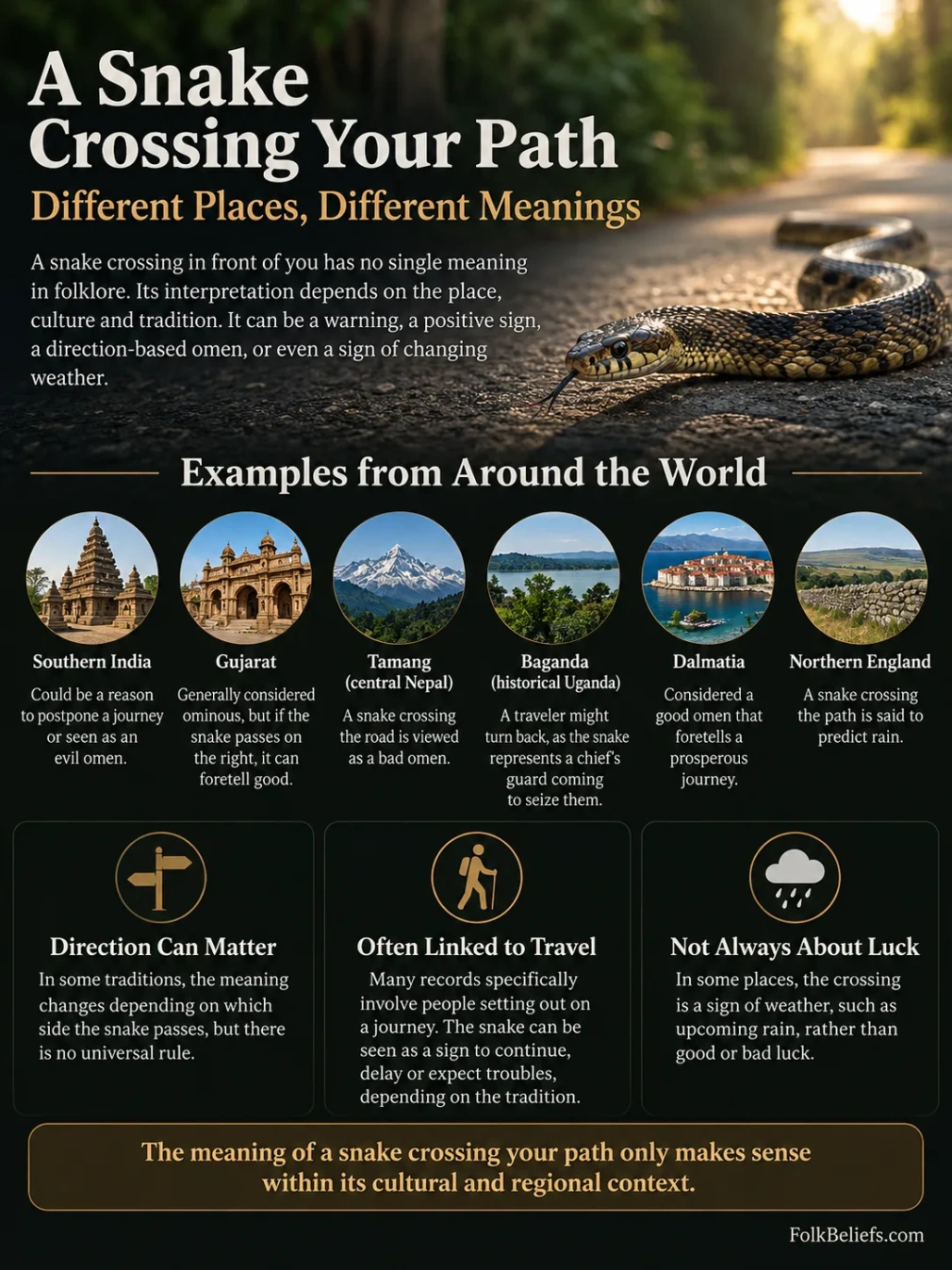
A snake crossing directly in front of someone has no single meaning in folklore. Documented records give sharply different interpretations: the encounter can warn a traveler to postpone a journey, promise favorable travel, change meaning according to which side the snake passes, or simply predict rain. The belief only makes sense within the particular place and tradition in which it was recorded.
Is a Snake Crossing Your Path Good or Bad Luck?
Both readings are documented. Several records connect the snake with unfavorable travel omens, while others give the same encounter a positive meaning.
| Recorded Setting | Belief About a Snake Crossing the Path |
|---|---|
| Southern India, early 20th century | Edgar Thurston recorded that seeing a cobra or rat-snake when setting out could be a reason to postpone an errand. He also included a judicial account in which a traveler returned home after a snake crossed the road because he regarded it as an evil omen.[1] |
| Gujarat, early 20th century | A folklore collection stated that a cat or serpent crossing a person’s path was ominous, but added that either animal passing on the right foretold good.[2] |
| Tamang communities, central Nepal | Field research conducted in 2004–2005 recorded road-crossing by snakes and cats as a bad omen among the Tamang participants studied.[3] |
| Baganda, historical Buganda | John Roscoe recorded that a traveler would turn back for the day if a snake crossed his path. In the explanation he documented, the snake represented the rope of a chief’s guard coming to seize the traveler.[4] |
| Morlacchi communities described in Dalmatia, 1848 | John Gardner Wilkinson recorded the opposite interpretation: a snake crossing the road was considered a good omen that foretold a prosperous journey.[5] |
| Leeds and northern English folklore, 19th century | William Henderson recorded a saying that if a snake crossed the path, rain would follow. Here the encounter concerned weather rather than good or bad luck.[6] |
These records make it difficult to label the event simply as lucky or unlucky. Even beliefs collected in broadly neighboring regions can differ, while a record from another community may interpret the crossing as a weather sign rather than a prediction about the traveler.
Does the Direction of the Snake Change the Meaning?
Direction matters in some recorded traditions, but there is no worldwide rule for interpreting it.
The Gujarat collection gives a useful example. It first describes a serpent crossing the path as unfavorable, then says that the omen becomes favorable if the animal passes on the right.[2] The wording is important. “Passing on the right” should not automatically be rewritten as “moving from left to right” or “moving from right to left.” Those are more exact directional claims than the record itself makes.
For that reason, statements such as “left to right always means good luck” or “right to left always means bad luck” should not be treated as universal snake-crossing rules. A direction belief needs its own regional or community evidence.
Why the Journey Itself Matters
Several older records are specifically about setting out. The snake appears after a person has begun an errand or journey, and the encounter is interpreted as information about whether that journey should continue.
This is different from treating every unexpected snake sighting as a broad message about a person’s future. In the southern Indian and Baganda records, the practical response within the belief was to stop or delay travel. In Wilkinson’s Dalmatian account, however, the crossing promised a prosperous journey. The event is similar; the inherited interpretation is not.
This also explains why a modern personal interpretation such as change, renewal, or transformation should be kept separate from a documented path-crossing superstition. Someone may choose to give an encounter that symbolic meaning, but the historical records above do not support it as the universal meaning of a snake crossing one’s path.
Does a Snake Crossing Your Path Predict Something Bad?
Folklore records tell us what people have believed; they do not establish that the encounter predicts a later event. A bad-omen record documents a cultural interpretation, not a demonstrated connection between the snake and whatever happens afterward.
A snake crossing a path is therefore best described as an omen only within the belief system being discussed. The same encounter has been recorded as unfavorable, favorable, or related to weather, depending on the source.
Why a Snake May Actually Cross a Road or Path
Outside folklore, a snake crossing a road is ordinary animal movement. Roads cut through reptile habitat, so snakes may encounter them while moving through the landscape. The U.S. Geological Survey also notes that paved surfaces absorb and retain heat, which can attract snakes and lizards to roads.[7]
If a snake is physically in the way, giving it space is more useful than trying to determine an omen from its direction. Do not approach or handle an unfamiliar snake. On a road, avoid creating a traffic hazard and allow the animal to move away when it is safe to do so.
A family or local community may still preserve its own interpretation of such an encounter. That version can be meaningful as folklore while remaining distinct from a prediction of what will happen next.
Sources and Records
- ↑1 Edgar Thurston, Omens and Superstitions of Southern India,
- ↑2a ↑2b A. M. T. Jackson and R. E. Enthoven, Folk Lore Notes, Vol. I—Gujarat,
- ↑3 Usha Lohani, “Man-animal relationships in Central Nepal”,
- ↑4 John Roscoe, The Baganda: An Account of Their Native Customs and Beliefs,
- ↑5 John Gardner Wilkinson, Dalmatia and Montenegro, Volume II,
- ↑6 William Henderson, Notes on the Folk-Lore of the Northern Counties of England and the Borders,
- ↑7 U.S. Geological Survey, “Reptile and Amphibian Road Ecology”,
Documented Locations
Countries: Bolivia, Fiji, India, Myanmar, Uganda
These labels identify where a version has been documented. They do not mean that everyone in the country, region, or community shares the belief.