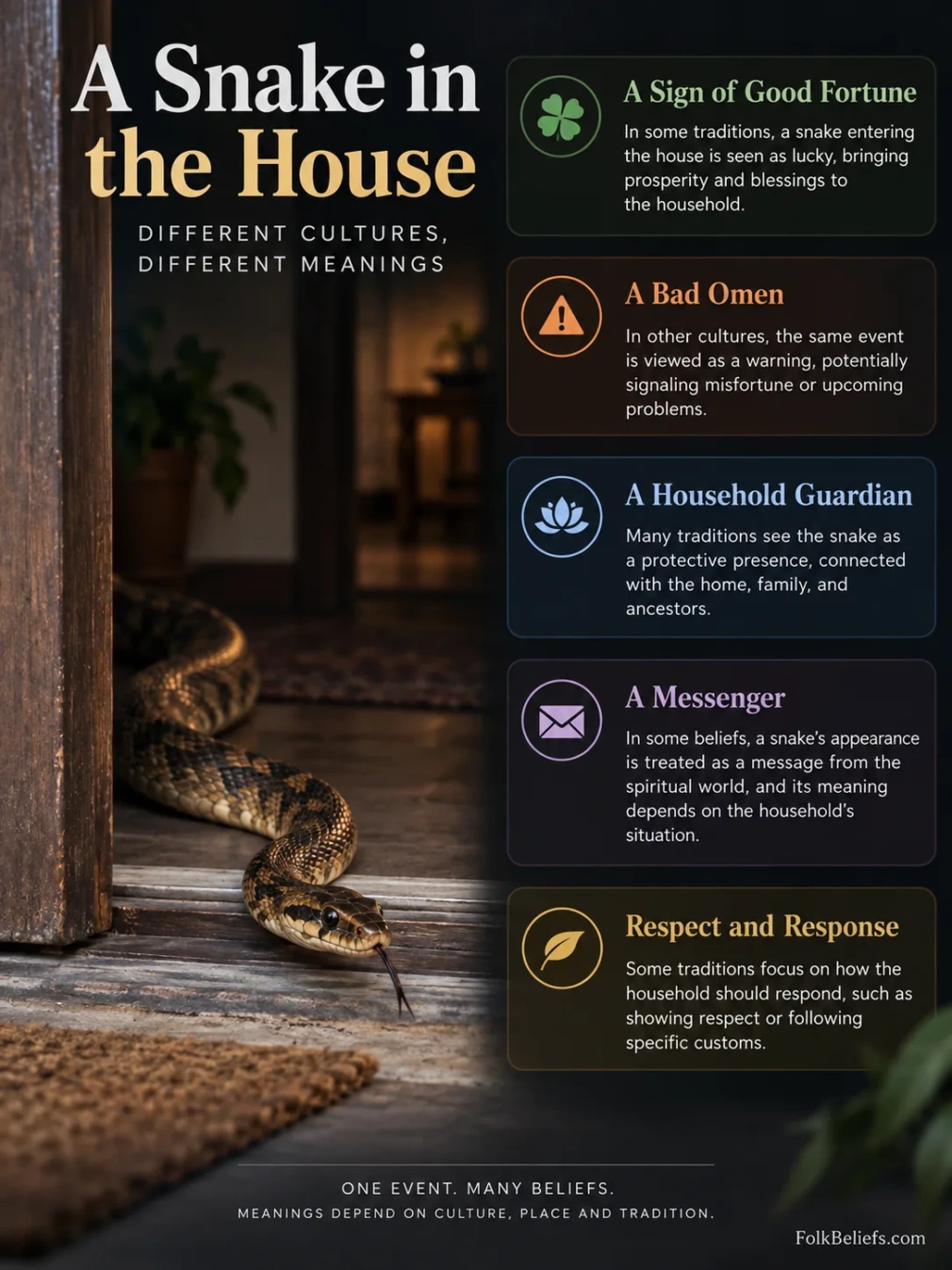
A snake entering a house does not have one fixed meaning in folklore. Depending on the community and setting, the event may be read as good fortune, a warning, the appearance of a household guardian, or a message that needs interpretation. A 2024 qualitative study in northern Thailand recorded opposite readings within the same broad region: northern Thai participants described a snake entering the house as lucky and associated it with good fortune, while Akha participants in Phop Phra described the event as a bad omen.[1]
These meanings belong to particular communities, places, and historical records. A belief documented in one community should not be presented as the belief of an entire country or culture.
When a Snake in the House Is a Good Omen
Some traditions treat a snake inside the home as a welcome presence rather than an intruder. In a historical account discussed by scholar Abraham Ofir Shemesh, snakes living in old Arab houses in Jerusalem were regarded by local inhabitants as beneficial household companions, and their presence was described as a good omen. The account belongs to a particular nineteenth-century setting and should not be expanded into a general rule for Jerusalem or Arab culture.[2]
The positive meaning becomes even clearer in traditions where the snake is understood as belonging to the household itself. Research on Modern Greek, Albanian, Bulgarian, Macedonian, Serbian, and related Balkan traditions documents a household guardian serpent. Narratives may portray this domestic snake as connected with the family, the master of the house, or the protection of children and heirs.[3]
A comparable pattern appears farther east. A study comparing Korean and Hungarian snake beliefs examines the Korean household deity known as ŏpsin alongside the Hungarian házikígyó, or house snake. Both traditions place serpentine figures within household religion and connect them with ideas such as domestic guardianship, offerings, and ancestral associations.[4]
In these records, the snake is meaningful because it is associated with the house and family, not simply because any snake has crossed a doorway. That distinction matters. A guardian house serpent in a particular folk tradition is not the same thing as a universal superstition that every wild snake entering every home brings luck.
When the Same Event Is a Warning
Other traditions interpret the arrival very differently. The northern Thailand study provides an unusually clear example because it records both favorable and unfavorable meanings. Among Akha respondents in the Phop Phra study area, a snake entering the house was described as a bad omen and was followed by a customary response. The researchers did not present this as a belief shared by every community around them; northern Thai respondents in the study gave the event a favorable meaning instead.[1]
This is why claims such as “a snake entering your home always means money” or “a snake indoors always predicts misfortune” do not match the folklore record. The interpretation depends on whose tradition is being described.
A Snake Can Be Treated as a Messenger
Some beliefs do not place the encounter neatly into either good luck or bad luck. Among the Igbo-speaking people of Ishiagu in Nigeria, researchers documented traditions surrounding a sacred green snake known locally as Aka. Within this local belief system, the snake is associated with Ali, the Earth spirit. When a green snake enters a house, especially one of its rooms, its appearance may be treated as a message whose meaning requires interpretation. The recorded message may be favorable or unfavorable depending on the household’s relationship with the traditions surrounding nsọ Aka and nsọ Ala.[5]
Here, asking only whether the snake is “lucky” misses part of the belief. The animal functions as a culturally recognized messenger, and the meaning comes from the local religious and social context rather than from the simple act of entering a building.
Some Traditions Focus on How the Household Responds
Folklore may also prescribe a response without giving the snake a simple lucky-or-unlucky label. Mayrambek Orozobaev recorded a Kyrgyz practice in which, when a snake entered a rural dwelling or yard, household members used milk-based drinks such as milk, ayran, or koumiss in a practice called ak çaçuu, commonly rendered as “white spreading.” The act was associated with sending the snake away.[6]
This kind of record shows another side of snake folklore. The encounter may be treated as an event requiring respectful or ritualized handling rather than as a prediction about what will happen next.
Why the House Matters So Much in Snake Folklore
The doorway separates domestic space from the outside world, so an animal crossing that boundary can acquire meanings it would not have in a field or forest. In traditions that recognize a household serpent, the snake may be understood as part of the home’s protective or ancestral order. Elsewhere, an unexpected animal entering private space may instead be read as a warning.
This helps explain why apparently contradictory beliefs can coexist. The snake itself does not carry one stable folklore meaning. Its role changes according to the local ideas surrounding the household, ancestors, guardian beings, sacred animals, and omens.
The best-supported interpretation is therefore context-dependent: a snake entering a house has been documented as a favorable omen in some communities, an unfavorable omen in others, a household guardian in several European and Asian traditions, and a sacred messenger in at least some locally documented African traditions.
Does the Snake’s Color, Direction, or Room Change the Meaning?
There is no dependable cross-cultural rule saying that a black snake means one thing, a white snake another, or that entering through a particular door has the same meaning everywhere. Detailed rules about color, direction, time of day, or individual rooms may exist within particular traditions, but they should be traced to those traditions before being presented as folklore.
The same caution applies to claims that a snake entering a bedroom always predicts romance, a kitchen snake always predicts money, or a snake leaving the house always means loss. Such interpretations may circulate in modern spiritual material, but they should not be treated as universal folk beliefs without supporting records.
Dream traditions are also separate. A dream in which a snake enters a house may have its own symbolism, but evidence about dreams should not be used to explain a physical snake entering an actual dwelling.
What Does Killing a House Snake Mean in Folklore?
Where a snake is regarded as the guardian or supernatural representative of a household, harming it can become taboo. Balkan material records special treatment of the household serpent and even traditions concerning the burial of one that was accidentally killed.[3]
The Ishiagu material gives a different local example. The sacred green snake is protected within nsọ Aka, and killing it is regarded within that tradition as a violation requiring a culturally prescribed response.[5] These are records of particular beliefs and practices, not evidence that harming a snake causes supernatural consequences.
Folklore describes how people have interpreted an encounter; it does not determine whether an actual snake is dangerous. An unfamiliar snake inside a home should not be touched or handled. Public-health guidance advises giving snakes space and using trained local wildlife or animal-control help when available. A snakebite requires prompt medical attention.[7]
Sources and Records
- ↑1a ↑1b Kanokwan Suwannarong et al., “Beliefs, Taboos, Usages, Health Perceptions, and Practices Toward Wildlife Among Different Ethnicities in Tak and Mae Hong Son Provinces, Thailand”,
- ↑2 Abraham Ofir Shemesh, “‘The Household Snake’: Detection and Eradication of Pests in the Home by Means of Snakes, as Reflected in Talmudic Sources”,
- ↑3a ↑3b Oksana V. Tchoekha, “The Mythological Character of the Household Guardian Serpent and Its Names in Modern Greek, Albanian and Balkan Slavic Traditional Cultures”,
- ↑4 Voeroes Erika Erzsebet, “The Snake in Korean and Hungarian Folklore: A Comparative Study Focusing on Its Role as a Household Deity”,
- ↑5a ↑5b J. Kelechi Ugwuanyi, Linda Ngozika Ajah and Stanley Jachike Onyemechalu, “Nsọ Aka Heritage, Traditional Ecological Knowledge, and Nature Conservation in Ishiagu, Nigeria”,
- ↑6 Mayrambek Orozobaev, “Kırgız Halk İnancı ve Halk Hekimliği Uygulamalarında Yılan”,
- ↑7 Centers for Disease Control and Prevention, “Wildlife”,
Documented Locations
Countries: Australia, Ghana, Kazakhstan, Kyrgyzstan, Nepal, Vietnam
These labels identify where a version has been documented. They do not mean that everyone in the country, region, or community shares the belief.