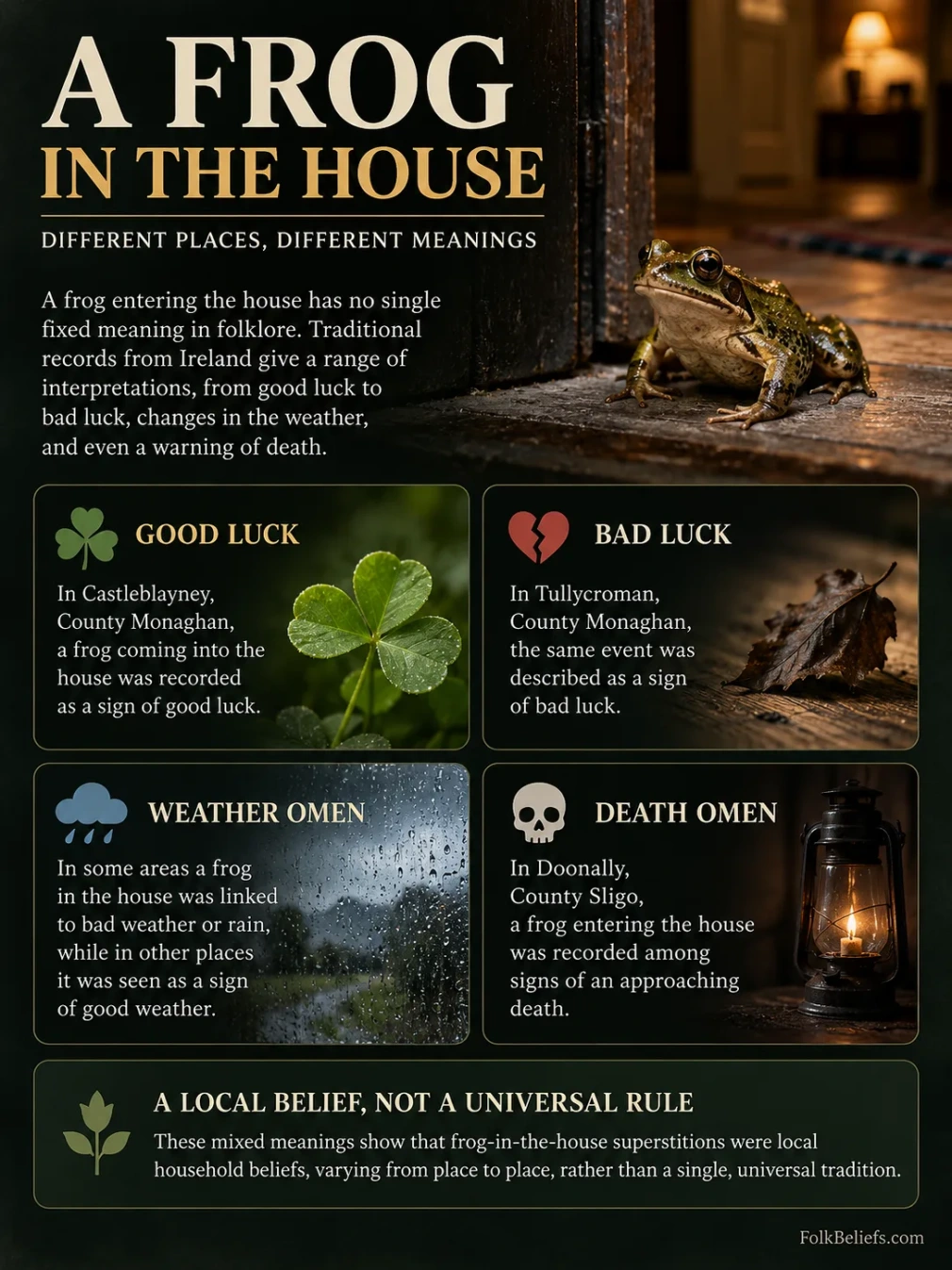
A frog entering the house has no single fixed meaning in recorded folklore. One Irish record from Castleblayney, County Monaghan, lists a frog coming indoors among signs of good luck.[1] Another record from Tullycroman in the same county gives the opposite interpretation: a frog entering the house means bad luck is coming.[2]
Other surviving records connect the visit with rain, fine weather, or death. The safest way to understand the superstition is therefore as a group of local household omens, not a universal rule about frogs.
What Does a Frog Entering the House Mean?
| Recorded place | Meaning attached to the frog |
|---|---|
| Castleblayney, County Monaghan | Good luck[1] |
| Tullycroman, County Monaghan | Bad luck[2] |
| Milltown, County Galway | Bad weather[3] |
| Thomastown, County Kilkenny | Rain[4] |
| Lisglassan area, County Monaghan | Good weather[5] |
| Doonally, County Sligo | Death omen[6] |
Good Luck and Bad Luck Could Exist Side by Side
The County Monaghan records are especially useful because they show how sharply a belief could vary within a relatively small area. A Schools’ Collection page from Castleblayney simply places a frog coming into the house under good luck. A Tullycroman record instead says that the same event foretells bad luck coming.[1][2]
This makes broad statements such as “a frog in the house always means prosperity” or “a frog indoors is always unlucky” hard to support. Both interpretations existed in collected folklore, and neither can be treated as the single traditional meaning.
The Frog as a Weather Omen
Several records place the frog firmly in weather lore rather than fortune telling. At Milltown in County Galway, an informant recorded that a frog coming into the house was a sign of bad weather.[3]
A record from Thomastown, County Kilkenny, is more specific. Among a series of local weather sayings, a frog entering the house is said to bring rain.[4] A County Cork record narrows the image further, stating that a brown frog entering the house was taken as a sign of rain.[7]
Yet weather interpretations were not uniform either. In a County Monaghan collection of local animal sayings, a frog coming indoors was recorded as a sign of good weather.[5] The contradiction is a useful reminder that weather lore often belonged to particular families and districts rather than to one standardized tradition.
When the Frog Was Treated as a Death Omen
Some records give the visit a much darker meaning. A Schools’ Collection entry from Doonally in County Sligo lists a frog coming into a house among signs of an approaching death.[6]
A record collected in County Donegal contains an unusually detailed variation: a frog entering the house during the year, except during harvest time, was said to foreshadow a death.[8] That seasonal exception shows why small details matter in folklore. Removing them can turn a local belief into a much broader claim than the surviving record actually supports.
These are records of folk belief, not predictions. A frog entering a home does not provide evidence that good luck, bad luck, rain, or death will follow. The records preserve what particular people or communities associated with the event.
Does the Frog’s Color Change the Meaning?
Most of the records examined simply say “frog” and do not distinguish species or color. The County Cork weather record is an exception because it specifically mentions a brown frog entering the house as an omen of rain.[7]
That single record is not enough to create a general rule that brown frogs have one meaning while green or other frogs have another. Color should only be treated as meaningful where the individual tradition actually mentions it.
Are Frog and Toad Superstitions the Same?
Older folklore sources sometimes place frogs and toads close together, but they should not automatically be treated as interchangeable. A nineteenth-century account of Cornish folklore, for example, records that a toad coming into the house was considered lucky in Cornwall.[9]
That Cornish toad belief supports the existence of a favorable household-amphibian omen, but it does not prove that every frog-entering-the-house tradition carried the same meaning. The Irish records alone preserve good luck, bad luck, weather, and death interpretations.
Why Are There So Many Different Meanings?
Household omens were often transmitted locally. A saying remembered in one family or district could differ from a saying collected only a short distance away. The surviving frog records illustrate this especially clearly: even County Monaghan preserves both favorable and unfavorable interpretations, as well as a weather-related one.
For that reason, questions such as “Is a frog entering the house good luck?” cannot be answered with a simple yes or no. Good luck is genuinely recorded, but so are bad luck and other meanings. The location and wording of the individual folklore record matter more than a modern universal interpretation.
Sources and Records
- ↑1a ↑1b ↑1c National Folklore Collection, “Superstitions about Good and Bad Luck”,
- ↑2a ↑2b ↑2c National Folklore Collection, “An Old Belief”,
- ↑3a ↑3b National Folklore Collection, “Old Signs and Sayings”,
- ↑4a ↑4b National Folklore Collection, “Weather-Lore”,
- ↑5a ↑5b National Folklore Collection, “Local Sayings about Animals”,
- ↑6a ↑6b National Folklore Collection, “Superstitions”,
- ↑7a ↑7b National Folklore Collection, “Omens and Signs”,
- ↑8 National Folklore Collection, “Superstitions”,
- ↑9 M. A. Courtney, “Cornish Folk-Lore”,
Documented Locations
Countries: Ireland
These labels identify where a version has been documented. They do not mean that everyone in the country, region, or community shares the belief.