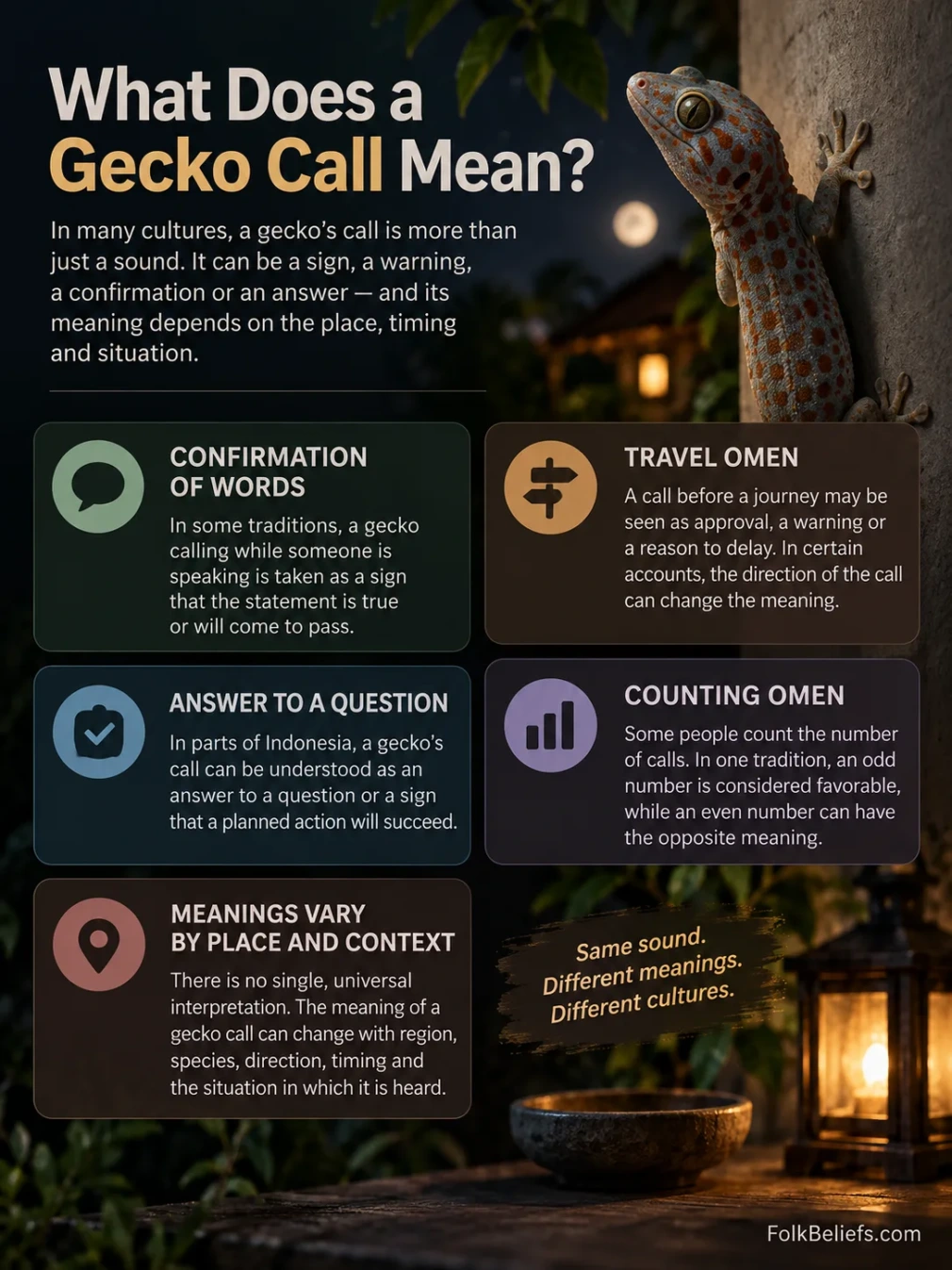
A gecko calling is not tied to one universal superstition. In documented traditions, the sound can confirm a spoken statement, warn someone about a journey, approve a plan, or become part of a counting omen. The meaning changes with place, species, direction, timing, and the situation in which the call is heard.
What Does a Gecko Calling Mean in Folk Belief?
Several recurring interpretations appear in folklore records, but they do not form a single cross-cultural rule. A call may be treated as:
- confirmation of words that have just been spoken;
- a favorable or unfavorable travel sign heard before departure;
- an answer to a question or planned action;
- a counting omen in which the number of repeated calls changes the reading.
Even within the same country, different communities can assign opposite meanings to the same sound. A gecko call that supports a decision in one tradition may interrupt a journey in another.
When the Call Confirms What Someone Just Said
A historical Bengali belief gives the gecko’s voice a very specific role. Jürgen Wasim Frembgen’s study of gecko folklore cites an older Bengal record in which a house lizard calling while someone is speaking is taken as confirmation that the statement is true or will come to pass. The association is strengthened by the resemblance between the lizard’s repeated ticking sound and words for “true” or “correct” in the local linguistic setting.[1]
A comparable motif occurs much farther east. Among the Nage of Flores in eastern Indonesia, anthropologist Gregory Forth recorded that the chirp of a small house gecko after people announce a plan or reach a decision can be understood as an augury that the undertaking will succeed.[2]
This makes the timing of the sound more important than the sound by itself. In these records, an ordinary call becomes an omen because it immediately follows human speech or a decision.
Gecko Calls Before a Journey
Travel is another setting in which gecko calls have acquired omen meanings. Frembgen’s survey records a nineteenth-century South Indian account in which the wall from which a house lizard calls changes the interpretation. A call from the east wall was described as favorable, while calls from the other directions could be enough to postpone an intended undertaking.[1]
Thai belief also preserves departure-related interpretations. Some people pause when a tokay or house gecko calls as they are about to leave. The sound may be read as approval, a warning, or a reason for delay depending on timing, direction, and family tradition. There is no single Thai interpretation that applies to every household or region.[3]
Why People Count Gecko Calls
The loud, repeated voice of the tokay gecko makes counting possible, and some traditions turn that repetition into a form of divination.
Forth documented a particularly clear example among the Nage. After hearing the opening sounds of a tokay, a person could pose a question about an uncertain event, such as the next day’s weather or whether a planned activity would succeed. If the gecko stopped after an odd-numbered call, the outcome was interpreted positively; stopping after an even number produced the opposite reading. Forth also notes that people did not regard the animal’s prediction as infallible.[2]
There is no universal chart for gecko call numbers. Lists claiming that five calls always mean one event, seven always mean another, or nine always guarantee luck flatten several separate traditions into one system. Recorded counting practices need to be attached to the community or source in which they appear.
Thai accounts likewise preserve call-counting traditions, but the assigned meanings vary. The number of calls may be judged favorable or unfavorable without forming a fixed rule shared across Thailand.[3]
Indonesian Tokay Calls as Answers
Eastern Indonesian evidence shows that the gecko’s call can function almost like an audible response. In the Nage material, the smaller house gecko may spontaneously approve a decision, while deliberate questioning is associated with the larger tokay gecko. The two animals therefore occupy related but not identical roles in local augury.[2]
Other Indonesian records contain their own counting variants. A source-backed collection for Indonesia notes a Yogyakarta account in which an odd number of tokek calls is associated with luck or prosperity. Another regional version connects seven consecutive calls with clear weather the following day. These are presented as local beliefs rather than Indonesian rules.[4]
The Tuko Call in Filipino Folk Belief
In the Philippines, the tokay gecko is commonly known as tuko, a name closely associated with its conspicuous call. One documented folk-belief collection records a reading in which a tuko calling after a statement or decision can be treated as confirmation. Other versions attach the calls to luck, an expected visitor, or the likely success of a plan.[5]
These variants should not be compressed into the claim that Filipinos as a whole believe a tuko always predicts one particular event. The evidence points instead to several related household interpretations.
Is a Gecko Calling Good Luck or Bad Luck?
| Recorded Setting | Folk Reading |
|---|---|
| Bengal historical record | A call during speech can confirm what was just said. |
| North Indian material | The cry could be treated as unfavorable in some communities. |
| South Indian historical account | Direction of the call changes whether an undertaking is considered favorable. |
| Nage, Flores | A house-gecko chirp can approve a decision; tokay calls can be counted for an answer. |
| Thai household traditions | Timing, direction, and number may alter the reading before departure. |
| Filipino traditions | The tuko may confirm words or be counted in beliefs about luck, visitors, or plans. |
So the most accurate answer is that a calling gecko can be either favorable or unfavorable in folklore. The surrounding tradition determines the meaning. Hearing the animal indoors, hearing it just before leaving, hearing it after someone speaks, and counting a tokay’s repeated calls are different omen situations rather than interchangeable versions of one belief.
Why Geckos Call in Nature
The animal’s actual vocal behavior does not predict future events. Geckos are unusually vocal among lizards, and their sounds serve biological communication.
Research on the tokay gecko, Gekko gecko, describes it as a highly vocal species with several types of sound. Its familiar “to-keh” advertisement call is distinct from alarm vocalizations, and experimental work has examined how its larynx produces these sounds.[6]
The common Asian house gecko, Hemidactylus frenatus, also uses acoustic communication. Studies have linked its calls with territorial encounters and other social behavior.[7]
Folklore gives those noticeable sounds another layer of meaning. Because a gecko may call at the exact moment someone speaks, makes a decision, or steps toward the door, the coincidence can become memorable and enter household tradition. The resulting interpretations belong to cultural belief, not to the animal’s biological message.
Sources and Records
- ↑1a ↑1b Jürgen Wasim Frembgen, “The Folklore of Geckos: Ethnographic Data from South and West Asia”,
- ↑2a ↑2b ↑2c Gregory Forth, “Symbolic Lizards: Forms of Special Purpose Classification of Animals among the Nage of Eastern Indonesia”,
- ↑3a ↑3b SuperstitionsMap, “Thai Superstitions”,
- ↑4 SuperstitionsMap, “Indonesian Superstitions”,
- ↑5 SuperstitionsMap, “Filipino Superstitions”,
- ↑6 “Gekko gecko as a Model Organism for Understanding Aspects of Laryngeal Vocal Evolution”,
- ↑7 D. L. Marcellini, “The Function of a Vocal Display of the Lizard Hemidactylus frenatus”,
Documented Locations
Countries: India, Indonesia, Nepal, Thailand, Vietnam
These labels identify where a version has been documented. They do not mean that everyone in the country, region, or community shares the belief.