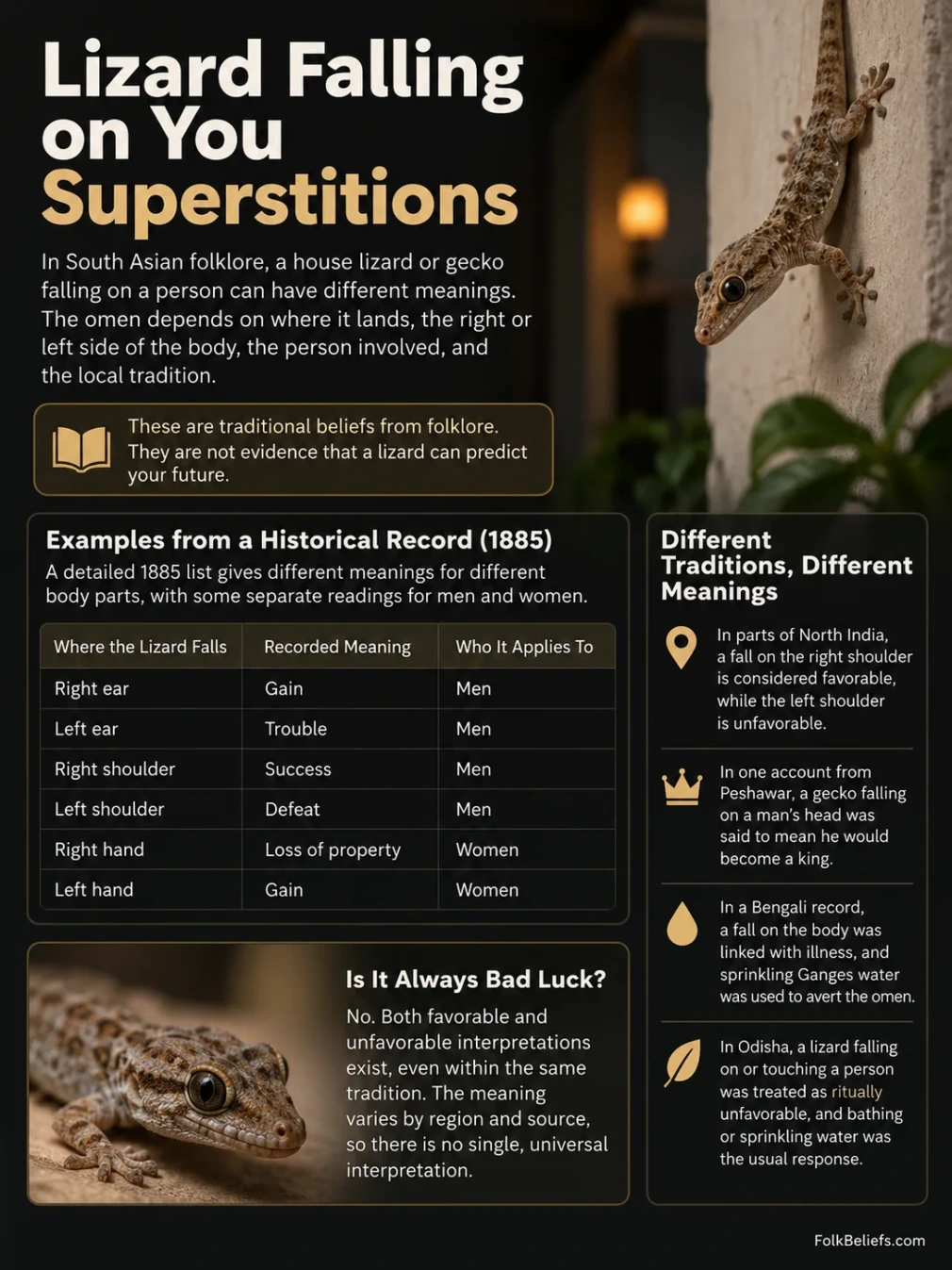
In documented South Asian folklore, a house lizard or gecko falling on a person does not have one fixed meaning. Historical and ethnographic records assign different omens according to where the animal lands, whether it touches the right or left side of the body, the person involved, and the local tradition. Some readings predict gain or success, while others warn of trouble or loss.[1][2]
The predictions belong to folklore. They are not evidence that a lizard can reveal future events, luck, illness, or personal fate.
Where the Lizard Lands Can Change the Omen
One unusually detailed record appeared in The Indian Antiquary in 1885. K. Raghunathji’s “Omens from the Falling of House Lizards” gives separate interpretations for many parts of the body and, in portions of the list, separate readings for men and women.
The contrast between the right and left sides is especially clear in several entries. These are selected examples from that particular 1885 record, rather than rules that can be applied to every Indian tradition.[1]
| Where the Lizard Falls | Recorded Meaning | Scope of the Entry |
|---|---|---|
| Right ear | Gain | Men in the 1885 list |
| Left ear | Trouble | Men in the 1885 list |
| Right shoulder | Success | Men in the 1885 list |
| Left shoulder | Defeat | Men in the 1885 list |
| Right hand | Loss of property | Women in the 1885 list |
| Left hand | Gain | Women in the 1885 list |
The full record goes far beyond these examples. It assigns meanings to the head, face, hands, feet, shoulders, clothing, circumstances of the fall, days, and even the direction in which the lizard moves afterward. This level of detail shows why a simple claim such as “a lizard falling on you means bad luck” does not accurately represent the historical material.
The Meaning Changes Between Local Traditions
Later ethnographic evidence does not produce a single shared interpretation either. Jürgen W. Frembgen’s 1996 study of gecko folklore drew largely on interviews conducted in Pakistan and North India in 1992 and 1993, together with earlier written records.
In Uttar Pradesh, Frembgen recorded a belief among both Muslim and Hindu informants that a gecko falling on the right shoulder was favorable, while a fall on the left shoulder was unfavorable. A woman interviewed in Peshawar gave another interpretation: a gecko falling on a man’s head meant that he would become a king. The paper also cites an older Bengali record in which a lizard falling on the body was connected with illness and sprinkling Ganges water was described as a way of averting the omen.[2]
These examples come from different places, sources, and informants. They should not be merged into a supposed belief held throughout India or throughout Hindu tradition.
A Different Response Recorded in Odisha
A 1997 monograph on the Aduria Dom community of Odisha records another form of the belief. In its discussion of luck and omens, the study says that a house lizard falling on or touching a person was treated as ritually unfavorable. Bathing or sprinkling water over the head was given as the customary response.[3]
This record concerns the community studied in that monograph. It does not establish a general practice for everyone in Odisha.
Is a Lizard Falling on You Always Bad Luck?
No. Even within a single historical list, favorable and unfavorable readings appear side by side. The 1885 record links the right ear with gain and the right shoulder with success, while assigning trouble or defeat to the corresponding left side. Other body locations receive entirely different interpretations.
The regional evidence also varies. A landing place regarded as favorable in one record may have no equivalent meaning in another. For that reason, the most accurate interpretation depends on which tradition is being discussed, rather than treating every lizard fall as the same omen.
Most of These Records Concern House Lizards and Geckos
“Lizard” can refer to many different reptiles, but the folklore documented here is narrower. Raghunathji’s 1885 article specifically concerns house lizards, while Frembgen’s study focuses on small common house geckos, particularly species of Hemidactylus. These geckos commonly occupy walls and ceilings, placing them in close contact with people inside houses.[1][2]
Applying these recorded meanings to every kind of lizard would therefore go beyond what the sources support.
Some Traditions Recorded a Ritual Response
Bathing was not the only response found in older records. Edgar Thurston’s 1912 Omens and Superstitions of Southern India describes the offering of a silver lizard at temples in some settings to counter an unlucky fall on a particular part of the body. Thurston also notes more generally that the interpretation could change according to the right or left side and whether the lizard landed on the hand, foot, head, or shoulders.[4]
Such practices are historical records of particular religious and folk settings. They are not a universal requirement after contact with a lizard.
Does a Falling Lizard Predict Illness or Death?
Some older sources do attach illness, death, or other alarming outcomes to particular forms of contact. Frembgen, for example, records and cites several beliefs connecting geckos with illness in parts of South and West Asia.[2]
Those statements describe folklore, not medical evidence. A lizard falling on someone does not provide a medical diagnosis or a reliable forecast of what will happen afterward. The surviving records are most useful for understanding how different communities interpreted an unexpected encounter with a familiar household animal.
Sources and Records
- ↑1a ↑1b ↑1c K. Raghunathji, “Omens from the Falling of House Lizards”,
- ↑2a ↑2b ↑2c ↑2d Jürgen W. Frembgen, “The Folklore of Geckos: Ethnographic Data from South and West Asia”,
- ↑3 A. K. Mohanty, A. K. Gomango, and K. K. Mohanti, The Aduria Dom of Orissa: A Monographic Study,
- ↑4 Edgar Thurston, Omens and Superstitions of Southern India,
Documented Locations
Countries: India, Nepal, Sri Lanka, Thailand
These labels identify where a version has been documented. They do not mean that everyone in the country, region, or community shares the belief.