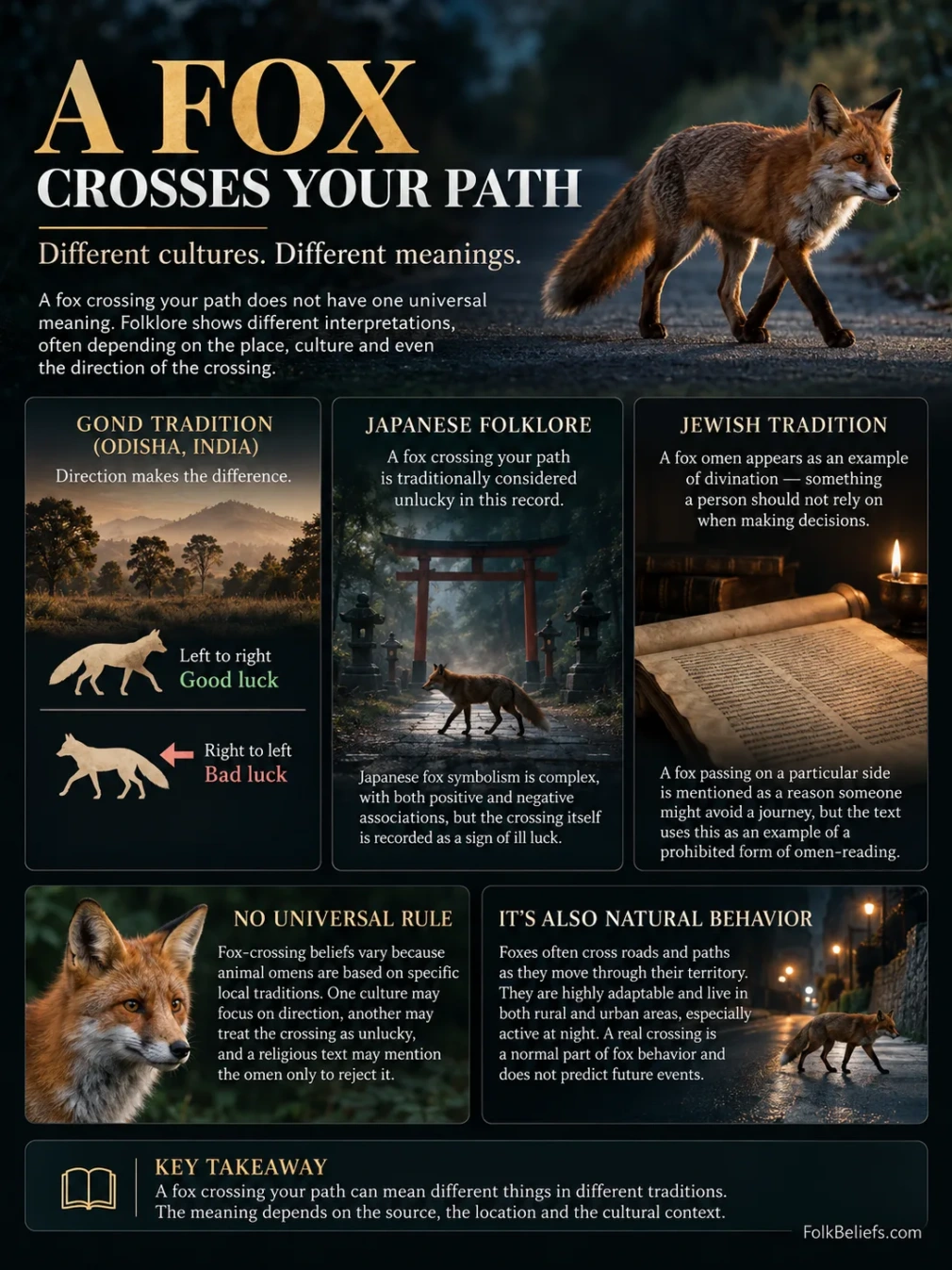
A fox crossing your path does not carry one fixed meaning in documented folklore. Some records treat the encounter as unlucky, while others make the result depend on the direction in which the fox moves. The safest reading is therefore local rather than universal: the place, community, and exact form of the recorded belief matter.
Is a Fox Crossing Your Path Good or Bad Luck?
Both interpretations appear in recorded belief. A 2024 monograph on Gond communities in Odisha, India, records a directional rule: a fox crossing the road from left to right is described as good luck, while a crossing in the opposite direction is treated as bad luck.[1]
A much different rule appears in a Japanese folklore study published in 1959. U. A. Casal recorded the belief that a fox crossing a person’s path could bring ill luck, noting that the superstition was associated with Japan and some Eastern Siberian areas.[2]
| Recorded Context | Fox-Crossing Meaning | Important Detail |
|---|---|---|
| Gond communities described in an Odisha monograph | Good or bad luck | Left to right is favorable; the reverse direction is unfavorable. |
| Japanese folklore recorded by Casal | Ill luck | The source describes a fox crossing the traveler’s path as unlucky. |
| Jewish legal discussion of omens | An example of prohibited divination | A fox passing on a particular side is used as an example of an omen on which a person should not base a decision. |
Direction Can Change the Meaning
The Odisha record is useful because it shows why broad statements such as “a fox crossing your path means good luck” can be misleading. In the belief recorded there, the crossing itself is not enough. Direction determines the reading.
The monograph, produced through the Scheduled Castes and Scheduled Tribes Research and Training Institute in Odisha and held by India’s Ministry of Tribal Affairs repository, places fox crossing among several omens connected with journeys and ordinary activities.[1] This should not be expanded into a rule for every Gond community or for India as a whole.
The Japanese Fox-Crossing Superstition
Casal’s study gives one of the clearest direct records of the fox-crossing belief. It states that a fox passing across one’s path was believed to bring ill luck. The same discussion also shows why fox symbolism in Japan cannot be reduced to “bad luck.” It distinguishes ordinary and supernatural foxes and records both favorable and unfavorable fox associations.[2]
That distinction matters. The familiar association of foxes with Japanese supernatural tradition does not mean that every fox sighting had the same meaning. A crossing omen is one specific belief within a much larger body of fox lore.
A Fox Omen Used as an Example of Divination
A different kind of evidence appears in Mishneh Torah. In its discussion of prohibited omen-reading, the text gives an example of someone refusing to go out because a fox has passed on the person’s right side and the person expects to encounter a deceiver.[3]
This record should not be presented as a religious endorsement of the superstition. The fox omen appears precisely as an example of a form of divination that the legal text prohibits. Its value for folklore study is that it preserves a recognizable pattern: an animal’s appearance, side, or movement being used to decide whether a journey or action should continue.
Why There Is No Universal Fox-Crossing Meaning
Fox-crossing beliefs vary because animal omens are often built from very specific local rules. One tradition may care about left and right. Another may treat the simple appearance of the animal as unfavorable. A religious text may preserve the same kind of omen only to reject acting upon it.
This also explains why modern interpretations such as “the fox means adaptability,” “the fox is warning you,” or “the fox predicts good fortune” should not automatically be described as old folklore. They may be personal or contemporary symbolic readings unless a historical or ethnographic source can tie them to a particular tradition.
What If the Fox Stops and Looks at You?
The sources above do not establish a general historical rule saying that eye contact, stopping, staring, or looking back changes the omen. Those details are common in newer symbolic interpretations, but they should not be added to older traditions without evidence.
If a fox simply crosses a road, footpath, garden, or trail, there is also an ordinary wildlife explanation. Red foxes are highly adaptable and live in both rural and urban environments. The Natural History Museum notes that urban foxes move through human landscapes while foraging, exploring territory, and using routes through gardens and built-up areas; they are especially active at night.[4] A real crossing therefore does not provide evidence that a later event will be lucky or unlucky.
Folklore note: A fox crossing your path can mean different things in different records. The Odisha Gond example makes direction decisive, the Japanese record treats the crossing as unlucky, and the Jewish legal example preserves a side-based omen while forbidding reliance on it. These are separate traditions, not parts of one worldwide rule.
Sources and Records
- ↑1a ↑1b Trilochan Sahoo and Badal Dhangadamajhi, GOND: An Agrarian Tribe of Odisha,
- ↑2a ↑2b U. A. Casal, “The Goblin Fox and Badger and Other Witch Animals of Japan”,
- ↑3 Maimonides, Mishneh Torah, Foreign Worship and Customs of the Nations 11:4,
- ↑4 Natural History Museum, “The Secret Life of Urban Foxes”,
Documented Locations
Countries: Eritrea, Ethiopia, Paraguay
These labels identify where a version has been documented. They do not mean that everyone in the country, region, or community shares the belief.