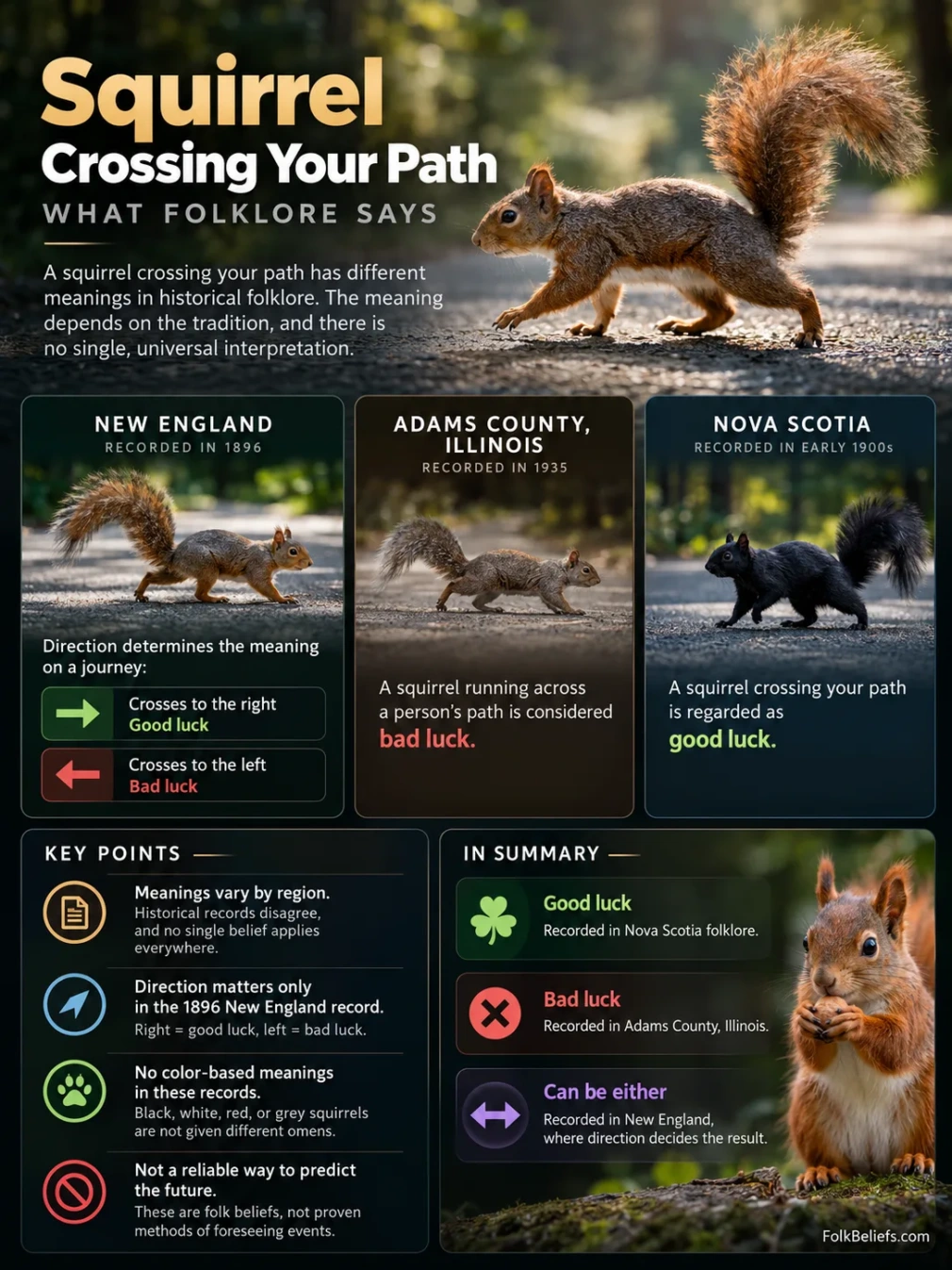
A squirrel crossing your path does not have one fixed meaning in recorded folklore. Historical North American collections preserve sharply different versions: one makes the direction of the crossing determine good or bad luck, another treats the crossing itself as unlucky, while a Nova Scotia collection records the squirrel as a good-luck encounter.
What Historical Folklore Records Say
| Recorded Setting | Meaning of the Crossing |
|---|---|
| New England, published 1896 | Clifton Johnson recorded a journey omen in which a squirrel crossing toward the traveler’s right meant good luck, while crossing toward the left meant bad luck.[1] |
| Adams County, Illinois, published 1935 | Harry Middleton Hyatt’s large local folklore collection includes a shorter rule: a squirrel running across a person’s path would cause bad luck. No directional condition accompanies that entry.[2] |
| Nova Scotia, collected by Mary L. Fraser | Fraser’s collection gives the opposite reading. In a passage about animal encounters, a black cat crossing the path was unlucky, a hare was considered worse, but a squirrel brought good luck.[3] |
These records document particular collected traditions. They do not show that everyone in New England, Illinois, Nova Scotia, or North America shared the same belief. The disagreement between them is part of the folklore rather than a problem that needs to be resolved.
Does the Direction of the Squirrel Matter?
Direction matters in the 1896 New England version. Johnson placed the belief specifically in the context of being on a journey: if a squirrel ran across the road and went toward the right, the traveler could expect good luck; if it went toward the left, the omen was bad.[1]
That directional rule should not be turned into a universal squirrel superstition. The Adams County record does not mention right or left at all, and the Nova Scotia version simply treats the squirrel as fortunate.
Right versus left is therefore a recorded variant, not a fixed rule. A claim that every left-to-right squirrel is lucky, or every right-to-left squirrel is unlucky, goes beyond what these collections support.
So Is a Squirrel Crossing Your Path Good Luck or Bad Luck?
Historically, it can be either. The answer depends on which recorded tradition is being discussed.
- Good luck: recorded in Fraser’s Nova Scotia material.
- Bad luck: recorded in Hyatt’s Adams County, Illinois collection.
- Either good or bad: recorded in Johnson’s New England collection, where direction decides the result.
This makes “a squirrel crossing your path always means good luck” and “a squirrel crossing your path always means bad luck” equally misleading as broad folklore claims.
Recorded Superstition and Modern Spiritual Meanings Are Not the Same Thing
Modern interpretations of squirrel encounters often use ideas such as preparation, saving, abundance, productivity, playfulness, or personal change. Those ideas may come from symbolic readings of squirrel behavior, but they are not what the historical crossing records above actually say.
The older records examined here are much simpler. They treat the event primarily as a luck omen connected with an unexpected animal crossing a traveler’s route. Assigning a personal message such as “prepare for an opportunity” or “financial abundance is coming” would require separate evidence for that particular tradition.
Do Black, White, Red, or Grey Squirrels Have Different Meanings?
The historical crossing records used here do not establish a color-based system for squirrels. Fraser’s account mentions a black cat as an unlucky path-crossing animal before contrasting it with the lucky squirrel, but it does not say that a black squirrel has a special meaning.[3]
Claims that a black squirrel predicts transformation, a white squirrel promises an exceptional blessing, or a red squirrel carries a different spiritual message should therefore not be presented as part of these documented crossing superstitions without another source that records such a belief.
Common Questions About the Squirrel Crossing Omen
What does it mean if a squirrel crosses toward your right?
In Johnson’s New England record, it means good luck for the journey. Other recorded versions do not use this directional rule.
What does it mean if the squirrel crosses toward your left?
The same New England record treats movement toward the left as bad luck. The Adams County version is already unfavorable regardless of direction, while Fraser’s Nova Scotia version is favorable without mentioning direction.
What if several squirrels cross your path?
The historical records discussed here do not assign a separate meaning to several squirrels crossing together. Giving the number of squirrels its own omen would add a rule that these sources do not provide.
Does a squirrel stopping or staring at you change the omen?
Not in these records. They concern the act of crossing the road or path. Special meanings attached to staring, approaching, pausing, or repeatedly appearing belong to other interpretations unless supported by a separate folklore record.
Does seeing a squirrel actually predict good or bad luck?
No. These are documented folk beliefs rather than reliable methods of predicting future events. A squirrel crossing a road or path is ordinary animal behavior; the fortunate or unfortunate meaning belongs to the tradition attached to the encounter.