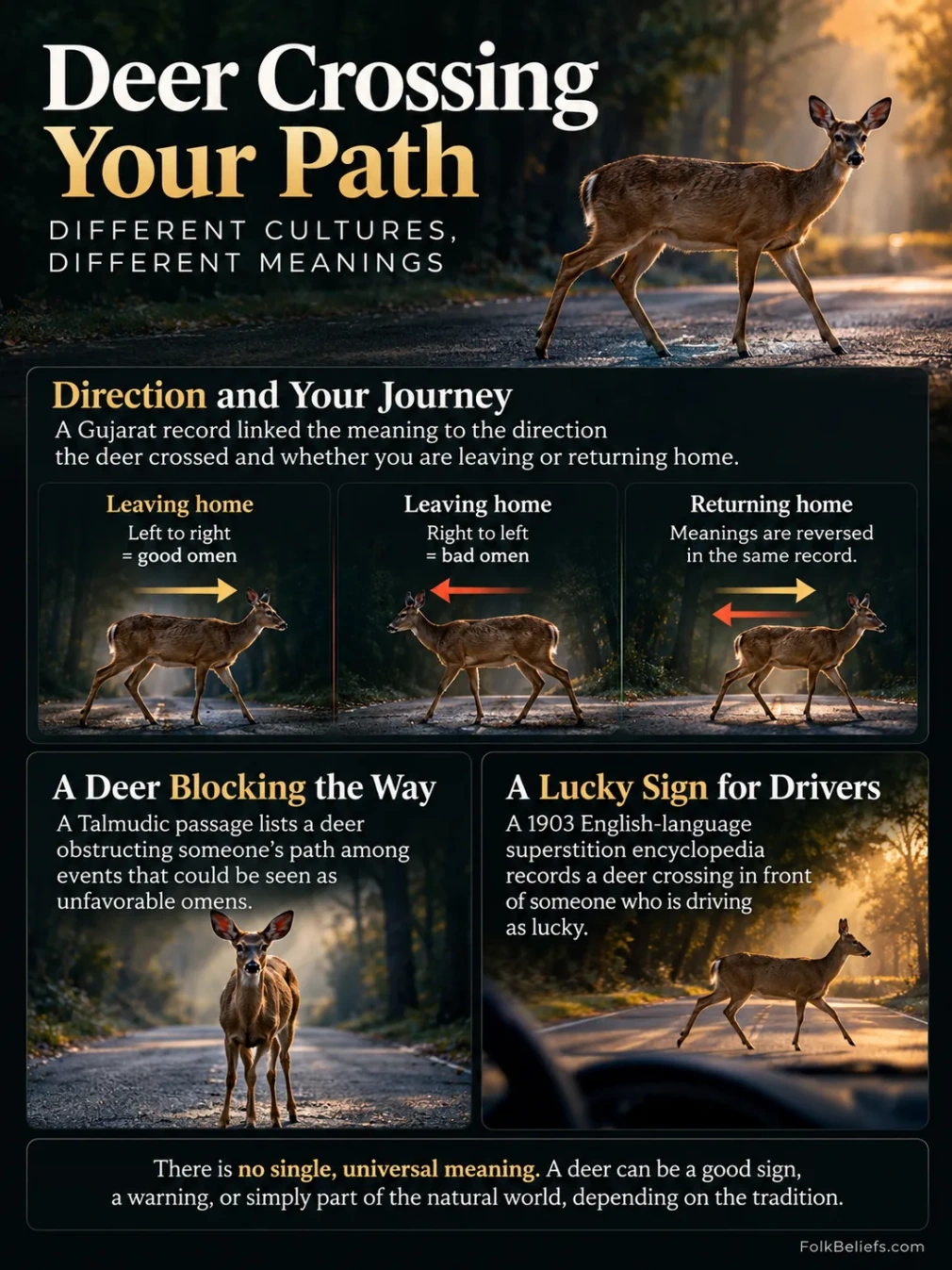
A deer crossing your path does not have one fixed meaning in recorded folklore. Historical sources preserve sharply different readings. A Gujarat collection published in 1914 made the omen depend on which direction the deer crossed and whether the traveler was leaving or returning. A Talmudic passage lists a deer blocking the road among signs that people might treat as unfavorable omens, while an English-language superstition encyclopedia published in 1903 records a deer crossing in front of someone who is driving as lucky.[1][2][3]
The safest historical reading, therefore, is not “a deer always means good luck” or “a deer always warns of trouble.” The meaning belongs to the particular tradition that recorded it.
Recorded Meanings of a Deer Crossing the Path
| Recorded Context | Folklore Meaning |
|---|---|
| Leaving home in one Gujarat record: deer crosses from left to right | Good omen.[1] |
| Leaving home: deer crosses from right to left | Bad omen in the same record.[1] |
| Returning home | The Gujarat source says the directional meanings are reversed.[1] |
| Deer blocking a person’s way in Sanhedrin 65b | Appears among examples of events interpreted as bad signs in a discussion of relying on omens.[2] |
| Deer crossing while someone is driving | A 1903 superstition encyclopedia records the event as lucky, without making that short entry a universal rule.[3] |
Why Left to Right and Right to Left Can Mean Different Things
The clearest directional version comes from Folk Lore Notes. Vol. I—Gujarat. When a person was leaving the house for a visit or another definite purpose, the recorded rule treated a deer moving from left to right as favorable and a deer moving from right to left as unfavorable. When the person was returning home, the interpretation switched.[1]
That reversal matters. It shows that the animal alone did not determine the omen. Direction, the traveler’s movement, and whether the journey was beginning or ending were all part of the recorded belief.
This should not be expanded into a rule for all Indian folklore. The volume was assembled from folklore questionnaires circulated through schoolmasters in parts of the former Bombay Presidency around the beginning of the twentieth century. Editor R. E. Enthoven also warned that the collected replies had not received full critical examination.[1]
A Deer Blocking the Way as an Omen
Another old record gives the encounter a very different setting. Sanhedrin 65b discusses the practice of treating ordinary incidents as supernatural signs. Among its examples is a deer obstructing or interrupting someone’s way, alongside such events as a raven calling or particular animals appearing on one side of the traveler.[2]
In that passage, the deer example is not offered as advice that travelers should obey. It appears in a religious discussion about omen-reading and divination. This makes it different from later lists that simply label an encounter lucky or unlucky.
It also shows why the familiar question “Is a deer crossing your path good luck?” cannot be answered from deer symbolism alone. One historical tradition could classify the interruption as ominous, while another could treat a crossing as favorable.
Why Some Older Sources Call It Lucky
Cora Linn Daniels and Charles McClellan Stevens’ 1903 Encyclopaedia of Superstitions, Folklore, and the Occult Sciences of the World includes a short entry stating that when a deer crosses someone’s path while driving, the event is considered lucky.[3]
The wording is useful because it proves that a favorable deer-crossing superstition was in print by the early twentieth century. The entry is much less useful for assigning the belief to an entire nation or ethnic tradition: the short statement does not provide enough local context to justify such a claim.
Good luck and bad luck versions both exist. A modern claim that every deer crossing carries one universal message smooths over the differences preserved in older records.
Does the Type of Deer Change the Superstition?
The documented crossing beliefs above do not establish a general system in which one deer means one thing, two deer another, or a buck, doe, and fawn each predict different future events. Their rules focus instead on the crossing itself, its direction, and the travel situation.
That distinction is useful when encountering elaborate modern lists assigning separate meanings to two, three, or four deer. Such interpretations may function as personal or contemporary symbolism, but they should not automatically be presented as inherited versions of the historical crossing beliefs recorded here.
Is a Deer Crossing Your Path a Good or Bad Omen?
Is seeing a deer cross your path good luck?
It can be in some recorded superstition. The 1903 encyclopedia describes a deer crossing while driving as lucky, and the Gujarat record gives a favorable interpretation when the animal crosses in the prescribed direction. Other records give an unfavorable reading, so good luck is not universal.
What does a deer crossing from left to right mean?
In the 1914 Gujarat collection, left-to-right movement was favorable when a person was leaving home on a visit or definite errand. The rule changed when returning home. That meaning should remain attached to this particular recorded context rather than being presented as a worldwide rule.
What does a deer crossing from right to left mean?
The same Gujarat record classified right-to-left movement as unfavorable when setting out. Again, the returning traveler received the reverse interpretation.
Does a deer standing in the road have a different meaning?
One old textual parallel is the deer that blocks a person’s way in Sanhedrin 65b. There it appears among incidents that could be treated as bad omens by someone relying on signs. The passage addresses omen-reading rather than claiming that deer actually predict future events.
Does seeing several deer make the omen stronger?
The historical crossing records cited here do not supply a counting rule. They do not say that two, three, or four deer produce progressively different predictions.
When a Deer Crosses in Front of a Car
Folklore may call the encounter lucky or unlucky, but an actual deer on a road is first a wildlife and traffic situation. Georgia’s Department of Natural Resources notes that deer are commonly active around dawn and dusk and that movement rises during the fall breeding season. It also warns drivers that deer often travel in groups, so another animal may follow one that has already crossed.[4]
A real roadside encounter therefore does not need an omen-based response. Staying attentive to the road and to additional animals nearby is separate from whatever traditional meaning a person associates with the sighting.
Deer-crossing superstitions are records of folk belief, not evidence that deer can predict luck, danger, relationships, or future events. Their value lies in showing how different communities and texts interpreted an unexpected animal encounter.
Sources and Records
- ↑1a ↑1b ↑1c ↑1d ↑1e ↑1f A. M. T. Jackson and R. E. Enthoven, Folk Lore Notes. Vol. I—Gujarat,
- ↑2a ↑2b ↑2c Sanhedrin 65b:20, Sefaria Library,
- ↑3a ↑3b ↑3c Cora Linn Daniels and Charles McClellan Stevens, Encyclopaedia of Superstitions, Folklore, and the Occult Sciences of the World,
- ↑4 Georgia Department of Natural Resources, “Knowing Why to Be Watchful Helps Prevent Deer-Car Collisions”,