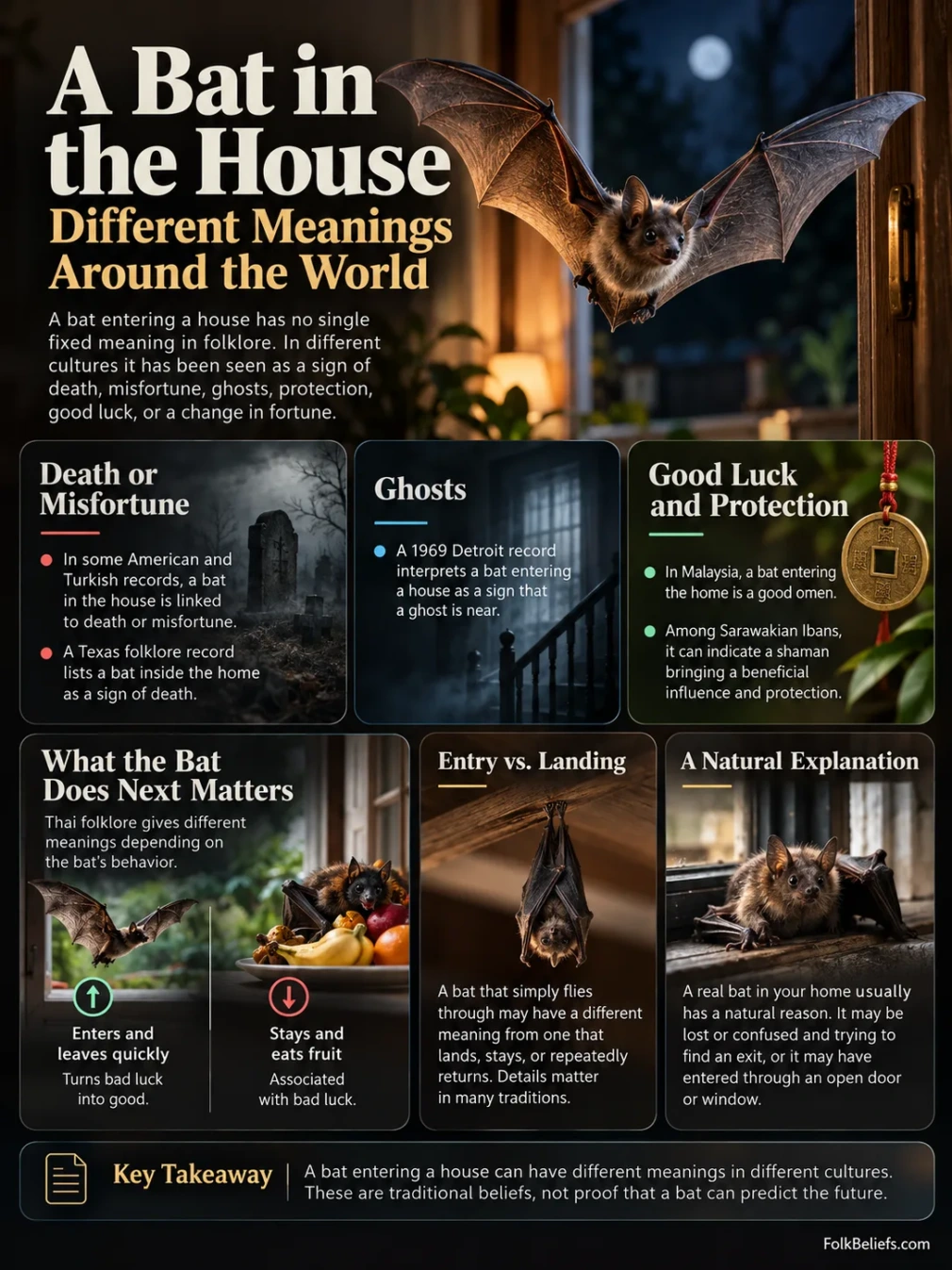
A bat entering a house has no single fixed meaning in documented folklore. Some records treat the event as an omen of death or misfortune, while others connect it with ghosts, protection, good luck, or a change in fortune. In several traditions, what the bat does after entering matters as much as the entry itself.
These meanings belong to recorded folk belief. They are not evidence that a bat can predict death, illness, luck, or another future event.
What Does a Bat Entering the House Mean in Superstition?
The death-omen interpretation appears in several North American and Turkish records, but it is not universal. Other documented traditions give the same event a positive or neutral meaning.
| Recorded Setting | Bat Event | Folklore Meaning |
|---|---|---|
| Texas folklore, United States | An owl or bat is inside the house | The animal was said to foretell death.[1] |
| Detroit, Michigan, archive record dated 1969 | A bat flies into a house | The entry was interpreted as a sign that a ghost was near.[2] |
| Koz village, Güce, Giresun, Türkiye | A bat enters a house | The entry was associated with misfortune.[3] |
| Ethnic Han Chinese in Malaysia | A bat enters the house | The event was recorded as a good omen.[4] |
| Thailand | A bat enters and immediately leaves, or stays and eats fruit | Immediate departure was said to change bad luck to good; staying and eating fruit was associated with bad luck.[4] |
Why Death Appears in Some House-Entry Beliefs
Death is one recurring interpretation in collected American folklore. A Texas Folklore Society compilation places the bat-in-the-house belief among a series of death omens and states that an owl or bat inside the home foretells death. The record documents a folklore association; it does not establish that everyone in Texas held the belief.[1]
Regional material collected in Türkiye also preserves ominous readings. A 2025 study records the belief in Şenyayla village in Zara, Sivas, that a funeral would come from a house entered by a bat. In Koz village in Giresun, the entry was associated with misfortune. A Midyat record concerns a bat alighting on a house and the belief that something would happen to someone living there. The examples are tied to particular places and informants rather than presented as one rule shared throughout Türkiye.[3]
Good Luck and Protective Meanings Also Exist
A 2021 review of bat beliefs across the Asia-Pacific region records several house-entry traditions that differ sharply from the death-omen interpretation. Among ethnic Han Chinese in Malaysia, a bat entering the home was reported as a good omen. Among Sarawakian Ibans of Malaysian Borneo, a bat flying inside could indicate a manang, or shaman, bringing chelap, described in the study as a beneficial influence that protects against harm.
The same review records a Thai belief in which the bat’s next action changes the meaning. Entering and quickly leaving turns bad luck into good, while remaining inside and eating fruit is unfavorable. Among the Nage of Flores, Indonesia, simple entry without landing was described as harmless, whereas entering and alighting carried a much more serious taboo meaning.[4]
Entry, Landing, and Staying Are Different Folklore Motifs
Bat superstitions often depend on small details. A bat that merely crosses the room may receive a different interpretation from one that lands, remains indoors, circles a room, or repeatedly returns. This is why a broad claim such as “a bat in the house always means death” does not match the surviving records.
The location also matters. A belief documented in one village, family, or community should not automatically be expanded into a national tradition. The contrasting records from Texas, Detroit, Türkiye, Malaysia, Thailand, Sarawak, and Flores show how the same basic event can acquire unrelated meanings.
Folklore Meaning and an Actual Bat Indoors
A real bat entering a home does not require a supernatural explanation. Bat Conservation International notes that a single bat found inside a house is usually lost or confused and will often try to locate an exit. Bats may also use buildings for shelter, while individual animals can accidentally enter living spaces through an open door, window, or other opening.[5]
Sources and Records
- ↑1a ↑1b Texas Folklore Society, The Best of Texas Folk and Folklore: 1916–1954, p. 240,
- ↑2 University of Detroit Mercy Libraries, James T. Callow Computerized Folklore Archive, “Signs of Ghosts”,
- ↑3a ↑3b Yasemin Domaç Yaşar, “Türkiye’de Yarasalarla İlgili Halk İnanışları ve Uygulamaları”,
- ↑4a ↑4b ↑4c Mary-Ruth Low et al., “Bane or Blessing? Reviewing Cultural Values of Bats across the Asia-Pacific Region”,
- ↑5 Bat Conservation International, “Bats in Homes & Buildings”,
Documented Locations
Countries: France, Jamaica, Sri Lanka
These labels identify where a version has been documented. They do not mean that everyone in the country, region, or community shares the belief.