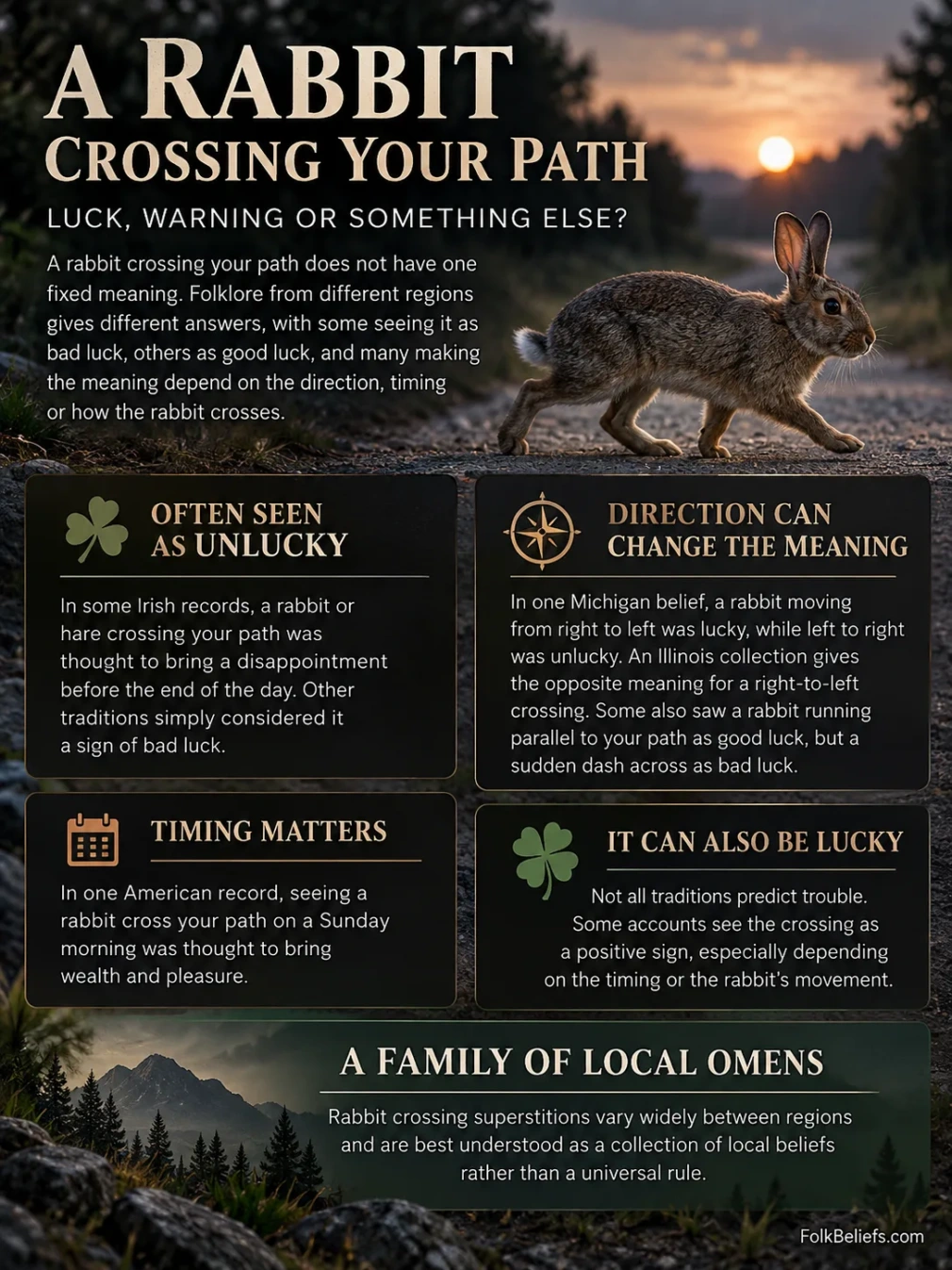
A rabbit crossing your path does not have one fixed meaning in recorded folklore. Some traditions treated the encounter as bad luck or a warning of disappointment, while others made the result depend on which direction the rabbit ran, when the crossing happened, or how it crossed the road. An Irish record from County Cork, for example, says that a rabbit or hare crossing a person’s path meant a disappointment before the end of the day.[1]
American records are less uniform. A Michigan belief made one direction lucky and the opposite direction unlucky, while an Illinois collection preserved several versions that disagree even with one another.[2][3] The encounter is therefore better understood as a family of local omens rather than a universal rule about rabbits.
When a Rabbit Crossing the Path Was Unlucky
Several surviving records associate the crossing with misfortune. In the Schools’ Collection of the National Folklore Collection of Ireland, material collected in the Cobh area of County Cork states that a person who saw a rabbit or hare cross the path expected a disappointment that same day.[1]
A separate record from County Kerry gives a simpler form of the belief: a hare crossing the path was considered bad luck.[4] These are individual collected traditions, not evidence that everyone in Ireland shared the belief.
The same general idea appears in Folk-Lore from Adams County, Illinois, published by Harry Middleton Hyatt in 1935. One entry calls a rabbit running across the path an unlucky omen. Another says that after such a crossing, the traveler should go home and begin the journey again. A related entry records spitting as a way of avoiding the expected bad luck.[3]
Direction Could Change the Meaning
The direction of the rabbit sometimes mattered more than the animal itself, but there was no stable rule.
| Recorded Setting | Crossing | Recorded Meaning |
|---|---|---|
| Warren, Michigan | Right to left | Lucky |
| Warren, Michigan | Left to right | Unlucky |
| Adams County, Illinois | Right to left | Bad luck |
| Adams County, Illinois | Rabbit runs parallel to the traveler | Good luck |
| Adams County, Illinois | Rabbit suddenly darts in front | Bad luck |
The Michigan example comes from the James T. Callow Computerized Folklore Archive at the University of Detroit Mercy. Its record says that a rabbit moving from right to left was lucky, while movement from left to right was unlucky.[2]
Hyatt’s Illinois collection preserves the opposite judgment for a right-to-left crossing. It also records a distinction between a rabbit moving alongside someone’s route and one suddenly cutting across it.[3]
Direction does not provide a universal interpretation. Two American collections can assign different meanings to the same movement. Treating “right to left” or “left to right” as having one fixed spiritual meaning would erase the local variation preserved in the records.
A Crossing Could Also Be Lucky
Not every recorded rabbit crossing predicted trouble. The Adams County collection includes a belief that seeing a rabbit cross the path on a Sunday morning brought wealth and pleasure. The same group of entries describes a rabbit running parallel to the traveler’s path as favorable.[3]
This helps explain why modern claims that a crossing is simply “good luck” or simply “bad luck” are too broad. Even within one regional collection, timing and movement could reverse the omen.
Why Older Sources Often Say “Hare” Instead of “Rabbit”
People searching for a rabbit-crossing superstition will encounter many older sources that speak specifically about hares. The terms should not automatically be treated as identical, since rabbits and hares are different animals. Folklore records, however, sometimes place them within the same group of beliefs. The County Cork record explicitly says “rabbit or hare,” while American archive records may classify material under both rabbit and hare keywords.[1][2]
The hare has a particularly long record of ominous associations in British folklore. William George Black’s 1883 article “The Hare in Folk-Lore” gathered earlier reports of people becoming uneasy when a hare crossed their path and described beliefs connecting hares with witchcraft and transformation.[5]
That material offers historical context for the animal’s uneasy reputation, but it does not establish one origin for every rabbit-crossing superstition. Black was comparing several traditions from different places and periods, and the later Irish and American records show that the belief continued to develop in different forms.
Was the Crossing Considered a Warning About the Journey?
In several versions, the omen was tied directly to travel. The rabbit or hare did not merely appear; it interrupted the route. Some people reportedly responded by postponing or restarting what they were doing.
Black’s nineteenth-century survey mentions a tradition in which someone meeting a hare while going to work might return home and wait before venturing out again.[5] Hyatt’s Illinois material similarly records returning home and beginning the journey again after a rabbit crossed the road.[3]
This travel setting is one of the more consistent features in the older material. The omen concerned a creature suddenly cutting across a person’s intended course, and the response was sometimes to alter that course. It remains a recorded folk practice, not evidence that an animal encounter can predict what will happen next.
Does the Rabbit’s Color Have a Fixed Meaning?
The path-crossing records do not support a single dependable system in which white, black, brown, or gray rabbits each carry a standard message. The better-documented examples above focus mainly on the act of crossing, direction, timing, and the traveler’s response.
Color may matter in particular stories or local traditions, but assigning a universal meaning such as “white means prosperity” or “gray means change” goes beyond what these records establish. A color interpretation is best treated as a separate belief unless a specific folklore source documents it.
What the Superstition Means Today
If a rabbit crosses the road or path in front of someone today, the event has no established predictive meaning. In folklore, however, the encounter has been interpreted in several ways: as bad luck, as a warning of disappointment, as good fortune under particular circumstances, or as an omen whose meaning changed with direction.
The variations are part of the history of the belief. A County Cork informant, a Michigan informant, and people represented in the Adams County collection did not preserve exactly the same rule. Their differences are more informative than forcing the records into a single modern interpretation.
Sources and Records
- ↑1a ↑1b ↑1c National Folklore Collection, UCD, “Superstitions,” Convent of Mercy, Rinn an Chabhlaigh, Cobh,
- ↑2a ↑2b ↑2c University of Detroit Mercy Libraries, James T. Callow Computerized Folklore Archive, “Belief/Luck”,
- ↑3a ↑3b ↑3c ↑3d ↑3e Harry Middleton Hyatt, Folk-Lore from Adams County, Illinois,
- ↑4 National Folklore Collection, UCD, “Signs and Omens,” An Drom Clochach,
- ↑5a ↑5b William George Black, “The Hare in Folk-Lore”,
Documented Locations
Countries: United States
These labels identify where a version has been documented. They do not mean that everyone in the country, region, or community shares the belief.