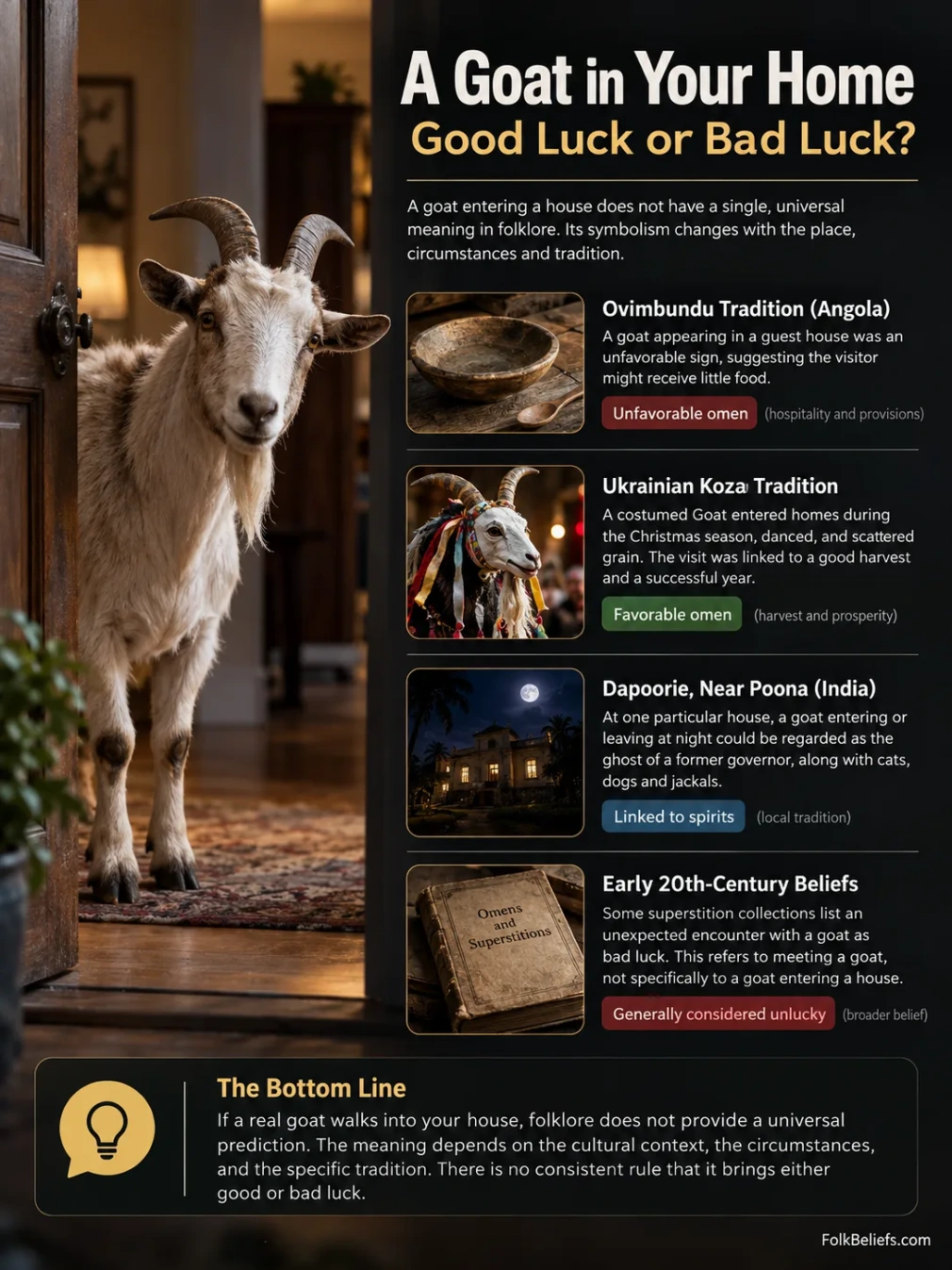
A goat entering a house does not have one fixed meaning in documented folklore. Some records treat the animal’s arrival as an unfavorable omen, while others deliberately bring a goat figure into the home as part of a ritual connected with harvest and household well-being. The meaning changes with the place, the type of entry, and the tradition in which the event occurs.
Is a Goat Entering the House Good Luck or Bad Luck?
Both interpretations occur, but they come from very different settings. There is no well-supported rule that an ordinary goat walking through a doorway always predicts either good or bad fortune.
| Recorded Setting | Meaning of the Goat’s Arrival | Important Context |
|---|---|---|
| Ovimbundu guest-house omen, Angola | Unfavorable sign concerning the food awaiting a visitor [1] | A local hospitality omen, not a general rule for every household |
| Ukrainian Koza tradition | A Goat figure entering the home was associated with harvest and a successful year [2][3] | A planned Christmas-cycle performance involving a person dressed as a goat |
| Government House at Dapoorie, near Poona | A goat entering or leaving at night could be treated as the ghost of a former governor [4] | The same belief included cats, dogs, and jackals and belonged to one highly specific local tradition |
| Early 20th-century superstition collection | An unexpected encounter with a goat was listed as bad luck [5] | The entry concerns meeting a goat, not specifically a goat entering a house |
The Ovimbundu Guest-House Omen
One of the closest documented matches to a goat unexpectedly appearing inside a building comes from an Ovimbundu setting in Angola. The omen concerned a stranger staying in a village guest house and the first animal that appeared there.
A dog was favorable because dogs were fed by people. Its arrival suggested that the visitor could expect food. A goat carried the opposite association: goats were understood in this account as finding a sparse living for themselves, so the animal’s appearance suggested that the traveller might receive little to eat.
This is therefore better understood as an omen about hospitality and provisions than as a broad warning that a goat inside any home brings misfortune. Extending it to every Angolan household, or to goat folklore in general, would go beyond the recorded context.
When the Goat Is Welcomed Into the Home
Ukrainian Koza traditions provide almost the reverse image. During the Christmas cycle, groups of young men visited village homes with a performer representing the Goat. The disguised Goat entered the house, bowed to the head of the household, and danced. The performance was connected with hopes for an abundant harvest and a successful year.
In some Hutsul forms of the custom, children led the Goat while scattering grain inside the house. The connection between the Goat, grain, and agricultural plenty makes the household entry deliberately favorable.
The distinction matters: this does not establish a Ukrainian superstition that a real stray goat unexpectedly walking indoors predicts good luck. Koza is a ceremonial character whose entrance belongs to a structured seasonal performance.
A Goat Entering at Night Could Have a Different Meaning
Mary Frere recorded an unusual tradition at Government House, Dapoorie, near Poona, in the nineteenth century. During certain night hours, a sentry was reportedly expected to present arms if a cat, dog, jackal, or goat entered or left the house, or crossed nearby. The animal could be regarded as the ghost of a former governor.
The account is unusually narrow. It does not describe goats generally as spirits, nor does it establish a household rule for India as a whole. The goat was only one of several animals included in a tradition attached to a particular building and its remembered former occupant.
Why Goats Are Sometimes Called a Bad Omen
Some later superstition collections detach goat omens from a particular household. Astra Cielo’s 1918 collection, for example, lists an unexpected meeting with a goat as unlucky while contrasting it with meeting a sheep.
That record may help explain why modern retellings sometimes reduce goat encounters to a simple “bad luck” formula. It does not, however, say that a goat entering the home has the same meaning. The difference between meeting an animal unexpectedly and an animal crossing a household threshold should not be erased.
What Does It Mean If a Real Goat Walks Into Your House?
From a folklore perspective, the location and circumstances are needed before assigning a traditional meaning. The surviving examples do not support a universal prediction.
- An unexpected goat at an Ovimbundu guest house could carry an unfavorable message about the visitor’s expected provisions.
- The Ukrainian Koza entering a home belonged to a favorable harvest ritual.
- A goat entering or leaving one particular house near Poona at night could be interpreted within a local ghost tradition that also involved several other animals.
- An unexpected goat encounter appears as bad luck in at least one older superstition compilation, but that is not specifically a doorway belief.
If a goat simply wanders into a modern home, these records do not provide a sound basis for predicting money, illness, death, pregnancy, visitors, or another future event. Such meanings would need their own documented local traditions rather than being inferred from the animal alone.
Folklore records what particular people have believed or practiced in particular settings. An omen tradition is not evidence that the event it predicts will actually occur.
Sources and Records
Documented Locations
Countries: Angola
These labels identify where a version has been documented. They do not mean that everyone in the country, region, or community shares the belief.